Choosing the right payment processing providers is an important decision for businesses that accept electronic payments. With different pricing models, features, security tools, and integrations options available, comparing providers requires more than looking at a single transaction rate.
Businesses should understand how payment processing services work and evaluate factors like processing fees, payment methods, transaction volume, POS integration, and online payments.
The comparison should also consider payment security, fraud prevention, recurring billing, international payments, payment gateways, API integrations, customer support, and contract terms.
Such factors can affect both the overall expenses and the day-to-day payment experience. Businesses should also examine how well a provider connects with their existing ecommerce, accounting, invoicing, or POS systems.
Providers like AcePay offer payment solutions designed for different business payment requirements, including online and in-person transactions.
While evaluating AcePay or other providers, businesses should review current pricing, supported payment methods, security features, integrations, hardware options, and service terms.
By comparing these aspects systematically, business owners can better understand the differences between providers and identify a payment solution that matches with their transaction patterns, operational needs, customer preferences, and future growth plans.
Also Read: Payment Processing Services Explained for Business Owners
How Businesses Can Compare Payment Processing Services
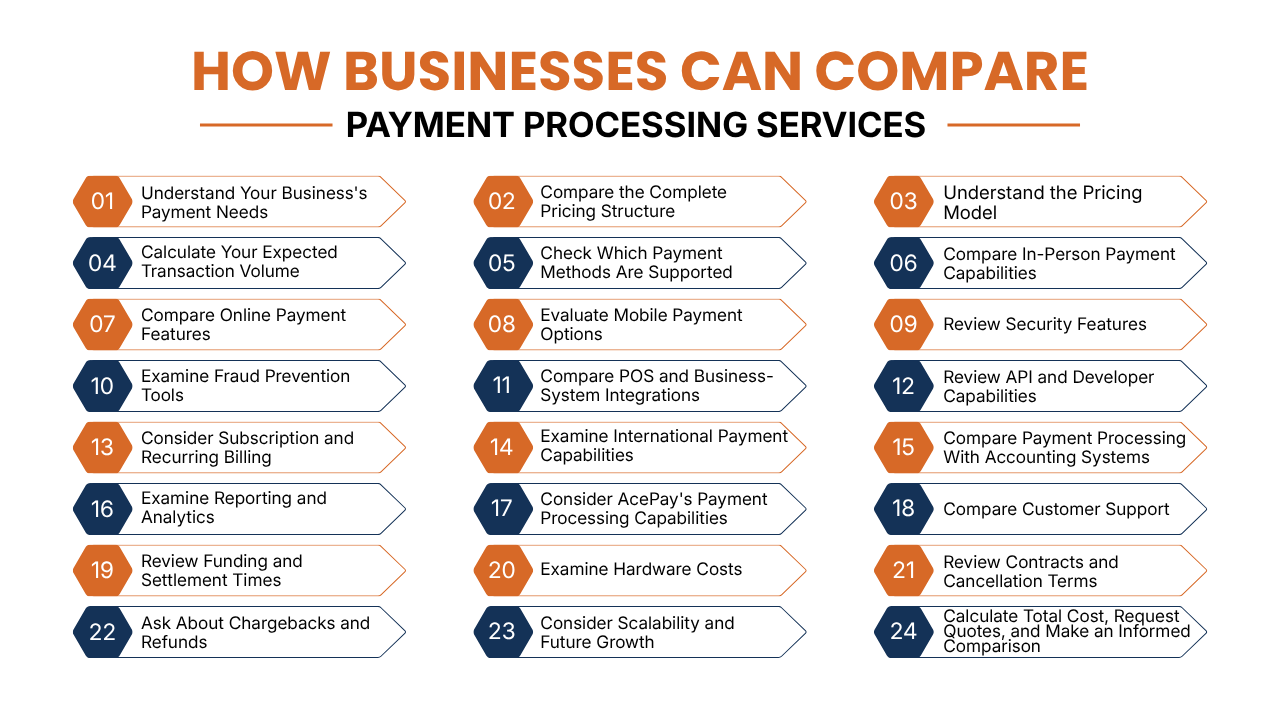
Choosing a payment processing provider is an essential decision for businesses that accept electronic payments. The provider affects how customers pay, how transactions are processed, how funds are settled, and how payment information connects with other business systems. For this reason, businesses should look beyond a single advertised processing rate.
Different businesses have different requirements. A small retail store may need a simple POS terminal, while an ecommerce company may require an online gateway, APIs, fraud controls, recurring billing, and multiple payment methods.
A subscription company may prioritize automated recurring payments, while a professional service business may need invoices, payment links, and virtual terminals.
Businesses should therefore compare providers based on their actual transaction patterns, payment channels, security requirements, integrations, support needs, and expected growth.
Providers like AcePay can also be included in the comparison when businesses are evaluating online, mobile, in-person, and integrated payment solutions.
Below are the points that explain the major factors businesses should consider while comparing payment processing services.
1. Understand Your Business’s Payment Needs
The initial step is to understand how your business currently accepts payments and how you expect payment activity to change in the future. A provider that works for a small retail business may have different capabilities from one needed by an ecommerce company, restaurant, subscription business, professional service provider, or multi-location organization.
Begin by identifying where customers make purchases and which payment methods they use. Consider whether transactions happen at a physical checkout, through a website, inside a mobile application, through invoices, or through recurring billing.
Important questions include:
- Do customers primarily pay in person or online?
- Do you need mobile payment acceptance?
- Do you sell through multiple channels?
- Do you accept recurring payments?
- Do you need payment links?
- Do you need a virtual terminal?
- Do you sell internationally?
- Which payment methods do customers prefer?
- Which POS or ecommerce platform do you use?
- Which accounting system do you use?
- How many transactions do you process each month?
- What is your average transaction value?
Creating such a profile before contacting providers makes comparisons more impactful. It can also help to prevent businesses from paying for features that they do not require.
2. Compare the Complete Pricing Structure
Pricing is one of the most important aspects while comparing payment processors, but businesses should avoid focusing only on the advertised transaction rate.
The total cost of payment processing can include several different charges, based on the provider and agreement.
Potential costs include:
- Percentage-based transaction fees
- Per-transaction charges
- Processor markups
- Interchange-related costs
- Network assessment fees
- Monthly account fees
- Payment gateway fees
- POS software charges
- Hardware costs
- Chargeback fees
- Refund-related charges
- International transaction fees
- Currency conversion costs
- Contract or cancellation charges
A provider with a low advertised rate may have other charges that affect the overall expenses. Another provider may have a different pricing structure that includes additional services.
Businesses should request a detailed pricing proposal based on their actual transaction volume, average ticket size, payment methods, and sales channels.
Also Read: Credit Card Processing for Small Business: Complete Beginner’s Guide
3. Understand the Pricing Model
Payment processors can use different pricing structures. Understanding how each model works makes it easier to compare pricing.
Flat-Rate Pricing
Flat-rate pricing generally applies a predetermined percentage and or fixed fee to transactions. This approach can make costs easier to understand because businesses may have a simpler calculation for each payment.
Interchange-Plus Pricing
Interchange-plus pricing separates underlying interchange costs from the processor’s markup. This can provide more visibility into different components of payment processing expenses.
Tiered Pricing
Tiered pricing places transactions into different categories. The applicable rate may be based on transaction characteristics, card type, or other criteria.
Membership or Subscription Pricing
Some providers combine recurring membership or account fees with transaction-related charges.
Businesses should compare these pricing models using their own transaction data. A pricing model should be evaluated based on the complete expected cost instead of a single percentage.
4. Calculate Your Expected Transaction Volume
Transaction volume can highly affect payment-processing expenses.
Consider two businesses. One business might process 10,000 transactions each month with a low average transaction value. Another business might process only 1,000 transactions but handle substantially larger purchases.
The same pricing structure can affect these businesses differently because their transaction counts and average ticket sizes are different.
Businesses should estimate:
- Monthly transaction count
- Average transaction value
- Total monthly processing volume
- Card-present transactions
- Card-not-present transactions
- Online transactions
- International transactions
- Recurring transactions
These figures can be used when requesting provider quotes. A personalized estimate is generally more useful than depending on generic examples because actual payment activity determines how different fee structures affect the business.
5. Check Which Payment Methods Are Supported
Customers highly expect businesses to offer convenient payment options. A payment processor should support the methods that are relevant to the business’s customers and sales channels.
Based on the business, these may include:
- Credit cards
- Debit cards
- Contactless cards
- EMV cards
- Digital wallets
- ACH payments
- Bank transfers
- Payment links
- Recurring payments
- Regional payment methods
Businesses should also determine whether specific payment methods involve separate charges or technical requirements. For ecommerce businesses, payment-method availability can affect checkout convenience. For physical businesses, contactless cards, and digital wallets may be particularly relevant.
The important question is not simply how many payment methods a provider supports, but whether it supports the methods your customers actually use.
Also Read: Top Payment Processing Companies in the USA
6. Compare In-Person Payment Capabilities
Businesses operating physical locations should evaluate the provider’s in-person payment capabilities carefully.
Important considerations include:
- EMV terminal support
- Contactless payments
- Mobile wallets
- Chip-card acceptance
- POS integration
- Digital receipts
- Printed receipts
- Employee permissions
- Refund functionality
- Transaction reporting
- Multi-location support
A payment terminal is only one part of the overall payment environment. Businesses should also consider how transaction data moves into inventory, sales reporting, customer records, and accounting systems.
For instance, a restaurant may need payment processing to work closely with its POS systems and ordering system. A retail store may require payment data to connect with inventory and sales reporting. The provider should therefore fit the business’s existing technology environment or provide a suitable alternative.
7. Compare Online Payment Features
Ecommerce businesses have different requirements from businesses that only accept payments at physical locations.
Important online payment features can include:
- Hosted checkout
- Payment pages
- Payment links
- Virtual terminals
- Payment APIs
- Digital wallets
- ACH acceptance
- Recurring billing
- Refund management
- Fraud controls
- Reporting
- Ecommerce integrations
The checkout process should be easy to use on desktop computers and mobile devices.
Businesses should also confirm whether the provider integrates with their current ecommerce platform. An integration can reduce development work and make it easier to connect payment transactions with orders and customer information.
When comparing online payment providers, businesses should consider both the technical functionality and the customer checkout experience.
8. Evaluate Mobile Payment Options
Some businesses need to accept payments away from a traditional checkout counter. This can include contractors, delivery companies, event vendors, field-service businesses, food vendors, pop-up stores, and independent professionals.
Mobile payment solutions may support:
- Tap payments
- Chip cards
- Mobile wallets
- Mobile card readers
- Payment links
- Digital invoices
- Smartphone payments
- Tablet payments
A mobile solution should also provide transaction records and reporting.
For instance, a service technician may collect payment at a customer’s location. A business operating at any event may need to accept payments without a traditional POS setup.
When comparing providers, determine whether mobile payments require additional hardware, software subscriptions, or separate transaction fees.
Also Read: How to Choose the Right Credit Card Processing Company for Your Business
9. Review Security Features
Payment security should be a major part of the provider comparison. Payment systems can handle sensitive account information, so businesses should understand how payment information is protected and which security responsibilities remain with the merchant.
Common security technologies and practices include:
- Encryption
- Tokenization
- Authentication
- Fraud monitoring
- Access controls
- Secure payment pages
- Network security
- Security assessments
- PCI DSS-related controls
Businesses should ask how payment information is transmitted, stored, and protected.
They should also understand the division of responsibilities between the business and the payment provider. Using a third-party processor does not automatically remove every security or compliance responsibility for the merchant.
10. Examine Fraud Prevention Tools
Fraud prevention is an important part of choosing a payment processor because fraudulent transactions can cause financial losses, chargebacks, admin work, and customer-service issues.
Businesses should compare the fraud controls included with each payment processing service.
Common tools may include:
- Address verification and card security checks
- Risk scoring and transaction monitoring
- Velocity controls and rules-based screening
- Device analysis and 3-D Secure authentication
The right combination depends on the business’s transaction profile and sales channels.
Businesses should consider:
- Average transaction value
- Customer locations and sales channels
- Industry and historical fraud patterns
- Card-present versus card-not-present transactions
No single tool can remove payment fraud. Businesses should choose a provider that offers flexible controls and monitoring features that align their specific risks and operational needs.
11. Compare POS and Business-System Integrations
Payment processing can become more useful when it connects with other business systems.
Based on the business, integrations may include:
- POS software
- Ecommerce platforms
- Accounting systems
- Inventory software
- CRM platforms
- ERP systems
- Subscription platforms
- Invoicing tools
- Customer loyalty systems
Integrating payment processing systems to existing POS systems and business systems helps synchronize payment information with sales, inventory, customer, and financial records.
Before signing an agreement, ask whether the provider offers direct integrations, supported connections, APIs, or other integration options.
Businesses should also determine whether integration features are included in the standard service or require additional charges.
Also Read: Small Business Credit Card Processing: Everything Business Owners Need to Know
12. Review API and Developer Capabilities
Businesses with customized websites, mobile applications, or specialized payment workflows may need APIs.
Developers should review:
- API documentation
- SDK availability
- Programming-language support
- Webhooks
- Sandbox environments
- Testing tools
- Authentication
- Error handling
- Reporting APIs
- Technical support
Good documentation can make implementation easier. Sandbox environments allow development teams to test payment workflows before going live.
Webhooks can also help applications respond to payment events such as successful transactions, failed payments, refunds, and other status changes. Businesses should ask whether the provider’s API supports the specific workflows required by their development team.
13. Consider Subscription and Recurring Billing
Subscription businesses have payment requirements that are different from businesses selling one-time products.
Important capabilities may include:
- Recurring billing
- Automated payment retries
- Card updates
- Subscription management
- Customer notifications
- Refund handling
- Billing reports
Failed recurring transactions can interrupt subscription revenue. Businesses should therefore understand how the processor handles declined payments, expired cards, and payment-method updates.
They should also determine whether customers can update payment information easily and whether billing schedules can be customized. For businesses with memberships, subscriptions, retainers, or scheduled services, recurring billing can be an essential part of the provider comparison.
14. Examine International Payment Capabilities
Businesses serving international customers need payment processing that supports different markets, currencies, and payment preferences. Important capabilities may include:
- Multiple currencies and currency conversion
- International and local payment methods
- Cross-border transaction support
- Country availability and requirements
- International fraud controls
Businesses should also compare currency conversion charges, cross-border fees, supported countries, settlement currencies, and available payment methods.
International transactions may have different expenses and processing requirements than domestic payments. If global expansion is part of the business strategy, these capabilities should be reviewed carefully before choosing a payment processing provider.
Also Read: Best Credit Card Processing Solutions for Small Businesses
15. Compare Payment Processing With Accounting Systems
Payment processing and accounting systems should work together to reduce manual tasks and improve financial recordkeeping. Businesses should look for integrations that transfer transaction information efficiently.
Useful capabilities include:
- Automated transaction records
- Payment reconciliation
- Refund and fee tracking
- Invoice matching
- Revenue and payout reports
- Accounting software integrations
When systems are disconnected, employees may need to enter information manually, increasing repetitive work. Businesses should check whether payments, refunds, fees, payouts, and settlement data can flow into their accounting software. A connected environment can simplify payment reconciliation and help maintain accurate, consistent financial information.
16. Examine Reporting and Analytics
Payment reports can help businesses to understand transaction activity and identify payment-related issues. Based on the provider, useful data may include:
- Payment volume and transaction counts
- Failed payments, refunds, and chargebacks
- Payment methods and payouts
- Locations and sales channels
- Recurring transactions
Businesses should check whether reports can be exported to spreadsheets or accessed through APIs. Centralized reporting can be especially useful for businesses with multiple locations. These tools can also help combine payment data with sales, accounting, and operational information for better analysis and recordkeeping.
17. Consider AcePay’s Payment Processing Capabilities
AcePay offers payment solutions for online, mobile, and in-person transactions, with features such as cards, ACH, digital wallets, payment links, virtual terminals, and recurring billing. Its gateway also supports online checkout, invoices, transaction management, and reporting.
Businesses comparing AcePay should review:
- Pricing and processing fees
- Payment methods and hardware
- POS and ecommerce integrations
- Recurring billing and security
- Fraud controls and reporting
- Settlement terms and support
- Contract requirements
Businesses should request current pricing and confirm which features and integrations are available for their specific needs.
Also Read: QuickBooks Credit Card Processing: Features and Alternatives
18. Compare Customer Support
Reliable customer support can help businesses to resolve payment problems quickly and reduce disruptions to sales. Businesses should compare providers based on:
- Phone, email, and live technical support
- Support hours and emergency assistance
- Dedicated account representatives
- Technical escalation processes
- Payment dispute assistance
Businesses should also check whether support is available during their operating hours and busiest periods. Retailers may need immediate help during busy sales periods, while ecommerce businesses may require technical assistance when checkout problems happen. Support quality and accessibility should therefore be considered alongside transaction pricing.
19. Review Funding and Settlement Times
Businesses should understand when processed payments become available in their bank accounts because settlement timing can affect cash flow and operating expenses.
Important questions include:
- What is the standard settlement time?
- Are weekends and holidays handled differently?
- Is same-day funding available?
- Can reserves or risk reviews delay funds?
- Are settlement reports provided?
- What bank-account requirements apply?
Businesses should compare actual settlement terms instead of assuming all providers follow the same schedule. Predictable funding can be particularly essential for businesses managing regular inventory purchases, payroll, and other ongoing expenses.
20. Examine Hardware Costs
Physical businesses may need payment terminals, card readers, receipt printers, or other equipment. Hardware expenses can differ based on the provider and agreement, so businesses should review the complete pricing structure.
Important factors include:
- Purchase or rental costs
- Replacement and warranty policies
- Installation charges
- Software and upgrade fees
- Equipment compatibility
- Support costs
Businesses should also determine what happens to equipment when the contract ends. Ask whether devices can work with other processors, how replacements are handled, and whether software updates or technical support require additional charges. Understanding these terms help businesses to avoid unexpected equipment expenses.
Also Read: Mobile Credit Card Processing Guide for Field Businesses
21. Review Contracts and Cancellation Terms
Payment-processing contracts can affect a business’s expenses and obligations, so businesses should review the agreement carefully before signing.
Key areas to examine include:
- Contract duration and renewal terms
- Cancellation requirements and termination fees
- Equipment obligations and monthly minimums
- Statement fees and rate-change provisions
- Service commitments
Businesses should keep copies of the contract, pricing schedule, and related documents for future reference. These records can help to verify billing and contractual terms. If any clause is unclear, businesses should request an explanation from the provider before accepting the agreement.
22. Ask About Chargebacks and Refunds
Chargebacks and refunds are common parts of payment operations, especially for ecommerce businesses. Understanding the provider’s procedures can help businesses manage disputes and customer requests efficiently.
Businesses should ask:
- How are chargebacks communicated?
- What tools support dispute responses?
- Are chargeback fees charged?
- How are refunds processed?
- How quickly are refunds reflected?
- Can employees issue refunds through the POS?
- Are refund reports available?
Businesses should also establish internal procedures for refunds and disputes. Employees should understand authorization requirements and how supporting transaction information should be recorded and maintained.
23. Consider Scalability and Future Growth
Businesses should choose a payment provider that can adapt as operations expand. Future needs may include:
- More locations and higher transaction volumes
- Ecommerce, mobile, or international payments
- Subscription billing and additional employees
- Advanced reporting and API integrations
- New Payment methods
A solution suitable for a small business may need to handle significantly more transactions as the company grows. Scalability does not require choosing the most complex platform.
Rather businesses should confirm that the provider can support expected growth without requiring frequent system changes, complicated migrations, or unnecessary replacement costs.
Also Read: How Businesses Accept Credit Card Payments Online
24. Calculate Total Cost, Request Quotes, and Make an Informed Comparison
In the final comparison businesses should consider total costs, features, operational needs, and future requirements. Businesses should calculate all expected expenses, including:
- Transaction, monthly, gateway, and software fees
- Hardware, chargeback, refund, and international costs
- Currency conversion and contract-related charges
Businesses should request customized quotes using the same information like processing volume, average transaction value, payment methods, sales channels, and locations.
They should also compare integrations, reporting, security, automation, and support. Different businesses may prioritize different capabilities, like POS tools for retailers, checkout and fraud controls for ecommerce, recurring billing for subscriptions, or invoicing for service businesses.
The goal is to compare providers according to actual business requirements rather than advertised pricing alone.
Conclusion
Comparing payment processing providers requires a broader analysis than simply looking at transaction rates. Businesses should examine the complete cost structure, supported payment methods, security capabilities, fraud controls, POS and ecommerce integrations, reporting, settlement terms, customer support, contracts, and scalability.
The most useful comparison starts with the business’s own transaction data and operational requirements. Understanding monthly volume, average ticket size, sales channels, payment methods, and future needs makes it easier to identify relevant providers and request impactful pricing proposals.
AcePay is one example of a payment provider offering solutions across online, in-person, mobile, and integrated payment environments. Its website describes features including online checkout, payment links, recurring billing, EMV terminals, POS integrations, reporting, and fraud-related tools.
Businesses considering AcePay or another provider should verify current pricing, contract terms, available features, integrations, and applicable requirements directly with the provider. A structured comparison can help business owners understand the overall payment-processing cost and how well each solution fits their day-to-day operations.
If you still have any query about how to compare payment processing providers then you may book a free demo at AcePay and we are more than happy to assist you.