Businesses today require reliable ways to accept payments from customers, whether they sell their products online, run a physical store.
Every card, bank, or digital wallet depends on a secure system that securely transmits payment information between customers, merchants, banks, and payment networks.
A payment processing platform combines these components together to help businesses securely accept, process, and manage electronic payments efficiently.
Understanding the way payment processing works helps business owners to make better decisions about payment technology, transaction costs, security, and customer experience.
The payment process involves several components such as payment gateway, payment processor, merchant account, issuing bank, acquiring bank, and card network.
Modern payment processing solutions support several payment methods such as credit cards, debit cards, ACH payments, digital wallets, contactless payments, and recurring transactions.
Businesses can also use features like online payment processing, in-person payments, mobile payments, payment links, and recurring billing to serve customers across different channels.
AcePay provides payment methods that help businesses to manage online, in-person, mobile, and integrated payments. It offers card payments, ACH, digital wallets, POS systems, payment links, invoices, virtual terminals, and recurring billing.
Through this blog, we will walk you through the payment processing platform, the way it works, its important components, fees, security features, advantages, and what businesses should consider before selecting a payment processing provider.
Also Read: Payment Processing Services Explained for Business Owners
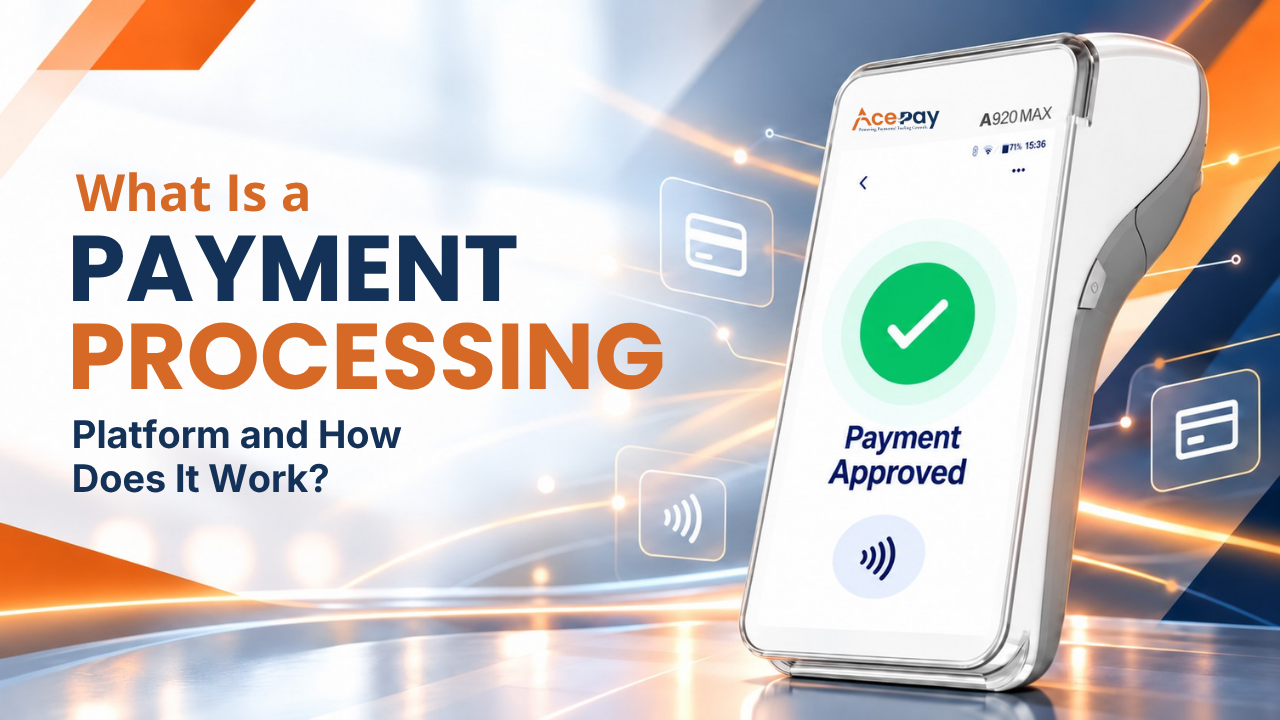
What Is a Payment Processing Platform?
A payment processing platform is a system that helps businesses to accept, process, manage, and track electronic payments. This platform connects the customer’s chosen payment method with the systems that verify, authorize, process, settle, and manage electronic transactions.
A payment platform may support:
- Credit and debit card payments
- Contactless payments
- Digital wallets
- ACH payments
- Online checkout
- Mobile payments
- In-person payments
- Payment links
- Invoices
- Virtual terminals
- Recurring payments
- POS transactions
- Transaction reporting
- Refunds
- Fraud monitoring
- Payment reconciliation
While the actual features of payment platforms differ between providers. Some platforms focus on online payments while other payment platforms integrate online, in-person, mobile, POS, recurring, billing, and business-management tools.
A modern payment platform works as a comprehensive infrastructure that supports more than simply transferring funds.
How Does a Payment Processing Platform Work?
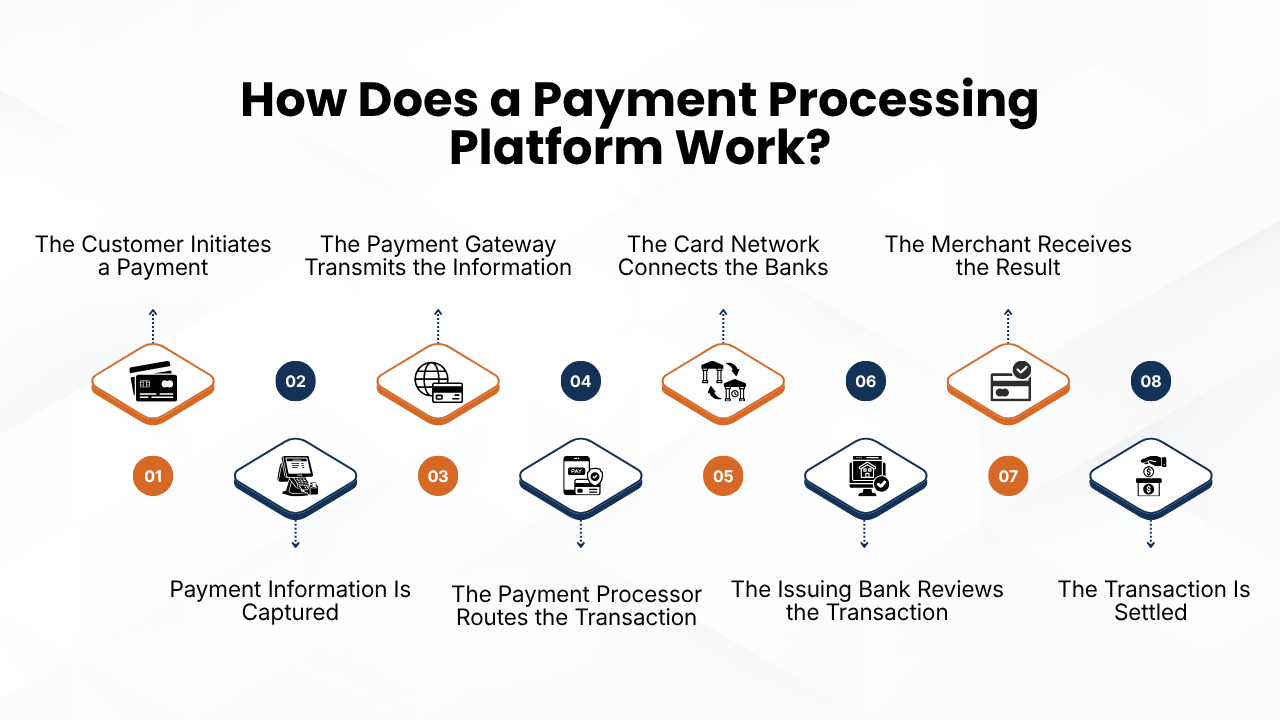
A payment processing platform connects customers, merchants, payment gateways, processors, banks, and card networks to complete electronic transactions. Although the technology of the payment processing platform seems complex, the overall payment processing platform process can be understood in eight main phases.
1. The Customer Initiates a Payment
The process begins with a customer deciding to purchase a product or service and chooses a payment method. A payment processing platform can support transactions through several channels such as:
- Physical checkout terminals
- Ecommerce websites
- Mobile devices
- Payment links
- Online invoices
- Virtual terminals
- Recurring billing
For instance, if a customer is purchasing a $100 product from an online store, then they enter their card details at checkout. Then the payment platform receives the transaction request and starts processing.
At this phase, the system captures the important transaction details like the merchant, payment amount, selected payment method, and other information required to complete the payment.
2. Payment Information Is Captured
The customer’s payment information is captured through the appropriate payment interface. The interface is based on the way the transaction is being completed.
For example:
- A physical store may use a card terminal.
- An online business may use a checkout page.
- A service provider may send a payment link.
- A business may use an invoice or virtual terminal for remote payments.
While the payment system handles sensitive payment information securely. Through security features like encryption and tokenization helps to protect payment data when it is transmitted between different systems. Such platforms apply security and fraud-prevention checks before the transaction continues through the payment network.
Also Read: Top Payment Processing Companies in the USA
3. The Payment Gateway Transmits the Information
A payment gateway offers a secure connection between the customer’s payment interface and the payment-processing infrastructure. It receives transaction details and securely transmits it to the appropriate processing system.
For an online transaction, the gateway may handle information such as:
- Transaction amount
- Payment method
- Customer payment details
- Merchant information
- Transaction information
The role of payment gateway goes beyond displaying a payment form. It helps to securely transmit payment information to the system responsible for authorization and processing. Based on the provider, gateway functionality may be included as being part of a broader payment processing platform.
4. The Payment Processor Routes the Transaction
The payment processor helps to route transaction information through the appropriate financial networks. For card payments, this process can involve the merchant’s acquiring bank, the card network, and the customer’s issuing bank.
The processor securely transmits the transaction information between the appropriate financial institutions and receives the authorization response. The processor manages the exchange of payment details required to verify and authorize the transaction.
This process usually happens very quickly. In many cases, customers receive an approval or decline response within seconds. The processor therefore has a crucial role in connecting the merchant’s payment system with the financial institution involved in the transaction.
5. The Card Network Connects the Banks
For card transactions, the card network offers the infrastructure through which transaction information is transmitted between the merchant side and the issuing bank of customers.
Common card networks include:
- Visa
- Mastercard
- American Express
After receiving the transaction information, the card network routes it toward the appropriate issuing bank. The network also operates as per established rules and procedures that govern card transactions.
Such transmission allows the issuing bank to receive the information it needs to evaluate the transaction. The response can transmit back through the network and processing infrastructure toward the merchant.
Also Read: How to Compare Payment Processing Providers
6. The Issuing Bank Reviews the Transaction
The issuing bank is the financial institution that issued the customer’s credit or debit card. This bank reviews the transaction and determines whether it can be approved.
The issuing bank may consider factors such as:
- Available funds or credit
- Card validity
- Payment credentials
- Account status
- Fraud indicators
- Risk controls
If the transaction meets the bank’s requirements, then it returns an authorization response. If the payment cannot be approved, then it returns a decline response.
An approved response transmits back through the payment network to the merchant’s payment system. If the transaction is declined, then the customer may be asked to use another card, digital wallet, or supported payment method.
7. The Merchant Receives the Result
The payment processor transmits the transaction result to the merchant’s payment system. If the payment gets approved, then the business can complete the sale and send confirmation to the customer.
For instance, an online store may display an order-confirmation page after successful payment. A physical retailer may provide a receipt and release the purchased product.
If the payment is declined, then the merchant informs the customer and offers a different payment option. Sending clear payment messages to customers is essential because customers require to understand whether their purchase was successfully completed.
At this phase, the business also logs the transaction for order management, reporting, accounting, and reconciliation purposes.
8. The Transaction Is Settled
The authorization process confirms whether a transaction has been approved. But payments getting authorized, does not necessarily indicate that the merchant instantly receives the money in their bank account.
While in the settlement phase, approved transaction funds are transferred through the valid financial institutions and then finally made available to the merchant.
The time of payment settlement may differ depending on the payment method, payment provider, banking, transaction type, and other factors.
Businesses also require payment reconciliation that involves comparing transaction records with the funds deposited into their accounts.
Through payment reconciliation businesses can find whether there are any payment discrepancies, monitor transaction activities, and maintain accurate financial records.
Together all these phases represent the way a payment processing platform connects the customer, merchant, payment infrastructure, banks, and payment networks to complete an electronic transaction.
Also Read: Modern Payment Processing Solutions for Growing Businesses
The Main Participants in Payment Processing
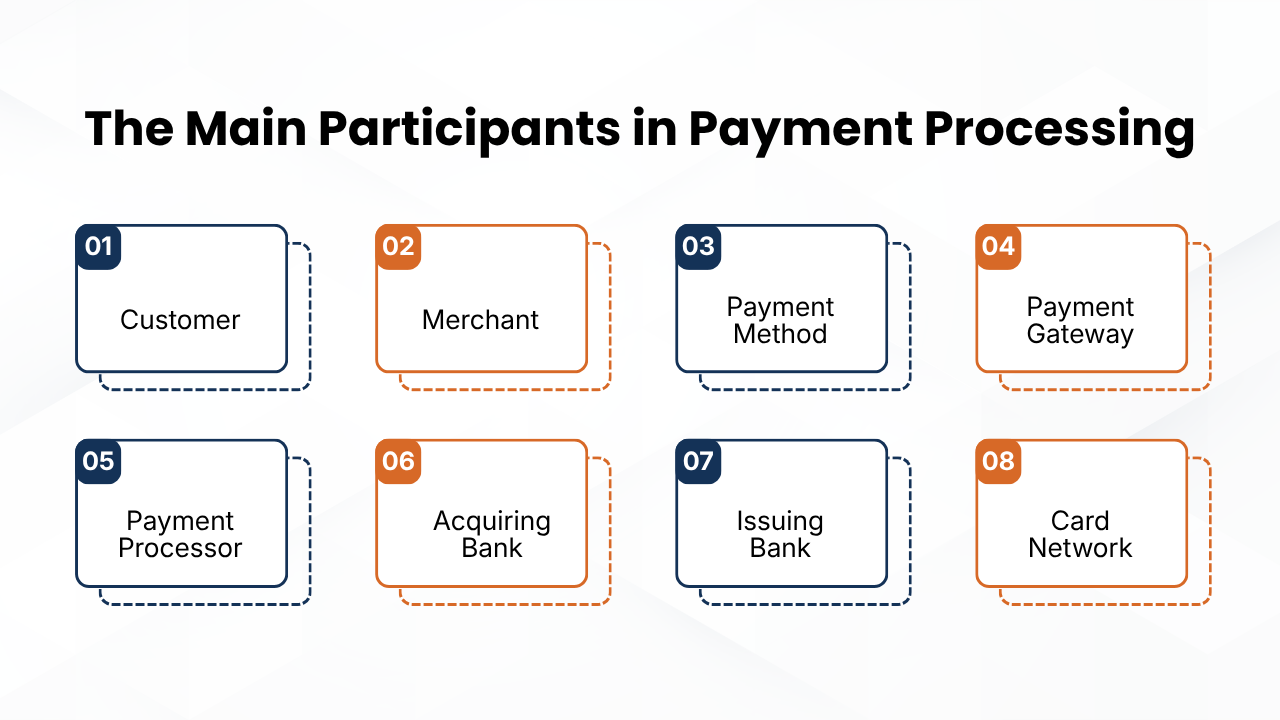
A usual electronic payment involves several participants. Each participant has specific roles that help to authorize, process, and settle the transaction.
1. Customer
A customer can be a person or organization buying a product or service. They may choose a payment method and offer the needed payment information. They can make payments online, in-person, or through a mobile device.
2. Merchant
The merchant is the business accepting the payment. They provide the product or service to the customer. The merchant receives the funds after the transaction is processed and settled.
3. Payment Method
It is the way the customer makes payment. Some of the common payment methods that customers use include credit cards, debit cards, digital wallets, and ACH transfers. Companies offering several payment methods to their customers can make the checkout process more convenient.
4. Payment Gateway
The payment gateway securely captures and transmits payment information. It connects the customer’s payment interface with the processing infrastructure. Payment gateways are commonly used for online and digital transactions.
5. Payment Processor
The payment processor manages transaction messages between the relevant parties. It helps to route payment information for authorization. The processor also supports the transaction-processing and settlement process.
6. Acquiring Bank
The acquiring bank, or acquirer, works with the merchant to process payments. It receives transaction funds on behalf of the business. The acquirer is an essential part of the merchant-side payment process.
7. Issuing Bank
The issuing bank provides the credit or debit card to the customers. The issuing bank reviews the transaction and determines whether the transaction can be authorized. The bank then sends an approval or decline response.
8. Card Network
During a card transaction, the card network facilitates communication between the issuing bank and acquiring bank. Networks like Visa and Mastercard provide transaction infrastructure and operating rules. Together these components enable electronic payments to transmit information securely from customers to merchants.
Also Read: Medical Payment Processing: A Complete Guide for Healthcare Businesses
What Payment Methods Can a Payment Platform Support?
Each customer has different payment preferences based on the business, industry, location, and purchasing channel. A flexible payment processing platform supports multiple payment methods that helps businesses to provide convenient payment options for customers.
1. Credit and Debit Cards
Credit and debit cards are widely used by customers for making online and in-person purchases. It involves customers entering card details during online checkout or using a physical card at payment terminals. Businesses can either accept chip, swipe, and other supported card transactions.
2. Contactless Payments
Contactless payments are used by customers where they tap compatible cards or mobile devices on supported terminals. Such payments make the checkout process quick and more convenient. They are widely used in retail stores, restaurants, events, and physical stores.
3. Digital Wallets
Digital wallets allow customers to make payments using stored card or account details. Customers usually complete transactions through compatible smartphones, tablets, or other devices. Digital wallet payment is an alternative payment option to manually entering card details.
4. ACH Payments
ACH payments allow businesses to receive electronic payments through eligible bank accounts. ACH payments are useful for invoices, larger transactions, recurring billing. ACH payments is an alternative option to card-based transactions.
5. Payment Links
Businesses can also create payment links and share them through email, text messages, websites, or social media. This payment involves customers opening the link and completing payment through a secure payment page. Payment links are a good option for businesses to collect payments without needing a dedicated ecommerce website.
6. Invoices
This payment method involves businesses sending invoices to customers with payment options. Then the customers can make payments directly through a payment-enabled invoice. Invoices simplify payment collection for service providers and businesses that bill customers after providing services.
7. Recurring Payments
This payment method involves automatically charging customers as per the scheduled billing. These payments are useful for subscriptions, memberships, maintenance plans, retainers, and ongoing services. Automated billing can reduce the need for manual payment collection and provide a consistent payment experience.
Businesses offering several payment methods to customers can provide services as per customer preferences, accepting payments online, in-person, and mobile channels.
Also Read: Payment Processing Solutions for High-Risk Businesses
Essential Features of a Payment Processing Platform
1. Recurring Billing and Subscription Payments
Many businesses do not just offer one-time purchases to their customers.
Subscription companies, membership organizations, software providers, professional service businesses, and maintenance companies may need to regularly collect payments at a scheduled time.
Recurring billing allows businesses to automate scheduled charges of the customer instead of manually asking customers to make payments each time.
Common recurring payment uses include:
- Memberships
- Software subscriptions
- Maintenance services
- Subscription products
- Retainer services
- Service plans
AcePay provides recurring billing for memberships, subscriptions, service plans, and retainers. Automating recurring payments can reduce the need for manually follow up with the customers, make the payment collection simple, and build a more consistent billing process.
2. Payment Processing Security
Payment processing security is an important requirement as payment transactions have financial details. So, a payment processing platform must use security features and controls appropriately to secure transaction data.
Important security features include:
- Encryption: Encryption protects payment information when it is transmitted between systems.
- Tokenization: Tokenization involves replacing sensitive payment information with tokens that can be used by authorized systems securing the original data.
- PCI DSS: this feature helps to provide security requirements for organizations that handle cardholder information.
- Fraud Detection: helps to identify unusual transaction patterns and fraud activities.
- Authentication: Authentication helps to confirm that a transaction is legitimate.
AcePay provides security features like fraud detection and PCI compliance, while businesses should also evaluate the security measures and features provided by their payment provider.
3. Payment Processing Fees
Businesses make payment for the technology and infrastructure required to process electronic payment. The total payment processing fees can include:
- Interchange Fees: Costs associated with card transactions which are paid to the issuing bank.
- Assessment Fees: Fees charged by card networks for transactions processed through networks.
- Processor Fees: Fees charged for payment processing technology, services, support, and transaction processing.
The actual payment processing fees can differ based on the provider, payment method, card type, transaction type, and pricing.
4. Common Payment Pricing Models
Based on the pricing model, payment providers have different pricing based on the type of business and transaction volume.
- Flat-Rate Pricing: applies a fixed percentage or transaction fee that makes payment processing easier to understand.
- Interchange-Plus Pricing: combines interchange and assessment fees with a processor markup providing businesses with more transparency into payment processing expenses.
- Tiered Pricing: this pricing involves grouping transactions into different pricing categories based on factors like transaction type, qualification, or risk.
For businesses the most suitable pricing model is based on transaction volume, average transaction value, payment methods, business type, and overall processing requirements. So they must compare different pricing structures carefully before choosing a payment processing platform.
Also Read: Best Credit Card Processing Companies for Small Businesses
Why Businesses Need a Payment Processing Platform
A payment processing platform goes beyond helping businesses to accept customer payments. This platform combines payment methods, transaction management, reporting, security, and business integrations together in one system.
The right payment processing platform for the business is the one that supports daily operations and also supports long-term growth.
1. More Payment Options
Customers prefer to make payments using different payment methods based on their current location, devices used, and their purchasing habits. So, businesses supporting several payment options allow customers to complete payments conveniently
- Credit and debit cards
- Digital wallets
- ACH payments
- Contactless payments
- Payment links
Offering many payment options for customers helps businesses to serve customers on different sales channels.
2. Better Customer Experience
Businesses having a complex or slow checkout process make customers abandon a purchase. So, offering a smooth payment experience to customers reduces unwanted payment steps and makes transactions easier. So it is essential for businesses to provide convenient payment options and offer a smoother checkout for customers.
3. Centralized Payment Management
Businesses accept payments on websites, mobile devices, and other channels. While having a centralized payment platform integrates all components together that makes it easier for businesses to manage transactions without relying on several disconnected systems.
Also Read: Best Credit Card Processing Solutions for Small Businesses
4. Improved Reporting
Payment data offer important insights regarding business transactions. Payment platforms provide reports about sales, refunds, settlements, transaction activity, and payment-based information. With these insights businesses can track performances of payments and also make informed decisions.
5. Reduced Manual Work
Integrating different payment systems that connect payment processing with POS systems, accounting software, ecommerce platforms, and business applications. Such payment integrations help businesses to reduce the need for repetitive entry of data manually and manage transactions more efficiently.
6. Stronger Security
Payment platforms can provide security features that protect sensitive transaction details. Implementing security features like encryption, tokenization, fraud detection, authentication, and PCI-based controls help businesses to manage security features effectively.
Also Read: Credit Card Processing Fees: Complete Breakdown for Businesses
7. Support for Business Growth
Whenever business grows, payment requirements are more complex. A company may move from card acceptance to ecommerce payments, multiple locations, recurring billing, mobile payments, POS integrations, advanced reporting, and fraud controls.
Using a scalable platform supports these changing business requirements while helping businesses to manage payments efficiently.
Conclusion
A payment processing platform has the technology and infrastructure needed by businesses to accept, process, and manage electronic payment across different channels.
This platform connects customers, merchants, payment gateways, processors, banks, and card networks helping transactions to transfer funds securely.
Modern payment platforms can support various payment methods like credit and debit cards, ACH, contactless payments, digital wallets, payment links, invoices, and recurring billing.
Such platforms provide important features like fraud detection, security controls, reporting, POS integration, and automated payment management.
Choosing the right platform requires businesses to consider payment methods, sales channels, security, integrations, pricing, reporting, scalability, and customer support. A payment solution should meet requirements of customers and also support future growth.
AcePay offers payment processing capabilities for online, in-person, mobile, and integrated payments, helping businesses manage different payment workflows through a connected solution. Selecting a suitable platform can improve payment efficiency, customer convenience, and overall transaction management.
If you still have any query about the payment processing platform and the way it works then you may book a free demo at AcePay and we are more than happy to assist you.