In a quickly changing digital economy, businesses operating in industries that have high fraud risks, chargeback ratios, or complex regulatory requirements usually face difficulty to secure reliable payment services. And this is where Payment Processing solutions for High-Risk businesses become essential.
Unlike standard merchant accounts, high-risk payment processing specifically supports businesses that traditional banks and payment providers may feel risky to support due to industry type, transaction volume, recurring billing models, or international operations.
Many industries like online gaming, travel, CBD, cryptocurrency, subscription services, and nutraceuticals often require specialized high-risk merchant accounts for accepting payments smoothly without any interruptions.
Without the right processing partner high-risk businesses may face many issues like account freezes, delayed settlements, rolling reserves, or even termination of services.
Hence it is crucial for high risk businesses to select the accurate high-risk payment gateway for long-term stability and business growth.
Modern payment processing solutions offer advanced fraud prevention tools, chargeback management systems, multi-currency payment support, and secure transaction technologies that help businesses to minimize financial risks and also improve customer experience.
Additionally, many providers offer scalable systems, support alternative payment methods, and global acquiring solutions that support online businesses.
While eCommerce keeps growing all over the world, the demand for reliable payment solutions for high-risk businesses is increasing.
Today companies require payment systems which not just process transactions efficiently but also give compliance support, advanced security, and flexible underwriting.
Businesses by understanding how high-risk payment processors work and selecting the right provider may help businesses to improve approval rates, reduce disputes, and achieve revenue growth in a highly competitive market.
What Makes a Business High Risk?
Businesses can be categorized as high risk due to many factors such as high chargeback rates, recurring billing models, high transaction volumes, international sales, or operating in industries that have strict regulatory inspections.
For instance, online gambling, CBD, nutraceuticals, travel, ticketing, tobacco, and subscription businesses are frequently reviewed more carefully because they tend to generate more disputes, refund requests, legal requirements, or compliance concerns.
In other cases, the risk is due to the transaction model. Card-not-present payments, online orders, phone payments, international transactions, multiple currencies, high average order values, recurring billing, free trials, delayed delivery, and digital products can all increase financial and fraud-related risks for payment processors.
Businesses that handle international transactions, process multiple currencies, offer subscription-based services, sell intangible products, manage high-value transactions, or have a history of terminated merchant accounts which are often categorized as high-risk by payment processors.
Payment processors also evaluate a merchant’s business history, and also factors like poor credit records, frequent customer disputes, excessive refunds, lack of prior processing experience, terminated accounts, unclear business policies, or incomplete documentation can result in a high-risk classification.
But the important point is that being classified as high risk is not necessarily negative; rather it is simply a risk assessment category used by payment processors to verify potential financial exposure, determine processing fees, set reserve requirements, and establish the security measures needed before approving a merchant account.
High-Risk Merchant Account vs Payment Gateway
Many merchants confuse payment gateways with a merchant account that are identical, but in reality they serve different roles within the payment processing system.
A payment gateway acts as the secure technology interface that collects customer payment information, encrypts sensitive data, transmits authorization requests, and connects your website, app, invoice, virtual terminal, or POS system to the payment network. It does not usually hold your funds.
A merchant account is the financial account where card payment funds are temporarily before settlement to your business bank account. The acquiring bank or processor reviews your business, accepts the risk, and sets account terms like pricing, reserves, settlement timing, processing limits, and chargeback controls.
The main difference between the two is that the payment gateway securely processes and transmits transaction data, while the merchant account works as the holding account where funds that are approved are temporarily stored before it is transferred to the merchant’s business bank account.
For high-risk businesses, both payment gateway and merchant account are equally crucial roles as a business may still face operational disruptions and financial risks when the gateway does not have advanced fraud protection, intelligent routing, recurring billing functionality, flexible tokenization, detailed reporting, or support for alternative payment methods, even after securing account approval.
A strong payment gateway with a poor merchant account can also fail if fees are too high, reserves are excessive, settlement is slow, or underwriting does not match your business model.
The best setup combines both a high-risk friendly merchant account and a gateway built for fraud control, customer experience, reporting, and scalability.
Why High-Risk Businesses Need Specialized Payment Processing
High-risk merchants need specialized payment processing solutions because traditional providers only support low-risk businesses with predictable transaction patterns, minimal chargebacks, clear delivery timelines, and low compliance complexity.
A specialized high-risk processor understands to verify businesses that other providers reject. Rather than instantly rejecting an application because of the category, they review the complete picture about business model, ownership, website, refund policy, fulfillment process, compliance documents, processing volume, chargeback history, fraud controls, and financial stability.
High-risk processors may also offer tools that standard providers do not prioritize such as rolling reserve management, chargeback alerts, fraud scoring, blacklist controls, multi-currency support, recurring billing management, industry-specific underwriting.
They also provide advanced features like dynamic transaction routing, access to multiple merchant IDs, local acquiring options, real-time reporting, fraud prevention systems, chargeback monitoring, tokenization, and compliance management tools to improve approval rates and reduce financial risk.
For merchants, it matters because payment stability is business stability. If your account is frozen, terminated, or placed under high reserve, revenue can stop almost instantly. A specialized solution reduces that risk by implementing preventive risk controls that identify and address potential issues early, before they turn into serious operational or financial disruptions.
Common Challenges High-Risk Merchants Face
The first challenge high-risk merchants face is approval. High-risk applications usually need more documentation than standard accounts.
Processors may ask for business registration documents, ownership details, bank statements, processing history, chargeback reports, supplier invoices, refund policies, fulfillment details, product descriptions, compliance licenses, website screenshots, marketing material, and customer service procedures.
The second challenge is cost. High-risk businesses often pay higher transaction fees because the processor is accepting more liability. Because high-risk merchants may face higher processing fees, cash reserves, higher chargeback fees, and longer application processes.
High-risk pricing may include higher transaction fees, rolling reserves, separate chargeback fees, and administrative costs connected to compliance requirements.
The third challenge is reserves. A rolling reserve means the processor will hold a percentage of each transaction for a period of time to protect against chargebacks or losses. For instance, a processor may hold 5% to 10% of processed volume for 90 to 180 days. Some merchants may also face fixed reserves, capped reserves, or delayed settlements.
The fourth challenge is chargebacks. High-risk businesses are monitored closely because excessive chargebacks can damage the processor’s credibility with acquiring banks and card networks, ultimately affecting their ability to maintain stable payment processing relationships.
High-risk merchants must continuously track chargeback ratios and ensure compliance with payment network rules, as excessive dispute activity can place their merchant account(MID) at risk of penalties, processing holds, or account termination.
The fifth challenge is account continuity. Relying on only one merchant account creates a significant vulnerability, as any disruption, suspension, or termination can immediately stop a business’s ability to process payments and generate revenue.
If the account is closed or funds are held, the businesses may lose their ability to accept payments. This is why larger or more complex high-risk businesses often require backup processing options, multiple MIDs, or a gateway setup that allows easier migration.
Best Payment Processing Solutions for High-Risk Businesses
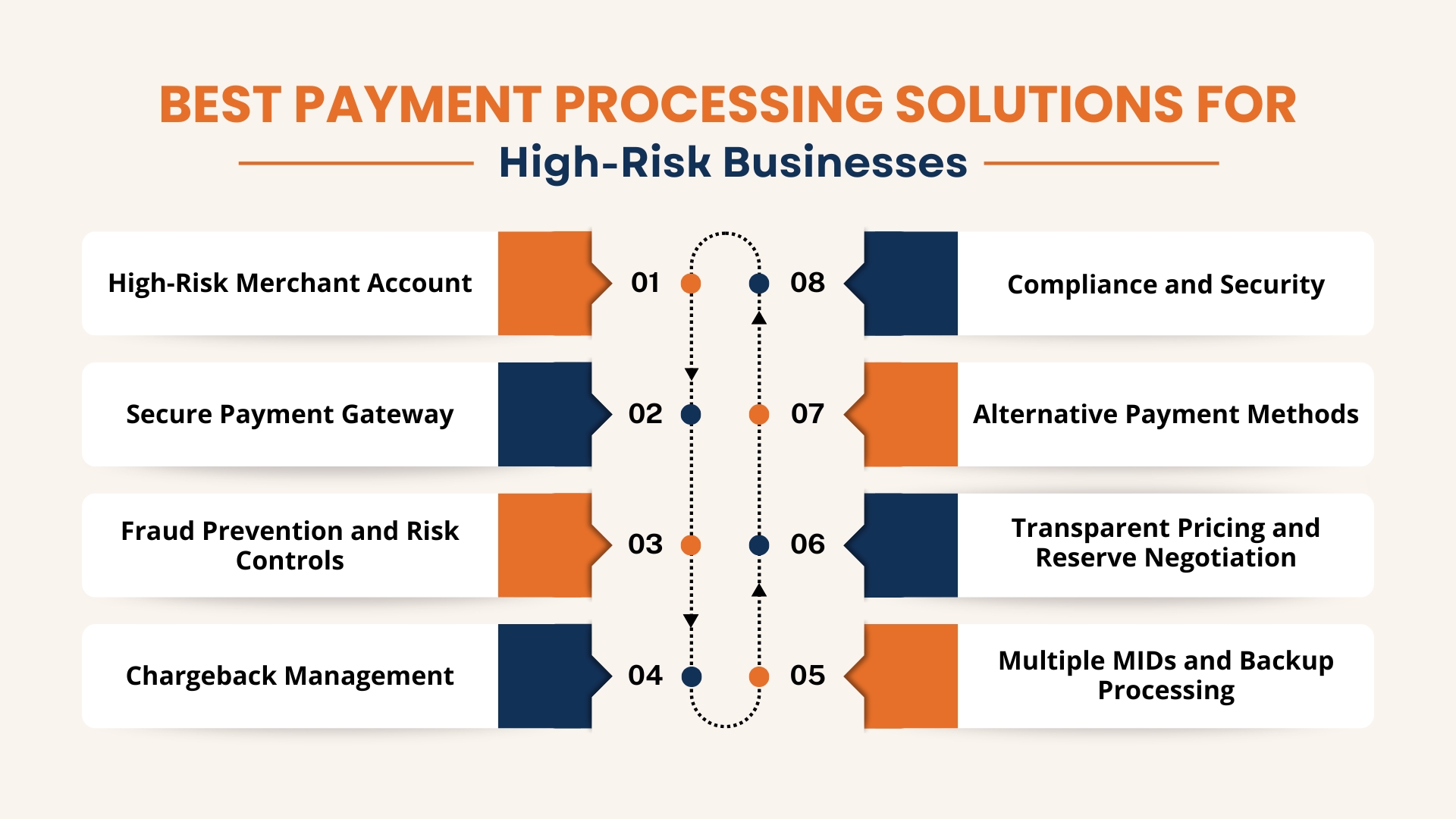
1. High-Risk Merchant Account
The foundation is a merchant account designed for your industry. Businesses must not hide their business model to get approved faster. That usually creates bigger problems later.
It is essential for businesses to be transparent about the products they sell, how customers are billed, know how products or services are delivered, about your refund policy and where your customers are located.
A strong high-risk merchant account should provide realistic processing units, fair settlement terms, transparent reserves, clear chargeback rules, and support your specific industry.
The processor should understand your category rather than forcing you into a generic account that may be closed later.
Before applying it is essential for businesses to prepare their documents carefully. Your website should have clear pricing, product descriptions, refund terms, privacy policy, terms of service, contact information, fulfillment timelines, cancellation instructions, and billing descriptors.
Weak websites often create underwriting concerns because they increase customer confusion and disputes.
2. Secure Payment Gateway
The gateway should support the way your business actually sells. For eCommerce, your payment gateway should integrate with your website or cart.
For subscriptions, payment gateway should support recurring billing, retries, cart updates, cancellation flows, and customer notifications. For phone orders, payment gateway may require a virtual terminal. For in-person sales, it may need POS support.
A good high-risk gateway will provide features such as tokenization, encryption, fraud filters, velocity rules, AVS, CVV, 3D Secure, reporting, recurring billing tools, and the ability to support multiple payment methods.
The PCI DSS framework establishes a set of technical and operational security requirements which helps to protect cardholder data and is applicable to any organization that stores, processes, transmits, or otherwise impacts the security of payment information within the cardholder data environment.
For high-risk businesses, even having a flexible gateway is crucial because payment requirements can change. This lets you add new markets, new currencies, higher volume, new products, subscription offers, affiliate campaigns, or backup processors. While a rigid gateway can limit growth.
3. Fraud Prevention and Risk Controls
Fraud prevention is not optional for high-risk merchants. As fraud prevention directly affects approval rates, chargeback exposure, processor trust, and long-term account health.
Useful fraud controls include AVS checks, CVV verification, device fingerprinting, IP risk scoring, email risk checks, velocity limits, geolocation rules, transaction monitoring, 3D Secure, backlists, allowlists, manual review queues, and fraud alerts.
Key fraud prevention tools for high-risk merchants typically include Address Verification System (AVS) checks, CVV validation, multi-factor authentication, real-time fraud monitoring, and secure payment gateway infrastructure to help reduce fraudulent transactions and improve payment security.
The best fraud setup should not block every unusual order automatically. Because high strict rules can reduce approvals and also affect revenue.
Rather merchants should implement a tiered risk management approach which classifies transactions and customers on the basis of their risk level, that allows more targeted controls and enhanced fraud prevention.
Low-risk orders can be approved quickly. Medium-risk orders can trigger additional verification. High-risk orders can be declined, reviewed manually, or routed through stronger authentication.
4. Chargeback Management
Chargebacks are one of the biggest reasons high-risk merchants lose payment accounts. A good chargeback strategy begins before the dispute happens.
Use clear billing descriptors so customers recognize the charge. Send confirmation emails after purchase. Offer tracking numbers where possible. Ensure you make refund and cancellation policies easy to find.
Offer fast customer support. Respond to complaints before customers contact their bank. Keep proof of delivery, customer communication, IP logs, signed agreements, checkout records, and refund history.
Chargeback alert systems such as early dispute notifications or network-based alerts help merchants identify potential chargebacks in real time, giving them the opportunity to intervene, issue refunds, or resolve customer concerns before the dispute escalates into a formal chargeback.
For subscription businesses, chargeback prevention should include renewal reminders, easy cancellation, clear trial terms, transparent pricing, and customer self-service portals. Many disputes happen because customers forget they subscribed and do not recognize the billing descriptor, or cannot find a simple cancellation path.
5. Multiple MIDs and Backup Processing
A single MID may be enough for a small merchant, but high-volume or high-risk businesses should consider redundancy. Multiple MIDs can reduce operational risk if one account is temporarily held, capped, or reviewed.
It is also recommended to use a gateway that stores tokens independently from the merchant services provider so merchants can move more smoothly if a processor relationship changes.
It does not mean every business should immediately open several accounts. Multiple MIDs must be managed properly. Transaction volume should be managed transparently and in accordance with processor guidelines, as multiple merchant accounts are intended to support operational stability and risk management instead of hiding any chargeback activity or circumvent underwriting requirements.
6. Transparent Pricing and Reserve Negotiation
High-risk processing will often cost more than standard processing, but it does not indicate that merchants should accept unclear pricing. Rather it is essential to ask for the full cost and not the headline rate.
Businesses must review all types of fees like transaction fees, monthly fees, gateway fees, chargeback fees, refund fees, PCI fees, batch fees, cross-border fees, currency conversion fees, reserve terms, early termination fees, minimum monthly fees, and any volume penalties.
They should also conduct payment processing audits on a regular basis by analyzing transaction statements, approval percentages, chargeback ratios, and processing costs, while also discussing effective pricing structures, dispute management tools, with providers in case chargebacks levels increase.
Merchants should carefully negotiate reserve terms by understanding whether the reserve structure is rolling, fixed, limited, or temporary, clarifying the timeline for fund releases, and discussing the performance benchmarks which could cause reduced reserve requirements, while ensuring the processor provides clear justification for the reserve conditions and pathways to improved terms.
7. Alternative Payment Methods
High-risk businesses should not only depend on credit cards when other payment methods can improve flexibility, reduce risk, and improve customer convenience.
Alternative payment methods can improve customer experience, reduce card dependency, and sometimes lower certain risk exposures.
Based on the market and business model, payment options may include debit cards, ACH, eCheck, bank transfer, digital wallets, local payment methods, pay-by-link, virtual terminal payments, recurring bank payments, mobile wallets, or invoice-based payments.
High-risk businesses can also benefit by providing alternative payment methods such as mobile wallets, buy now pay later(BNPL) solutions, digital currencies, and other flexible payment solutions required to meet changing customer preferences and also reduce their dependence on a single payment channel.
The ideal payment strategy should match with the business model and customer base, because high-value B2B companies benefit from ACH and bank transfer options, international eCommerce businesses often need localized payment methods, and subscription-based services usually need recurring billing optimization and automated account updater tools.
8. Compliance and Security
High-risk merchants must take compliance seriously because payment security is not just a technical requirement rather it affects processor confidence, customer trust, and account stability.
PCI DSS is one of the most crucial standards in card payment security. PCI SSC states that PCI DSS was created to encourage and enhance payment account data security and provide a foundation of technical and operational requirements to protect payment account data globally.
Merchants should also understand industry-specific rules. CBD, financial services, gaming, tobacco, travel, debt services, and health-related products may require additional legal, advertising, age verification, disclosure, licensing, or documentation controls.
A processor that understands your industry can help you identify what underwriting will expect, but merchants should also work with qualified legal and compliance professionals whenever required.
How to Choose the Right High-Risk Payment Processor
For any businesses in a high-risk industry, selecting the right high-risk payment processor is one of the most crucial decisions.
Because the right payment provider is not just the one which offers lowest rates, rather the provider that can offer account stability in the long-term, protect cash flow, support business growth, and also provide reliable communication when risk-related problems increase.
A strong payment partner helps businesses to reduce disruptions, improve approval rates, and manage fraud and chargebacks effectively.
When evaluating a high-risk payment processor, businesses should focus on several important factors:
- Industry Experience: The provider must have experience of working with businesses in your industry and also understand the unique challenges faced by the industry.
- Transparent Pricing: All fees like transaction charges, reserves, gateway costs, compliance fees, and chargeback penalties, should be explained clearly.
- Strong Underwriting Support: A reliable provider must guide merchants through the application process and help them to prepare accurate documentation to increase the chances of approval.
- Fraud and Chargeback Protection: Businesses should look for features like AVS checks, CVV verification, 3D Secure authentication, velocity controls, blacklist management, chargeback alerts, and detailed reporting tools.
- Flexible Payment Gateway Integration: Businesses must ensure that gateways easily integrate with websites, CRMs, shopping carts, subscription platforms, APIs, or POS systems.
- Settlement and Reserve Transparency: Businesses should clearly understand payout schedules, reserve requirements, release timelines, and conditions that may trigger holds.
- Responsive Customer Support: High-risk merchants benefit greatly when they have access to knowledgeable customer support teams instead of depending only on automated systems.
Selecting a processor with strong risk management capabilities and transparent communication can highly improve long-term payment stability.
Conclusion
In today’s highly competitive digital market, for businesses operating in high-risk industries it is crucial to have reliable payment systems.
Whether your company deals with international transactions, recurring billing, digital products, high-ticket sales, or operates in highly regulated sectors having the right payment processing can impact their growth and financial stability.
Where traditional banks and standard processors often hesitate to work with high-risk merchants because of high fraud risks, chargebacks, refunds, and compliance challenges.
But, specialized high-risk payment processors can manage such complexities of high-risk merchants efficiently.
Modern high-risk merchant accounts not just help businesses to accept payments but also offer many features. They offer advanced fraud prevention systems, chargeback management tools, multi-currency support, secure payment gateways, and flexible underwriting.
This helps businesses to maintain operations smoothly while also reducing financial risks. Additionally, scalable payment technologies and alternative payment methods help businesses to grow globally and also improve customer experience with strong security and compliance.
Choosing the right high-risk payment gateway involves careful verification of fees, reserve requirements, fraud protection capabilities, industry experience, and customer support.
Businesses that focus on being transparent, and maintain low dispute ratios, and implement strong security practices are more likely to build steady processing and avoid any account disruptions.
While eCommerce, subscription services, and cross-border transactions keep growing, the demand for reliable payment processing solutions will also increase across many industries.
Partnering with experienced providers and adopting proactive risk management strategies, helps high-risk businesses to achieve secure transactions, operational continuity, and sustainable long term success in a changing global payment environment.
If you still have any query about payment processing solutions for high-risk businesses then you may book a free demo at AcePay and we are more than happy to assist you.