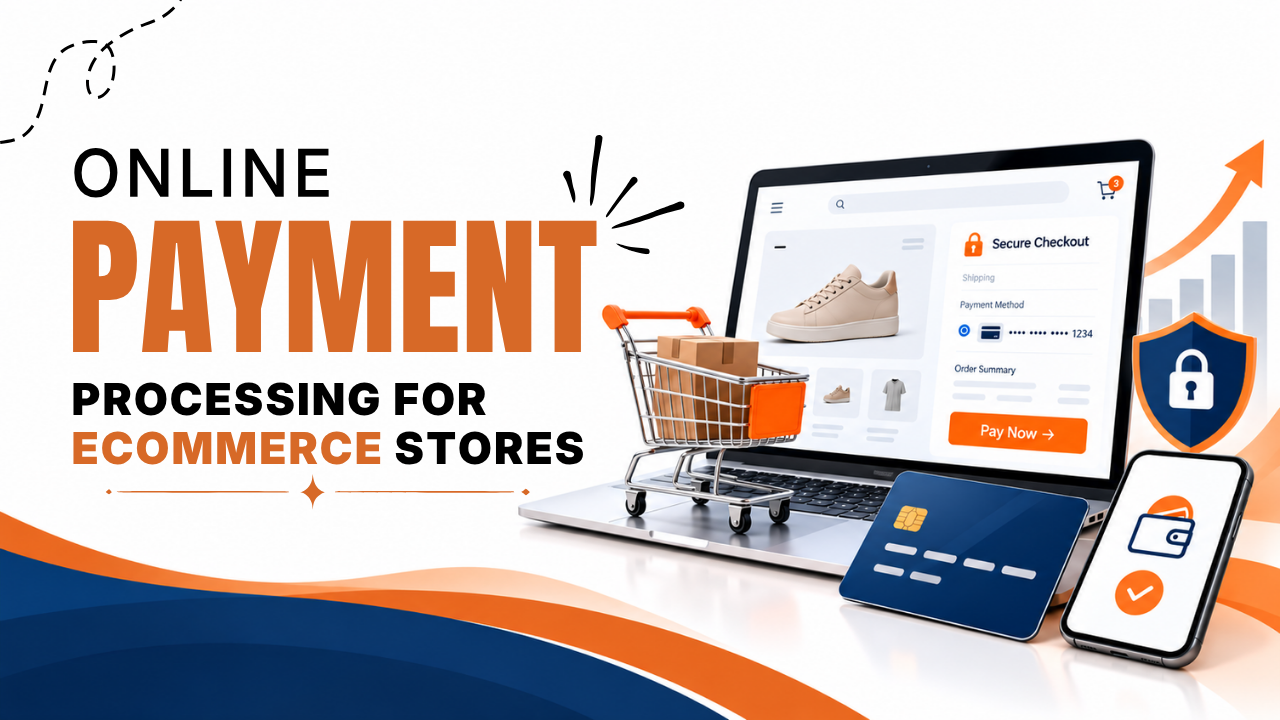
Online payment processing for ecommerce stores is essential for businesses that want to provide customers with a convenient, secure, and reliable shopping experience.
As online shopping continues to grow, businesses need an efficient payment processing system to accept payments, authorize transactions, manage refunds, and receive funds.
A reliable ecommerce payment gateway connects customers, merchants, and financial institutions, helping them to complete transactions smoothly. Choosing the right online payment solution can improve customer satisfaction, build customer trust, and support long-term business growth.
While choosing a suitable payment service provider, ecommerce businesses should evaluate transaction fees, payment security, and supported payment methods.
Options like credit card processing, debit card payments, digital wallets, and UPI payments can make checkout more convenient for different customers.
Businesses should also consider fraud prevention, PCI DSS compliance, and data encryption to protect sensitive financial information. Additionally, international payments, currency conversion, and payment integration are essential for stores serving customers across different countries.
A smooth checkout experience can reduce cart abandonment and encourage repeat purchases. Solutions like Stripe, Payoneer, and AcePay offer payment-related services that businesses can evaluate as per their requirements.
By comparing available features, businesses can choose a payment processing solution that supports secure transactions, efficient settlements, and scalable operations while creating a dependable foundation for ecommerce success.
Also Read: How to Choose a Payment Processor for Small Businesses
What Is Online Payment Processing for Ecommerce Stores?
Online payment processing enables online businesses to accept online payments when customers purchase products when customers purchase products or services through a website or application.
Such systems connect the ecommerce store with the valid payment provider and financial institutions to verify transactions, authorize payments, and facilitate the movement of funds.
A typical payment processing setup includes three main components.
- Payment gateway: It securely transmits payment information between the customer’s checkout page and the payment processing system.
- Payment processor: It coordinates transaction processing and communication with the valid financial institutions.
- Merchant account or settlement arrangement: It offers the mechanism through which accepted payments are settled to the business.
Some providers combine both payment gateway and payment processor into one service, reducing the need for merchants to manage multiple systems. For instance, when a customer purchases a product using a credit card, the payment system sends an authorization request through the appropriate networks.
If the transaction is approved, then the store can confirm the order and start fulfillment. The funds are then settled as per the provider’s payment schedule and terms.
A reliable payment system makes this process easier to manage while helping businesses maintain accurate order records and financial reports.
How Does Ecommerce Payment Processing Work?
Understanding the way the transaction process works helps merchants to identify problems and ensure that the orders are handled accurately.
The typical process involves these steps:
- Customer places an order: Customer initially selects products, reviews the cart, and proceeds to checkout.
- Payment information is submitted: The customer then chooses a supported payment option and provides the required details.
- The payment request is transmitted: The payment gateway or integrated checkout securely sends the transaction information for processing.
- Authorization takes place: The valid financial institutions verify the transaction either approve or decline the payment.
- Security checks are performed: Based on the payment method and risk settings, more authentication or fraud screening may be required.
- The transaction is captured: The payment is collected instantly or after a separate confirmation, based on the setup.
- Funds are settled: The provider then transfers the funds as per the settlement schedule after applicable fees and adjustments.
Authorization and settlement are different phases. If a payment is approved then it does not mean that the money has already reached the merchant’s bank account.
Ecommerce businesses should also configure their store accurately so that payment notifications update order statuses accurately. It helps to avoid duplicate orders, confusion over failed transactions.
1. Which Payment Methods Should Ecommerce Stores Accept?
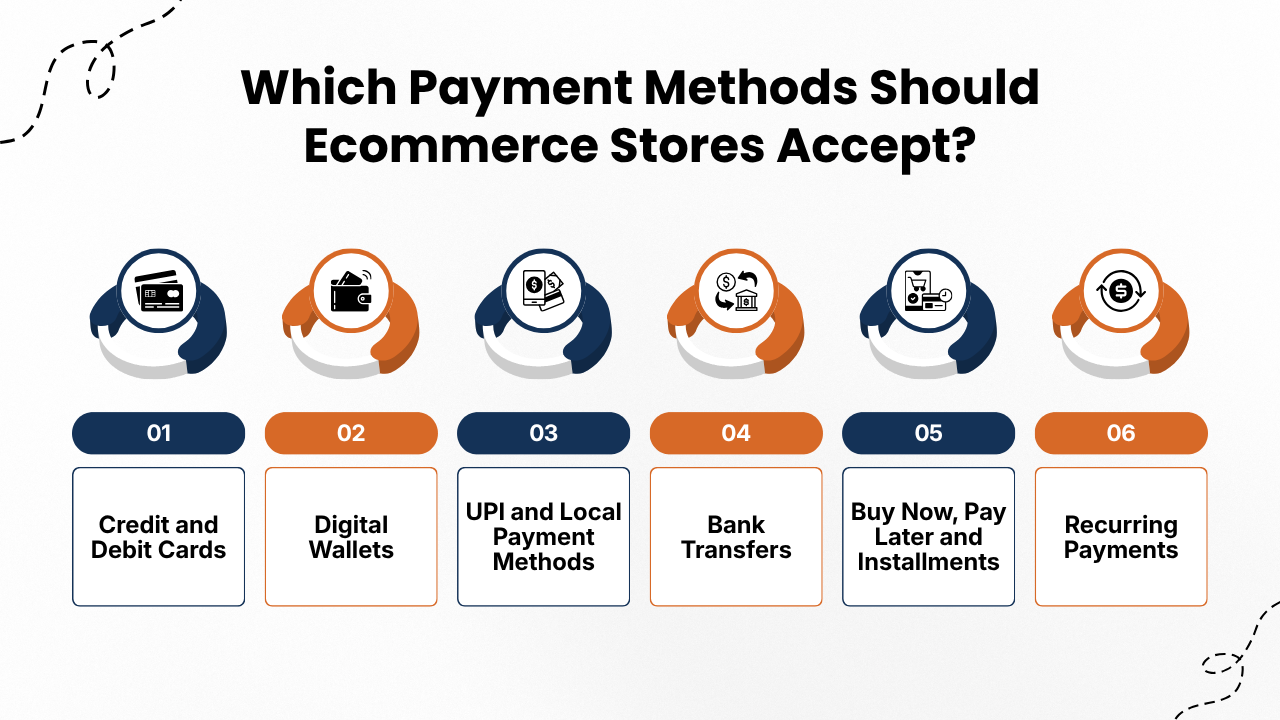
Providing suitable payment methods helps customers to complete purchases using payment options that they already know and trust. The right combination of payment methods is based on the business’s target market, average order value, product category, and customer preferences.
1. Credit and Debit Cards
Customers widely use credit and debit cards for ecommerce purchases. They let customers enter their card information at checkout or use valid saved payment credentials.
Merchants should check card networks that are supported, whether international cards can be accepted, and whether additional fees are applicable to cross-border transactions.
2. Digital Wallets
Digital wallets like Apple Pay, Google Pay, and PayPal can make checkout more convenient by reducing the amount of information customers require to enter manually.
Their availability is based on the provider, device, market, and merchant configurations.
3. UPI and Local Payment Methods
For businesses serving customers in India, UPI is an important digital payment option. Based on the payment provider, merchants may also provide net banking, eligible wallets, and other locally preferred methods.
Offering local payment options can improve customer convenience and help businesses to reach customers who do not regularly use international cards.
4. Bank Transfers
Bank transfers are suitable for high-value orders, business-to-business, ecommerce, and markets where customers can make payments directly through their bank.
Businesses should consider transaction confirmation timelines and create efficient processes for handling refunds and fulfilling customer orders.
5. Buy Now, Pay Later and Installments
Some providers offer installment or buy now, pay later options for eligible customers. These options may be valid for higher-priced products, but merchants should compare provider charges, eligibility conditions, and refund procedures before enabling them.
6. Recurring Payments
Subscription businesses need payment solutions that support recurring billing, payment retries, and appropriate handling of failed payments and subscription changes.
Choosing the right payment methods is not about offering every available payment option. Rather, it is about supporting the payment methods that customers are most likely to use successfully.
Also Read: Best Payment Processing Software for Businesses
2. Comparing Ecommerce Payment Processing Providers
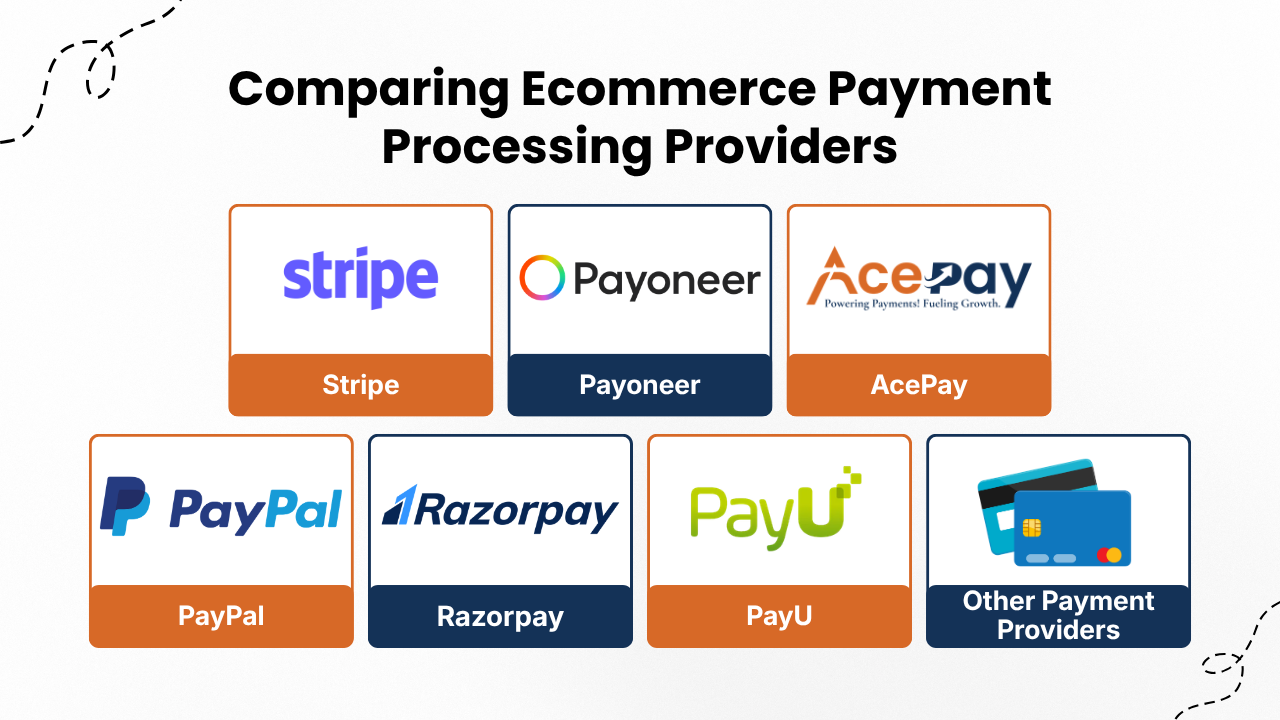
The best payment provider is based on what an ecommerce business requires to accomplish. Below are the following options that show why merchants should compare capabilities rather than assuming all payment platforms will have the same purpose.
1. Stripe
Stripe offers payment infrastructure, checkout tools, developer integrations, and services for online businesses. Based on market and account eligibility, Stripe supports card payments, other payment methods, recurring billing, and fraud-management workflows.
Stripe may be well suitable for businesses that require customizable checkout experiences, flexible integrations, or more advanced payment workflows.
Merchants based in India should verify current onboarding eligibility, available features, and requirements for their specific business structure.
2. Payoneer
Payoneer offers international business payments, receiving accounts, cross-border transactions, and marketplace payouts. This platform can be particularly relevant for online sellers and businesses receiving funds from international clients or marketplaces.
Payoneers also offers checkout for eligible ecommerce businesses which are subject to its requirements and availability. Merchants should differentiate between receiving marketplace payouts and accepting direct customer payments on their own websites.
3. AcePay
AcePay is another payment technology option that businesses can investigate. Its website describes tools such as the Vaultix Gateway for browser-based remote billing, POS systems, and payment terminals.
For an ecommerce store, the important consideration is whether AcePay’s available gateway supports the merchant’s online checkout, ecommerce platform, preferred payment methods, settlement needs, and business location. Businesses must review its current offerings and contact the provider to confirm the features and eligibility requirements valid to your store.
4. PayPal
PayPal is a well known digital payment provider that helps ecommerce businesses accept online payments from customers in different markets.
It supports payment options such as PayPal account payments and eligible debit and credit card transactions. Businesses can integrate PayPal checkout into supported ecommerce platforms to offer customers a familiar payment experience.
Its international payment capabilities make it useful for merchants selling products or services internationally. Before choosing PayPal, businesses should review transaction fees, currency conversion charges, country availability, and settlement conditions to determine whether it meets their requirements.
5. Razorpay
Razorpay is an Indian payment solutions provider that enables businesses to accept and manage online payments. It supports payment methods such as credit cards, debit cards, UPI, net banking, and digital wallets, subject to availability.
Ecommerce businesses can integrate Razorpay with supported websites and platforms to simplify checkout and manage transactions. Its additional business payment tools may help merchants to streamline collections and financial operations. While businesses should compare its pricing, supported integrations, settlement timelines, and security features before implementation.
6. PayU
PayU provides online payment processing solutions for ecommerce businesses and other merchants. Depending on the market and product, its services support various payment methods, including cards, bank payments, and digital payment options.
Businesses can use its payment gateway integrations to process customer transactions and manage online collections. PayU may suit merchants seeking flexible payment options and regional payment capabilities.
Before selecting the provider, businesses should evaluate transaction charges, integration requirements, supported currencies, security measures, and available customer support.
7. Other Payment Providers
Businesses in India can also compare Razorpay, Cashfree payments, and PayU for supported domestic payment methods and ecommerce integrations. While the availability and features are based on the provider’s current terms and the merchant’s eligibility.
Also Read: What Is a Payment Processing Platform and How Does It Work?
3. What Businesses Should You Compare?
Before selecting a payment processing provider, businesses must evaluate:
- Supported countries, currencies, and payment methods.
- Transaction fees and additional charges.
- Website integration options.
- Security and fraud prevention features.
- Settlement schedules and refund handling.
- Customer support and dispute management.
- Subscription billing and other specialized requirements.
Because a provider that works well for a marketplace seller may not be the best provider choice for a direct-to-consumer website. They must match the services to your actual payment workflow.
4. Understanding Ecommerce Payment Processing Fees
Payment fees directly affect how much revenue a store retains from each sale. Businesses should calculate the full expenses instead of comparing only the advertised transaction rate.
Common charges include:
- Transaction fees: It includes a percentage of the payment, sometimes combined with a fixed amount.
- International payment fees: It includes additional charges for eligible cross-border transactions.
- Currency conversion fees: Costs associated with converting payment into another currency.
- Setup or monthly fees: Charges that may be applicable to particular services or account arrangements.
- Chargeback fees: Additional costs associated with payment disputes.
- Refund-related charges: The original processing fee may not always be returned when a payment is refunded.
- Optional service fees: Charges for specialized integrations or additional features.
For example, suppose an ecommerce store processes 1,000 orders per month, with an average order value of ₹2,000. Its monthly payment volume is ₹20,00,000.
If its effective processing cost were 2%, then it would pay Rs40,000 in processing costs before other applicable charges.
It is just an example, and not a quoted rate for any provider. This shows why small differences in payment expenses can become major expenses as order volume increases.
Businesses must request a complete fee breakdown and calculate the expected cost based on your actual transaction mix before choosing a payment service.
5. Payment Security and Fraud Prevention: Security Features to look for
Customers expect online stores to secure their payment information. Even a single security incident can damage customer trust, create financial losses, and interrupt business operations.
So businesses should consider payment security during selecting providers and throughout the phase of ecommerce store.
1. Use Secure Payment Integrations
Businesses must choose a reputable provider with appropriate security controls. Hosting checkout pages and supported payment integrations can reduce the amount of sensitive card details handled directly by your website.
However, using a third-party provider does not instantly remove all merchant security responsibilities.
2. Understand PCI DSS Requirements
The Payment Card Industry Data Security Standard (PCI DSS) establishes requirements for securing payment card data. Ecommerce businesses should understand the obligations applicable to their specific integration and payment environment.
Consult your payment provider to understand the certain compliance requirements, as they may differ based on the integration and business setup.
Also Read: Modern Payment Processing Solutions for Growing Businesses
3. Enable Appropriate Authentication
Use supported security measures like card verification, risk scoring, and 3D Secure authentication whenever appropriate. Such measures can help to reduce unauthorized transactions although overly restrictive controls may also block legitimate customers.
4. Protect Administrative Accounts
Use strong passwords, multifactor authentication, restricted staff permissions, and regular software updates. Monitor unusual login activity and suspicious changes to customer or order information.
5. Maintain Clear Payment Policies
Display understandable shipping, refund, cancellation, and return policies. They must send order confirmations and provide accessible customer support.
Clear communication is essential to reduce confusion and help merchants to respond effectively when legitimate disputes arise.
6. How to Reduce Cart Abandonment at Checkout
Customers may abandon purchases if they found checkout to be slow, confusing, or inconvenient. Improving the payment experience helps more shoppers to complete their orders.
- Offer guest checkout. They must allow customers to make a purchase without creating an account when your business model permits it.
- Optimize for mobile devices. Ensure to optimize their checkout page for mobile devices. Ensure payment fields, buttons, and forms work properly on smaller screen sizes. Test the entire process across common devices and browsers.
- Show the total price early. Display applicable shipping costs, taxes, and other charges before the final payment step.
- Offer relevant payment options. Prioritize methods that match the preferences of your target customers.
- Reduce unnecessary form fields. Collect only the information needed to process the transaction, deliver the order, or meet applicable requirements.
- Provide clear error messages. If a payment fails, explain the next step and allow the customer to try another supported method without unnecessarily losing the cart.
- Build customer confidence. Use consistent branding, clear policies, recognizable checkout design, and accessible support information.
- Test the checkout journey regularly. Complete test purchases, check confirmation emails, verify order updates, and test refunds.
Track checkout conversion before and after making changes. This helps you determine whether the improvements are actually reducing abandonment.
7. Managing International Ecommerce Payments
International ecommerce can increase a store’s customer base, but cross-border transactions may have additional considerations.
Businesses may be required to support multiple currencies, international payment methods, and different settlement arrangements. Fees, eligibility requirements and compliance obligations may also differ by market.
Establishing international ecommerce payments begins by identifying your priority countries and researching the way customers in those markets prefer to make payments. Businesses must confirm that the payment provider supports your business location and the transaction types you intend to process.
Currency presentation is another major consideration. Displaying prices in a familiar currency may improve the shopping experience, but the final amount charged and conversion terms should be clear.
They must review the way funds are converted and withdrawn. Because currency conversion expenses can affect the final amount received, even if the initial transaction fee seems competitive.
For Indian businesses, it is essential to verify valid foreign-exchange requirements, tax documentation, and regulatory obligations for the specific transaction and business structure. They must seek professional advice whenever necessary.
International expansion of your business works well when payment acceptance, settlement, refunds, and customer support are planned together.
Also Read: Payment Processing Services Explained for Business Owners
8. Integrating Payment Processing Into Your Ecommerce Store
A successful integration connects the payment system with your website, order management process, customer notifications, and financial records.
Follow these steps to implement it effectively:
- Define your requirements: Identify target markets, currencies, payment methods, transaction volumes, and recurring billing needs.
- Choose a suitable provider: Choose a suitable provider by comparing eligibility, pricing, security, settlement terms, and supported integrations.
- Complete account verification: Complete account verification by providing the business information and documentation required by the provider.
- Connect your store: Use an official plugin, hosted checkout, embedded payment form, or supported API.
- Configure payment settings: Configure payment settings by setting up accepted currencies, available payment methods, capture rules, and appropriate risk controls.
- Test transactions: Check successful and declined payments, refunds, duplicate submissions, and order-status updates.
- Review settlement and reporting: Make sure payments can be matched with orders, fees, refunds, and bank deposits.
- Monitor live performance: Track payment failures, disputes, settlement times, and customer feedback.
Businesses must not just test a successful transaction. Rather it is also essential to check error handling, interrupted checkout sessions, delayed notifications, and refund workflows are also essential.
If there are custom integrations, then businesses must involve a qualified developer and follow the provider’s official documentation. It helps to reduce implementation errors and supports future maintenance.
9. Best Practices for Improving Payment Performance
Payment processing should be reviewed regularly rather than being treated as a one-time setup. They must begin by monitoring the payment authorization rate that shows how often authorization attempts are approved.
They must evaluate unusual payment declines, and identify whether they are due to technical problems, authentication, or payment-related limitations.
Next step is to measure checkout conversion and payment failure rates. If there are a high number of failed transactions may indicate an integration issue or an inconvenient payment experience.
Businesses must review chargebacks and refunds to find recurring problems with product descriptions, fulfillment, customer expectations, or fraud activities.
They must compare payment methods separately whenever sufficient data is available. Because one payment option may be popular but may have a higher failure rate or processing cost than another.
Finally, keep the integration updated and test important changes before deploying them. Monitor performance after each improvement to understand its effect on customer experience and business results.
Also Read: Top Payment Processing Companies in the USA
10. Common Ecommerce Payment Processing Mistakes
Several avoidable mistakes can increase costs or reduce completed orders.
- Choosing only by price: Choosing the lowest advertised transaction fee provider may not provide the right payment methods, support, or integration.
- Ignoring local preferences: Businesses cannot ignore local preferences because customers may abandon checkout if their preferred payment option is unavailable.
- Overlooking international costs: Businesses should not overlook currency conversion and cross-border charges as it can reduce the amount that the merchant receives.
- Neglecting reconciliation: Payment records should match orders, refunds, fees, and settlements.
- Failing to test refunds: A payment integration should support the store’s actual cancellation and return procedures.
- Storing sensitive data unnecessarily: Avoid collecting or retaining payment information unless it is necessary and appropriately protected.
- Ignoring payment analytics: Without monitoring declines, conversion, and disputes, businesses may miss opportunities to improve performance.
Regular reviews help ecommerce teams address these problems before they affect a significant number of orders.
Conclusion
Online payment processing for ecommerce stores is essential for delivering a reliable shopping experience and managing digital sales efficiently. Choosing the right payment system helps customers to pay conveniently while letting businesses handle transactions, refunds, settlements, and financial reporting more effectively.
Providers such as Stripe, Payoneer, and AcePay serve different needs. Stripe offers flexible payment infrastructure, Payoneer is particularly relevant to international business payments and eligible ecommerce checkout use cases, and AcePay provides payment technology offerings that merchants can evaluate for their requirements.
The best payment provider option is based on your business location, customer markets, payment methods, integration needs, fees, security requirements, and settlement arrangements.
By simplifying checkout, protecting payment information, monitoring transaction performance, and regularly reviewing costs, ecommerce businesses can reduce avoidable friction and build a stronger foundation for growth.
If you still have any query about online payment processing for ecommerce stores then you may book a free demo at AcePay and we are more than happy to assist you.