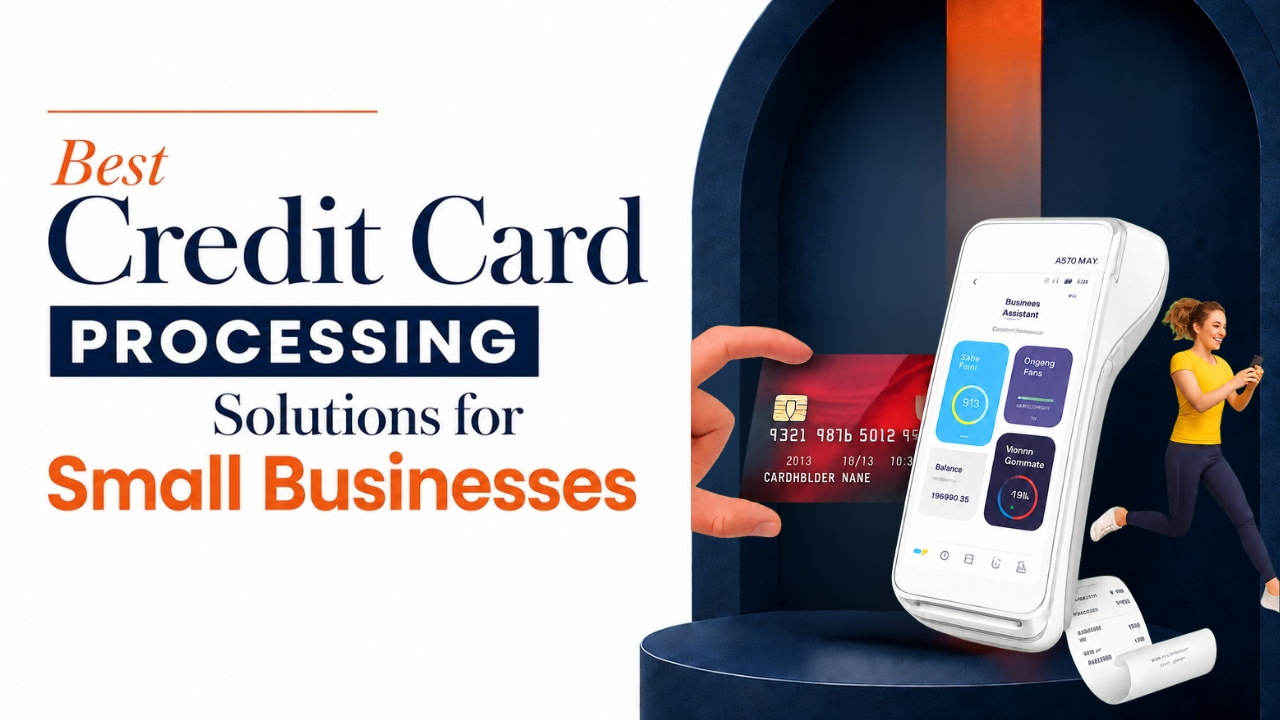
Choosing the best credit card processing solutions for small businesses is an important decision that business owners can make today.
As today, customers expect fast, secure, and convenient payment options, whether they shop in-store, online, or through mobile devices.
With a reliable credit card processing solution businesses can accept payments smoothly which improves customer satisfaction, increases sales, and simplifies daily operations.
With a lot of credit card processing companies being available, choosing the right provider can be challenging. While every solution has different pricing models, transaction fees, payment methods, security features, and business tools.
Where some providers offer low-cost payment processing, while other providers offer advanced features like point-of-sale(POS)systems, recurring billing, invoicing, inventory management, and detailed reporting.
Choosing the right payment processor for small businesses depends on industry, transaction volume, budget, and long-term growth plans.
The best credit credit card processing solutions provide secure payment features, which includes EMV chip card acceptance, contactless payments, mobile payment processing, digital wallets, and PCI DSS compliance to protect sensitive customer data.
Many modern platforms can be integrated into accounting software, eCommerce stores, and customer relationship management(CRM)systems, that help businesses to make operations smooth and improve efficiency.
Through this blog, we will walk you through the best credit card processing solutions for small businesses, compare their features, pricing, pros and cons, and explain features to consider before making a decision.
Whether you are running a retail store, restaurant, service-based business, or online shop, this detailed blog will help you choose a small business payment processing solution that offers secure transactions, competitive rates, and the flexibility required to support your business as it expands.
Also Read: How Credit Card Processing Works Step by Step
Why Small Businesses Need a Reliable Credit Card Processor
It is essential for small businesses to use a reliable credit card processor if they want to provide a smooth and secure payment experience to their customers.
As today’s customers expect businesses to offer different payment methods like credit cards, debit cards, contactless payments, and digital wallets.
So small businesses have to provide multiple payment options to customers which increases customer satisfaction, convenience, and also helps businesses to stay competitive in a highly digital market.
A dependable payment processor helps small businesses:
- Increase their sales by offering multiple payment options to customers
- Improving customer convenience by providing fast and flexible checkout
- Building customer trust through secure and reliable transactions
- Accepting online and mobile payments to reach more customers
- Reducing cash handling and reducing manual errors
- Speeding up the checkout process for a better customer experience
- Improving payment security with fraud protection and PCI compliance
- Supporting business growth with scalable payment solutions
Without having modern payment options, businesses have risks of losing customers to competitors that offer faster, safer, and more convenient ways to make payments.
Benefits of Credit Card Processing for Small Businesses
Using a credit card processing solution has many benefits that help small businesses to improve operations, increase revenue and provide a better customer experience.
advantages which help small businesses to improve operations, increase revenue, and deliver a better customer experience.
1. Faster Payment Processing
Online payments are processed faster than cash or cheques, which reduces checkout times for users and makes transactions smoother. While faster payments increase efficiency and improves the overall customer experience.
2. Higher Sales Opportunities
Often customers spend more when they make payments through credit cards or digital wallets. Accepting multiple payment methods increases average transaction values, and reduces lost sales due to limited payment options.
3. Better Customer Experience
Modern payment processors accept credit cards, debit cards, contactless payments, mobile wallets, online payments, and QR code payments. Providing flexible payment options increases customer convenience and encourages customers for repeat business.
4. Improved Cash Flow
Many payment providers deposit funds within one or two business days, while some payment providers provide same-day funding. When businesses have quick access to revenue helps them to manage expenses and maintain cash flow smoothly.
5. Enhanced Payment Security
Implementing advanced security features such as encryption, tokenization, fraud detection, secure payment gateways, and PCI DSS compliance helps to protect sensitive customer data and reduce the risks of fraud.
6. Easy Reporting and Business Insights
With built-in dashboards, businesses have access to sales reports, transaction history, refunds, chargebacks, and customer insights that help business owners to monitor their performance and make informed business decisions.
Also Read: Payment Processing Solutions for High-Risk Businesses
Key Features to Look for in a Credit Card Processing Solution
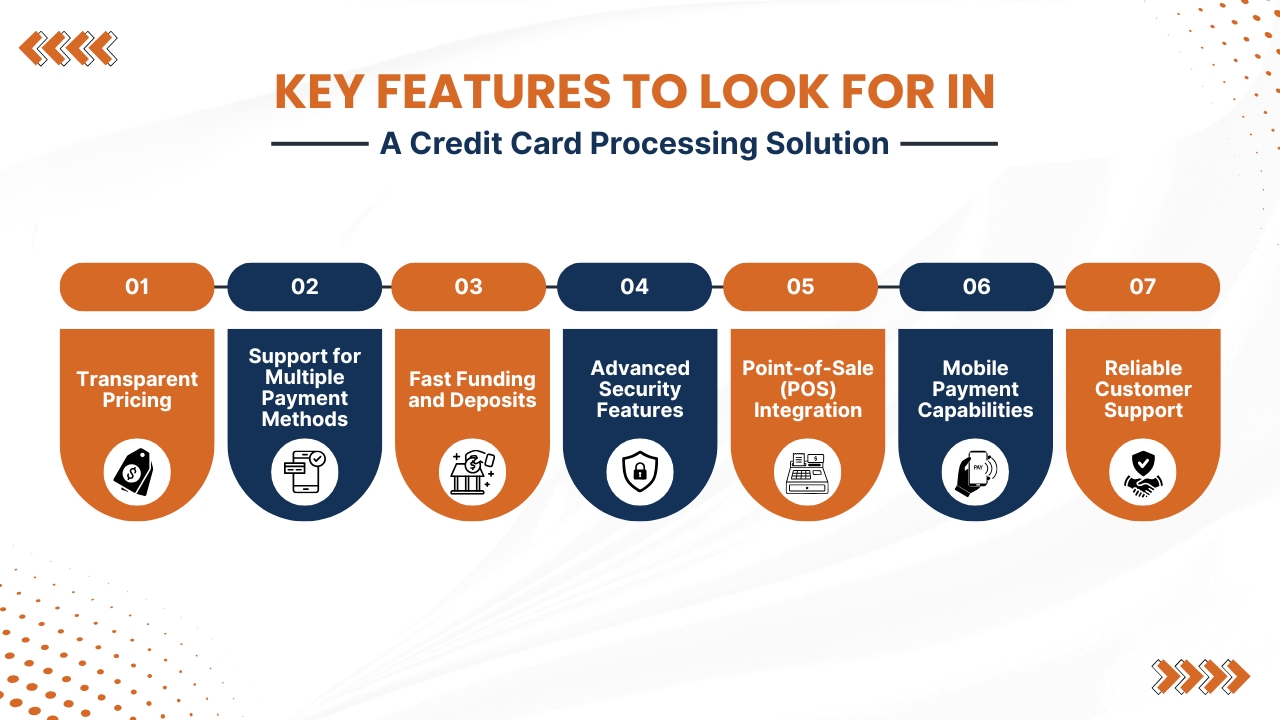
Choosing the right credit card processing solution needs more than comparing transaction fees. The best provider provides the features that your business needs today while supporting future growth.
1. Transparent Pricing
Select a provider that clearly explains all expenses before you sign up. Businesses must review monthly fees, transaction fees, PCI compliance fees, payment gateway fees, and early termination fees.
With such transparent pricing, small businesses can avoid unexpected charges and manage your budget more effectively.
2. Support for Multiple Payment Methods
A reliable processor should accept credit cards, debit cards, EMV chip cards, contactless payments, mobile wallets, online payments, and recurring billing.
Offering multiple payment options improves customer convenience and increases the chance of completed sales.
3. Fast Funding and Deposits
Small businesses must inquire about how fast payments are deposited into your business account. While some provide same-day funding, while others take one to three business days. While faster deposits improve cash flow and help to cover operating expenses more efficiently.
4. Advanced Security Features
It is essential to implement security features for secure customer payment details. Small businesses must search providers that offer PCI DSS compliance, end-to-end encryption, tokenization, fraud monitoring, and secure payment gateways to reduce the chances of fraud and data breaches.
5. Point-of-Sale (POS) Integration
Small businesses must select a processor that integrates with your POS system, inventory management software, accounting platforms, CRM tools, employee management systems, and eCommerce systems.
While smooth integration with existing systems reduces manual work, improves accuracy, and makes business operations smooth.
6. Mobile Payment Capabilities
Businesses without a traditional storefront should select a processor that supports mobile card readers, smartphone payments, and tablet-based POS systems.
While mobile payment solutions help small businesses to accept secure payments from anywhere.
7. Reliable Customer Support
There can be payment issues at any time, so it is essential for small businesses to have excellent customer service. Businesses must look for payment providers that provide 24/7 customer support, live chat, phone assistance, email support, and an online knowledge base which ensures that customer problems are quickly resolved and there are uninterrupted business operations.
Types of Credit Card Processing Solutions
Small businesses can choose from several credit card processing solutions, based on their business model, payment volume, and sales channels.
1. Traditional Merchant Account Providers
Traditional merchant account providers offer dedicated merchant accounts with customized pricing and advanced payment features. Such providers are suitable for established businesses with high monthly transaction volumes.
Important benefits include steady pricing, more scalability, advanced reporting, and access to dedicated account support, that makes a strong choice for growing businesses.
2. Payment Service Providers (PSPs)
Payment Service Providers(PSPs) simplify payment processing by letting multiple businesses share a single merchant platform.
Many popular payment service providers such as Stripe and Square allow quick setup, with no long-term contracts, easy online management, and flexible pricing that makes them ideal for startups and small businesses.
3. Mobile Payment Processors
Mobile payment processors are an excellent option for businesses that accept payments on the go, that includes food trucks, consultants, delivery services, and event vendors.
These processors work with smartphones, tablets, and portable card readers, which enables secure payments from virtually anywhere.
4. eCommerce Payment Processors
Online businesses rely on eCommerce payment processors that integrate smoothly with websites and shopping carts. These solutions support secure online checkout, recurring subscription billing, fraud protection, digital wallets, and international payments that provide a smooth and secure online shopping experience.
Also Read: Best Credit Card Processing Companies for Small Businesses
Common Credit Card Processing Fees
Understanding credit card processing fees helps small businesses to compare providers, estimate costs, and choose the most effective payment solution.
1. Interchange Fees
These fees are charged by the customer’s card-issuing bank for every transaction. Interchange fees may differ based on the card type, industry, transaction method, and risk level. As the fees are set by the card networks, they are generally non-negotiable.
2. Assessment Fees
Card networks like Visa and Mastercard charge assessment fees for processing transactions. Although these fees are usually small, they apply to every card payment and are included in the total processing cost.
3. Processor Markup
Payment processors charge a markup for handling transactions. Pricing models may include flat-rate pricing, percentage plus a fixed fee, interchange-plus pricing, or subscription-based pricing, based on the provider.
4. Monthly Service Fees
Some processors charge monthly fees for account maintenance, payment gateways, POS software, reporting tools, and additional business features. However, many modern providers offer basic plans with no monthly fee.
5. Chargeback Fees
When a customer disputes a transaction, then the business may be charged a chargeback fee. Selecting a processor with strong fraud prevention and security features help them to reduce chargebacks and protect your revenue.
Also Read: Credit Card Processing Fees: Complete Breakdown for Businesses
Best Credit Card Companies for Startups and Small Businesses
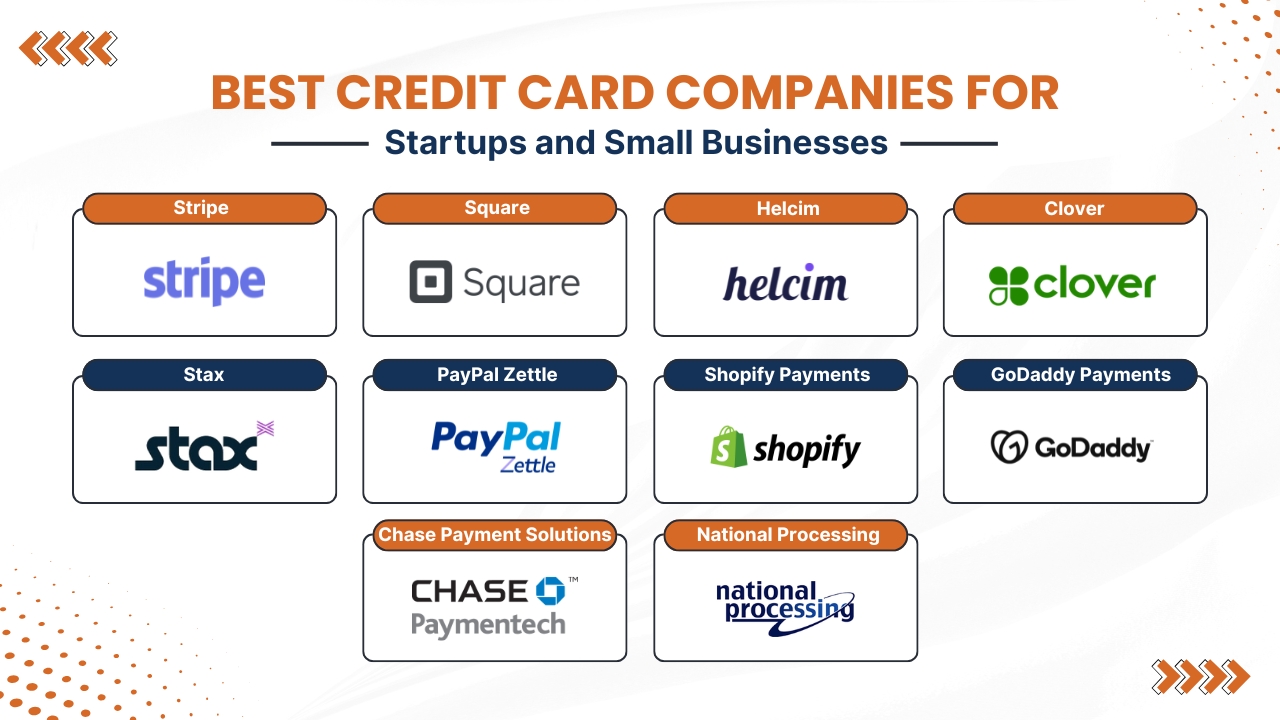
Choosing the best credit card processing solution for your small business is based on many factors like industry, monthly transaction volume, preferred pricing model, and the features that your businesses require.
Some providers specialize in online payments, while other providers provide complete point-of-sale(POS) systems, inventory management, and business reporting.
Below are ten of the best credit card processing solutions for small businesses, along with their important features, advantages, disadvantages.
1. Stripe
Stripe is one the best online payment processors for businesses that sell products or services online. It provides a customizable payment platform with powerful APIs that makes it a favorite payment solution among eCommerce stores, SaaS companies, subscription businesses, and digital markets.
This payment solution supports payments in more than 135 currencies and accepts important credit cards, debit cards, Apple Pay, Google Pay, and other digital wallets.
Key Features
- Global payment acceptance
- Recurring billing and subscription management
- Advanced fraud protection
- Custom checkout pages
- Detailed analytics and reporting
- International payment support
Pros
- Easy integration with websites and apps
- No monthly fee for the standard plan
- Excellent developer tools
- Highly scalable for growing businesses
Cons
- Can be challenging for non-technical users
- Limited in-person payment capabilities
- Chargeback management may require additional effort
Best For:
- Online stores
- SaaS companies
- subscription-based businesses
- digital product sellers.
2. Square
It is a payment solution among startups and local businesses due to its simple setup and affordable hardware. This payment solution combines payment processing, free POS software, and business management tools into a single platform.
Whether you are running a retail store, cafe, salon, or food truck, this payment solution provides an easy way to accept card and contactless payments.
Key Features
- Free POS software
- Inventory and employee management
- Customer loyalty programs
- Contactless and mobile payments
- Online store integration
- Affordable card readers
Pros
- Quick and easy setup
- No monthly fee for the basic plan
- User-friendly dashboard
- Ideal for first-time business owners
Cons
- Flat-rate pricing can become expensive for high-volume merchants
- Fewer customization options than some competitors
Best For:
- Retail stores
- restaurants
- cafes
- salons
- food trucks
- startups
3. Helcim
Helcim is well known for its transparent interchange-plus pricing. It is an excellent choice for businesses who are looking to reduce payment processing costs.
Unlike many providers, Helcim has no monthly fees or long-term contracts and instantly reduces rates when transaction volume increases.
Key Features
- Interchange-plus pricing
- Online payment gateway
- Virtual terminal
- Invoicing
- Subscription billing
- Inventory and customer management
Pros
- Transparent pricing structure
- Automatic volume discounts
- Excellent customer support
- No monthly or cancellation fees
Cons
- Better suited for businesses with moderate to high sales volumes
- Limited hardware options compared to larger providers
Best For:
- Growing businesses looking for lower long-term processing costs.
4. Clover
Clover offers payment processing with a powerful POS system that makes it an exceptional business management solution. It provides modern hardware, customizable software, and an app marketplace that allows businesses to expand functionalities when businesses grow.
Key Features
- Smart POS terminals
- Inventory management
- Employee scheduling
- Customer loyalty programs
- Gift card support
- Online ordering
- Sales reporting
Pros
- Modern and attractive hardware
- Flexible POS solutions
- Strong reporting and analytics
- Supports multiple industries
Cons
- Monthly software subscription fees
- Hardware can be costly
- Pricing varies by reseller
Best For:
- Restaurants
- retail stores
- hospitality businesses
- and service providers
5. Stax
It provides a subscription-based pricing model rather than charging higher percentage markups on every transaction. Businesses with large monthly payment volumes often save money through this pricing structure.
Key Features
- Membership-based pricing
- Payment gateway
- Virtual terminal
- Mobile payments
- ACH payment processing
- Invoicing
- Business analytics
Pros
- Lower costs for high-volume businesses
- Transparent pricing
- Excellent reporting tools
- No long-term contracts
Cons
- Monthly membership fee
- Not cost-effective for businesses with low transaction volumes
Best For:
- Businesses process high monthly payment volumes.
6. PayPal Zettle
It combines PayPal’s trusted payment platform with easy-to-use tools for in-person and online sales. Businesses can accept card payments, digital wallets, QR code payments, and send invoices from one account. Being a familiar brand also increases customer confidence during checkout.
Key Features
- Online checkout
- Mobile card readers
- QR code payments
- Digital wallet support
- Invoicing
- Buy Now, Pay Later options
- Business reporting
Pros
- Trusted global payment brand
- Quick account setup
- Supports international payments
- Simple checkout experience
Cons
- Some accounts may experience payment holds
- Processing fees may be higher than some competitors
Best For:
- Freelancers
- consultants
- online sellers
- and small retailers
7. Shopify Payments
It is built specifically for businesses using the Shopify eCommerce platform. Shopify Payments removes the need for third-party gateways and provides a smooth checkout experience for online shoppers. This platform also supports multi-currency payments and fraud protection.
Key Features
- Native Shopify integration
- Shop Pay support
- Fraud analysis
- Multi-currency payments
- Online and in-store payment processing
- Subscription support
Pros
- No additional gateway fees when using Shopify Payments
- Fast and simple setup
- Excellent eCommerce integration
- Streamlined checkout process
Cons
- Available only to Shopify merchants
- Limited flexibility outside the Shopify ecosystem
Best For:
- Businesses operating Shopify-based online stores.
8. GoDaddy Payments
It offers an affordable payment solution for businesses already using GoDaddy’s website builder or commerce platform. It also supports online and in-person payments and provides eligible merchants with same-day funding, helping improve cash flow.
Key Features
- Online payments
- Virtual terminal
- Mobile payment app
- Contactless payments
- Payment links
- Same-day funding for eligible users
Pros
- Competitive pricing
- Easy integration with GoDaddy websites
- Fast deposits
- Simple dashboard
Cons
- Fewer advanced features than larger competitors
- Best suited for businesses already using GoDaddy products
Best For:
- Small businesses with GoDaddy websites or online stores
9. Chase Payment Solutions
It combines merchant services with one of the largest financial institutions in the United States. Businesses benefit from secure payment processing, fraud protection, and a variety of payment acceptance options, which makes it suitable for companies who are looking for a traditional merchant account.
Key Features
- In-store payments
- Online payment processing
- Mobile payment support
- POS integration
- Fraud monitoring
- Business reporting
Pros
- Backed by a trusted financial institution
- Strong security and fraud protection
- Supports multiple payment channels
- Suitable for expanding businesses
Cons
- Pricing varies depending on business requirements
- Approval process may take longer than PSPs
Best For:
- Businesses seeking a full-service merchant account with banking support.
10. National Processing
It provides customized merchant accounts with competitive interchange-plus pricing and industry-specific payment solutions. It provides payment processing for retail, restaurants, healthcare, professional services, and eCommerce businesses while maintaining transparent pricing and responsive customer support.
Key Features
- Retail payment processing
- Restaurant payment solutions
- eCommerce payment support
- Mobile payments
- Virtual terminal
- ACH payment processing
Pros
- Transparent pricing
- Excellent customer support
- Industry-specific solutions
- No hidden fees
Cons
- Pricing depends on business type and processing volume
- Requires a merchant account application
Best For:
- Retail stores
- restaurants
- healthcare providers
- professional service firms
- businesses looking for customized payment processing solutions
Also Read: How Long Credit Card Transactions Take to Process: A Complete Guide for Businesses
Understanding Credit Card Processing Pricing Models
Choosing the right credit card processing pricing model can highly affect your business costs. The best option depends on your transaction volume, business size, and payment processing needs.
1. Flat-Rate Pricing
With flat-rate pricing, businesses pay the same fee for every transaction, regardless of the card type used. This model is simple, predictable, and easy to understand, making budgeting easier for new businesses. However, it can become more expensive as sales volume increases. This type of pricing is best for startups and small businesses with lower monthly transaction volumes.
2. Interchange-Plus Pricing
This model separates the interchange fee from the processor’s markup, providing greater pricing transparency. It often results in lower processing expenses for businesses with consistent sales, although monthly statements can be more detailed. This type of pricing is best for established businesses with moderate to high transaction volumes.
3. Tiered Pricing
Tiered pricing groups transactions into qualified, mid-qualified, and non-qualified categories, each with different rates. While commonly offered by traditional merchant account providers, it can be difficult to understand and predict overall expenses. This type of pricing is best for businesses familiar with their processor’s pricing structure.
4. Subscription (Membership) Pricing
Businesses pay a monthly membership fee plus a small markup above interchange expenses. This model provides transparent pricing and reduces transaction fees, making it cost-effective for companies with high payment volumes. This type of pricing is best for businesses processing a large number of transactions each month.
Conclusion
Choosing the best credit card processing solutions for small businesses is an important investment that can improve payment efficiency, customer satisfaction, and long-term growth.
The right payment processor should offer transparent pricing, strong security, flexible payment options, and seamless integration with your existing business tools.
Whether you operate a retail store, restaurant, online business, or service-based company, selecting a solution that matches your transaction volume and business needs can help reduce costs and streamline operations.
Before making a decision, compare pricing models, processing fees, funding times, customer support, and available features.
Providers such as Stripe, Square, Helcim, Clover, Stax, PayPal Zettle, Shopify Payments, GoDaddy Payments, Chase Payment Solutions, and National Processing each offer unique advantages for different business types.
By carefully evaluating your options, you can choose a reliable credit card processing solution that supports secure transactions, enhances the customer experience, and helps your small business grow with confidence.
If you have any query about Best Credit Card Processing Solutions for Small Businesses then you may book a free demo at AcePay and we are more than happy to assist you.