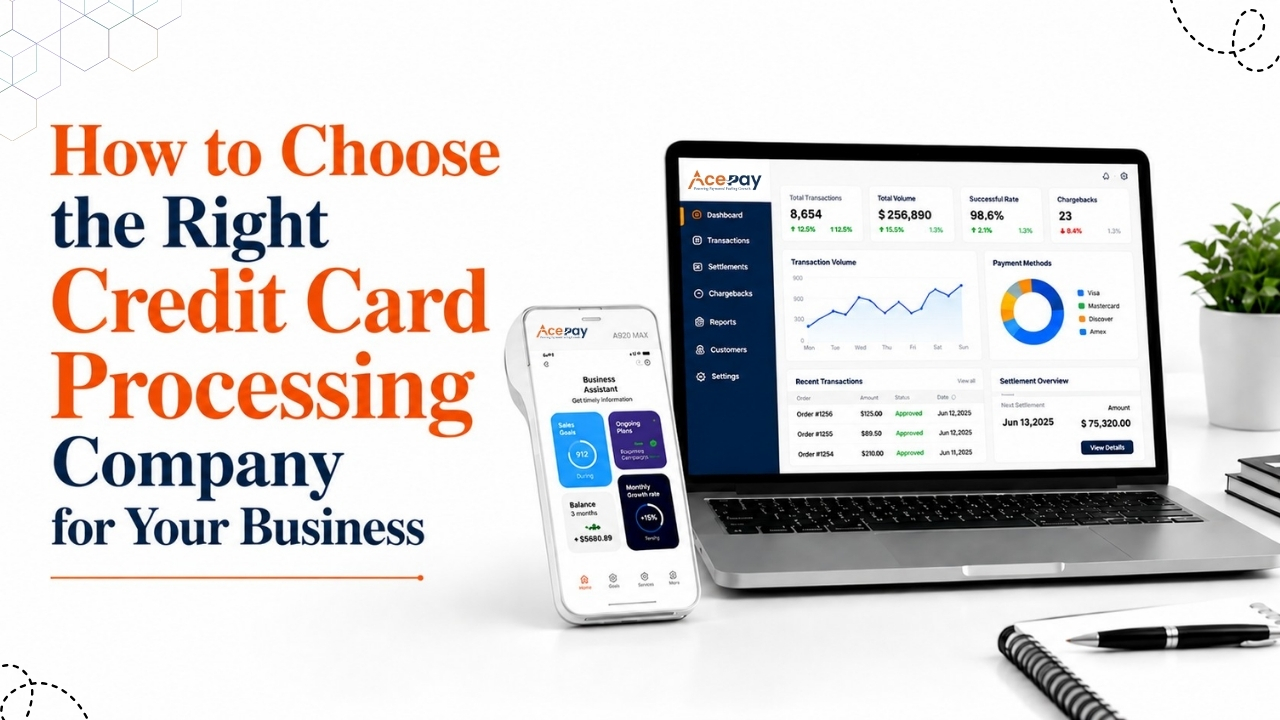
Choosing the right credit card processing company is a crucial decision for any business that accepts card payments. The processor you choose can directly affect your payment processing fees, transaction reliability, customer experience, security, and overall profitability.
With numerous providers providing different pricing models, contract terms, payment solutions, and support opinions, comparing them carefully is essential.
A suitable credit card processor should do more than process transactions. Businesses should evaluate factors like interchange fees, processor markups, monthly charges, PCI compliance, chargeback support, payment security, integration capabilities, funding speed, and customer service.
The right provider should also support the ways your customers prefer to pay, whether through in-store terminals, online checkout, mobile payments, or recurring billing.
Businesses should also consider their transaction volume, average ticket size, industry, sales channels, and future growth while comparing providers.
A pricing structure that works well for a small business may not be the most cost-effective option for a growing company with higher transaction volumes.
In this blog, you will learn how to choose the right credit card processing company for your business by comparing pricing, features, contracts, integrations, customer support, and scalability.
We will also discuss common processing fees, questions to ask providers, potential warnings, and how solutions like AcePay can fit into a business’s payment processing strategy.
What Is a Credit Card Processing Company?
A credit card processing company enables businesses to accept electronic payments from customers. This processing begins when a customer taps, inserts, swipes, or enters card information, then several components work together to authorize and complete the transaction.
The payment ecosystem can involve:
- The customer or cardholder
- The merchant
- The payment processor
- The acquiring bank
- The issuing bank
- The card network
- The payment gateway
- The POS system or payment terminal
The processor helps to transmit transaction information between the merchant, financial institutions, and card networks. For online transactions, a payment gateway securely transfers payment information from the checkout page to the processing system.
Although customers usually see a transaction completed within seconds, many processes like authorization, clearing, and settlement occur behind the scenes.
Understanding this process is important because the provider you choose can influence:
- Processing costs
- Payment acceptance
- Transaction reliability
- Funding speed
- Fraud protection
- Chargeback management
- Reporting
- Customer support
- POS integration
Therefore, choosing a processor should be treated as a crucial business decision instead of simply searching for the lowest processing rate.
Also Read: Payment Processing Solutions for High-Risk Businesses
Why Choosing the Right Credit Card Processor Matters
Payment processing affects more than your ability to accept cards. It can affect profitability, cash flow, operational efficiency, and customer satisfaction.
For instance, consider two businesses that each process $100,000 in card transactions every month. If one business pays a slightly higher advertised rate but has no unnecessarily monthly charges, while another pays a lower percentage combined with multiple additional fees, the second business may actually have the higher total processing expenses.
A processor can also affect the checkout experience. Unreliable terminals, declined transactions, connectivity problems, restricted payment options, and slow support can disrupt sales and can negatively affect the customer experience.
On the other hand, a well designed payment system can help businesses:
- To process transactions efficiently
- To accept multiple payment methods
- To reduce manual reconciliation
- To improve reporting
- To protect payment information
- To manage recurring payments
- To integrate with business software
- To improve customer convenience
The goal should therefore be to find a payment processing partner that balances cost, functionality, security, reliability, and support.
Also Read: How Credit Card Processing Works Step by Step
Key Factors to Consider When Choosing a Payment Processor
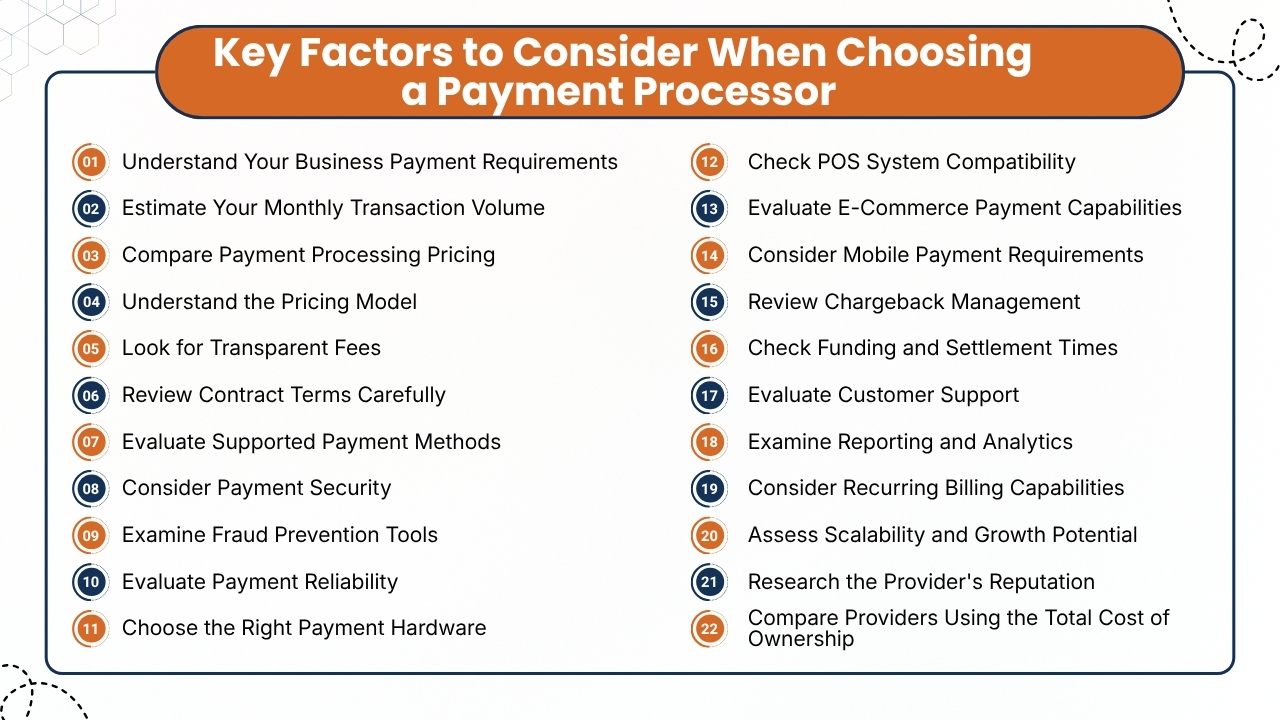
Choosing the right payment processing is a crucial decision for businesses that accept credit cards, debit cards, digital wallets, and other electronic payments.
The provider you choose can influence your processing expenses, payment reliability, customer experience, security, cash flow, and ability to grow.
A suitable provider should do more than process transactions. It should offer transparent pricing, reliable technology, appropriate payment methods, strong security, useful integrations, responsive support, and flexible services that align with your business model.
Before signing a contract, businesses should compare providers carefully and consider both current requirements and future growth. Below are some points that businesses can help to evaluate different payment processing companies and choose a solution that fits your business.
1. Understand Your Business Payment Requirements
The initial step while choosing the right credit card processing company for your business is to accept payments. Different businesses have different processing requirements, so there is no single payment solution that works equally well for everyone.
Consider whether you accept payments:
- In physical stores
- Through an e-commerce website
- By phone
- Through mobile devices
- Using invoices
- Through subscriptions
- Across multiple locations
- From international customers
Also evaluate your average transaction value, monthly processing volume, number of transactions, and expected growth. Understanding these requirements gives you a clear framework for comparing providers and avoids you from choosing a service based only on promotional pricing.
2. Estimate Your Monthly Transaction Volume
Transaction volume can highly affect the cost of payment processing. A business processing a few thousand dollars each month may have different needs from a company processing hundreds of thousands of dollars.
Before requesting quotes, calculate:
- Average monthly sales
- Average transaction value
- Number of monthly transactions
- Credit card volume
- Debit card volume
- Online transaction volume
- In-person transaction volume
Offering accurate information to processors helps them to give you more relevant pricing estimates. Businesses should also consider expected growth. A provider that works for your current volume should ideally remain competitive as transaction volume increases.
Also Read: Best Credit Card Processing Companies for Small Businesses
3. Compare Payment Processing Pricing
Pricing is one of the most crucial factors while selecting a payment processor. However, businesses should avoid comparing providers based only on the advertised percentage rate.
Payment processing costs can include:
- Interchange fees
- Assessment fees
- Processor markup
- Monthly fees
- Gateway fees
- Statement fees
- Batch fees
- PCI-related fees
- Chargeback fees
- Equipment costs
- Cancellation fees
Compare detailed pricing information from each provider before making a decision. A processor with a slightly higher transaction rate may actually cost less overall if it has fewer additional charges. Comparing the complete pricing structure gives you a more accurate view of the provider’s value.
4. Understand the Pricing Model
Payment processors may use different pricing models. Understanding the way each pricing model works can help businesses to identify the options that best align with their business.
Common pricing models include flat-rate pricing, interchange-plus pricing, tiered pricing, and membership pricing.
- Flat-rate pricing provides simple, predictable transaction costs, making it an attractive option for small businesses with straightforward payment processing needs.
- Interchange-plus pricing separates the underlying card expenses from the processor’s markup, which makes the pricing structure easier to examine.
- Tiered pricing groups transactions into different categories, but businesses should understand how transactions are classified.
Membership pricing may combine a recurring fee with lower transaction markups. Compare models based on your transaction volume, card mix, and business needs instead of choosing the model with the lowest advertised rate.
Also Read: Credit Card Processing Fees: Complete Breakdown for Businesses
5. Look for Transparent Fees
Transparent pricing makes it easier to calculate your actual processing expenses. If there are hidden or poorly explained fees can make an apparently inexpensive payment processor highly more expensive.
Ask providers to explain every fee before signing an agreement.
Pay particular attention to:
- Monthly minimums
- PCI compliance fees
- Gateway charges
- Statement fees
- Batch fees
- Annual fees
- Chargeback fees
- Early termination fees
- Equipment fees
If any fee is unclear, request a written explanation before agreeing to the terms. A reputable provider should offer a clear pricing breakdown and explain how each fee is calculated before you sign up.
6. Review Contract Terms Carefully
Businesses must review the payment processing agreement carefully before signing. They must pay attention to contract length, cancellation policies, renewal terms, termination fees, and other conditions that may affect future expenses.
Look for:
- Contract length
- Automatic renewal
- Cancellation requirements
- Early termination fees
- Equipment obligations
- Monthly minimums
- Rate-change provisions
- Notice periods
Some payment processors provide flexible month-to-month agreements, while other providers require longer-term commitments. Businesses before signing, must consider their business’s growth plans, expected transaction volume, changing payment requirements, and the potential expenses of switching providers in the future.
Also Read: How Long Credit Card Transactions Take to Process: A Complete Guide for Businesses
7. Evaluate Supported Payment Methods
Today more customers increasingly expect businesses to offer convenient payment options.
Based on your industry, your processor may need to support:
- Credit cards
- Debit cards
- Contactless payments
- Mobile wallets
- Digital wallets
- ACH payments
- Recurring payments
- Online payments
- Alternative payment methods
For e-commerce businesses, supporting multiple digital payment methods can make checkout more convenient. For physical businesses, contactless and mobile wallet acceptance can improve the customer experience.
Choose a provider that supports the payment methods that their customers use today while allowing them to add new options in the future.
8. Consider Payment Security
Payment security should be a major priority while choosing a provider. Businesses process sensitive payment information and need systems that help to protect transactions and customer data.
Important security capabilities may include:
- PCI DSS compliance support
- Encryption
- Tokenization
- Secure authentication
- Card verification
- Address verification
- Fraud monitoring
Ask the provider which security measures it handles and what responsibilities remain with your business. Strong payment security helps to reduce fraud risks, protect customer information, and maintain customer trust throughout the checkout process.
Also Read: Best Credit Card Processing Solutions for Small Businesses
9. Examine Fraud Prevention Tools
Fraud transactions can cause financial losses, chargebacks, and operational disruptions. Choose a payment processor that provides effective fraud detection tools to find suspicious transactions, reduce potential risks, and protect your business from avoidable payment-related losses.
Based on the provider, these may include:
- Transaction monitoring
- Risk scoring
- Fraud filters
- Velocity checks
- Card verification
- Address verification
- 3-D Secure authentication
Businesses should understand the way fraud prevention tools operate and whether they can be customized. Effective fraud detection should identify suspicious transactions accurately while reducing unnecessary declines, ensuring legitimate customers can complete payments smoothly.
10. Evaluate Payment Reliability
Payment reliability directly impacts revenue because technical payment failures can cause lost sales, frustrate customers, disrupt checkout, and negatively affect the overall customer experience.
Evaluate the processor’s:
- System reliability
- Transaction processing infrastructure
- Terminal performance
- Connectivity options
- Error handling
- Backup capabilities
- Monitoring systems
Physical businesses should consider whether terminals can maintain reliable connectivity. Online businesses should evaluate the reliability of the payment gateway and checkout infrastructure.
A dependable payment processing system should reduce unnecessary interruptions and provide clear support when problems happen.
11. Choose the Right Payment Hardware
Businesses accepting in-person card payments should choose reliable terminals and card readers that support their preferred payment methods, customer needs, and transaction requirements.
Hardware options may include:
- Countertop terminals
- Mobile card readers
- Wireless terminals
- Smart POS devices
- Contactless terminals
When comparing hardware, consider:
- Purchase price
- Rental costs
- Warranty
- Replacement policy
- Software compatibility
- Connectivity
- Contactless support
The cheapest terminal is not always the best option. Businesses should choose equipment that is reliable, easy for employees to operate, and appropriate for their environment.
Also Read: How Businesses Accept Credit Card Payments Online
12. Check POS System Compatibility
Your payment processor should work effectively with your existing point-of-sale(POS)system. Integration can help businesses to automatically synchronize transaction information with their POS and other operational systems.
Check whether the provider integrates with:
- POS software
- Accounting platforms
- Inventory systems
- E-commerce platforms
- CRM systems
- Booking software
- Subscription platforms
Strong integrations can reduce manual data entry, reduce errors, and make financial reconciliation easier. Before signing up, confirm that the processor is compatible with the exact software and hardware your business uses.
13. Evaluate E-Commerce Payment Capabilities
If your business sells online, the payment gateway is an important part of the customer experience, helping to process transactions securely while offering a smooth, convenient, and reliable checkout process.
Look for features such as:
- Secure online checkout
- Mobile-friendly payments
- Multiple payment methods
- Saved payment options
- Recurring billing
- Refund processing
- Fraud prevention
- Transaction reporting
The checkout process should be simple and intuitive. If there are complicated forms, limited payment options, or errors can cause friction and lead to cart abandonment, so it is essential for businesses to test the experience across mobile and desktop devices.
14. Consider Mobile Payment Requirements
Mobile payment solutions are especially valuable for businesses operating at events, markets, customer locations, or other mobile settings where traditional payment terminals may not be practical.
Mobile processing may require:
- Portable card readers
- Wireless terminals
- Smartphone compatibility
- Tablet compatibility
- Mobile wallets
- Reliable wireless connectivity
A mobile payment solution should be easy for employees to set up and use. Businesses should consider offline payment capabilities during temporary connectivity issues.
Implementing flexible payment technology can help businesses to accept transactions securely and conveniently across events, markets, customer locations, and other mobile environments.
Also Read: QuickBooks Credit Card Processing: Features and Alternatives
15. Review Chargeback Management
Chargebacks happen when customers dispute transactions through their card issuer. Managing disputes can consume time and create additional expenses.
Ask providers whether they offer:
- Chargeback alerts
- Dispute management tools
- Documentation support
- Transaction records
- Dispute tracking
- Chargeback reporting
Businesses should also understand the processor’s chargeback fees and dispute procedures. If your business experiences frequent disputes, examine the reasons carefully. Repeated chargebacks may indicate problems with billing descriptions, customer service, product delivery, or transaction processes.
16. Check Funding and Settlement Times
Businesses that need predictable access to their sales revenue. Therefore, settlement and funding times should also be considered before choosing a processor.
Ask:
- When are funds deposited?
- Are weekends included?
- Are holidays treated differently?
- Can funding be delayed?
- Are reserves required?
- Under what circumstances can funds be held?
Predictable funding is particularly essential for small businesses managing payroll, inventory, rent, and supplier payments.
Before opening an account, businesses should ensure the processor clearly explains its settlement schedule, funding timelines, and any conditions that could affect when funds become available.
17. Evaluate Customer Support
Having reliable customer support is essential during payment issues, transaction failures, or technical problems affecting daily business operations.
Before choosing a payment processor, businesses should evaluate the available customer support channels and understand how quickly assistance is provided to customers.
Consider whether the provider offers:
- Phone support: to resolve urgent payment problems
- Email support: to resolve account-related queries
- Live chat: to provide quick assistance
- Technical support : during integration and system problems
- Knowledge bases : during self-service troubleshooting
- Dedicated account representatives: for providing ongoing guidance to customers.
- Extended support hours: During evenings or weekends.
Businesses should also ask about usual response and resolution times. Companies operating outside standard business hours should confirm whether customer support is available during evenings, weekends, and holidays.
A processor may offer advanced payment technology, but responsive and knowledgeable customer support can make it much easier to resolve unexpected problems quickly.
Also Read: Mobile Credit Card Processing Guide for Field Businesses
18. Examine Reporting and Analytics
Payment reporting and analytics can give businesses a clearer understanding of transaction activity, sales performance, and overall payment patterns.
Detailed reporting can also simplify reconciliation and help restaurant managers to identify unusual transactions or changes that may require attention.
Useful reporting features may include:
- Transaction summaries to review payment activity
- Sales reports to monitor revenue performance
- Refund reports to track returned payments
- Chargeback reports to monitor disputes
- Settlement reports to reconcile deposited funds
- Payment method reports to compare transaction types
- Location reports to evaluate individual business locations
- Employee reports to monitor transaction activity
Businesses should also consider whether they are able to access reports easily, customize, export, and understand. Companies operating in multiple locations should look for centralized reporting that allows managers to compare locations, sales channels, and payment performance from one system.
19. Consider Recurring Billing Capabilities
Businesses that operate subscription or membership models require payment processing features which are specifically designed for recurring transactions.
Recurring billing functionality may include:
- Automatic payments
- Subscription management
- Scheduled billing
- Payment reminders
- Expired card updates
- Failed payment recovery
- Customer billing portals
Reliable recurring billing can reduce admin work and make it easier to maintain predictable revenue. Before choosing a provider, confirm whether recurring payments are supported and understand the associated expenses.
20. Assess Scalability and Growth Potential
Your payment requirements may change as your business grows. Therefore, select a provider that can support increasing transaction volumes and growing operations.
Consider whether the provider can support:
- More transactions
- Additional locations
- New payment methods
- E-commerce growth
- Mobile payments
- Subscription services
- International customers
- Omnichannel payments
Every time changing payment processors when your business expands can create unnecessary expenses and operational disruption. A scalable provider should be able to grow alongside your business.
21. Research the Provider’s Reputation
Before choosing a decision, research the provider’s reputation among merchants and customers.
Look for recurring comments about:
- Customer service
- Billing practices
- Unexpected fees
- Account holds
- Funding delays
- Technical problems
- Contract issues
- Cancellation experiences
While evaluating a payment processor, businesses cannot depend on a single review. Rather they must look for consistent patterns across multiple sources and ask other businesses about their experiences.
A provider’s reputation can show potential issues that may not be apparent from marketing materials.
22. Compare Providers Using the Total Cost of Ownership
Businesses should evaluate the total cost of ownership(TCO) while comparing payment processing providers instead of focusing only on advertised transaction rates.
A provider with lower processing fees may still be more expensive if it includes additional charges or requires costly equipment and services.
Consider the following costs:
- Processing fees: It includes charges applied to each transaction
- Monthly fees: It includes recurring account or service charges
- Equipment costs: It includes costs for terminals and card readers
- Gateway costs: It includes fees for online payment processing
- Additional charges: It includes setup, statement, PCI, or other applicable fees
Businesses should also consider indirect costs, including:
- Manual reconciliation
- Payment failures
- System downtime
- Poor integrations
- Chargeback management
- Employee training
A provider with slightly higher processing rates may provide better overall value if it provides reliable technology, reduces admin work, and improves operational efficiency. Comparing total cost ownership offers a more realistic view of the solution’s long-term financial impact.
Also Read: Small Business Credit Card Processing: Everything Business Owners Need to Know
How to Choose the Right Processor for Different Business Sizes
1. Small Businesses
Small businesses often benefit from payment processors that are simple, affordable, and easy to manage.
Key priorities of small businesses include:
- Simple and transparent pricing
- Affordable payment equipment
- Easy setup and user-friendly software
- Reliable customer support
- Basic reporting features
A straightforward solution may offer better value than complex Enterprise Merchant Solutions.
2. Growing Businesses
As businesses expand, their payment needs usually become more sophisticated. Growing companies may require:
- Advanced reporting and analytics
- Stronger integrations
- Recurring billing capabilities
- Multiple payment channels
- Improved fraud controls
- Scalable POS systems
Flexibility and scalability become highly crucial as transaction volumes and operational requirements increase.
3. Large Businesses
Large organizations often require customized payment solutions designed for complex operations. Important considerations include:
- Multi-location support
- Enterprise integrations
- High-volume transaction processing
- Advanced security and analytics
- Dedicated account management
- Customized reporting
- Negotiated pricing
Larger businesses should compare providers based on transaction volume, operational requirements, and long-term requirements.
Conclusion
Choosing the right credit card processing company can have an important effect on business expenses, payment reliability, customer experience, and long-term growth.
The decision should start with a clear understanding of your transaction volume, payment methods, technology requirements, and business goals.
They must compare pricing models, total fees, contract terms, security features, POS integrations, payment gateways, funding speed, customer support, reporting, and scalability.
Businesses must not focus only on the lowest advertised processing rate. A transparent provider with reliable technology and strong support may provide more value than a cheaper transparent provider option with complicated fees or restrictive contract terms.
Businesses should request written proposals from multiple providers, analyze their existing processing statements, calculate total costs, and test technology before making a final decision.
AcePay is one provider merchants can consider alongside other payment-processing companies, including options within the Payment Processing Franchise market. Its current offering includes payment processing, EMV terminals, POS systems, gateway capabilities, reporting, fraud protection, and recurring billing tools.
Whether you choose AcePay or another processor, the most important objective is the same which is to select a payment processing partner that provides transparent costs, secure transactions, reliable technology, strong customer support, and the flexibility to grow with your business.
If you still have any query about how to choose the right credit card processing company for your business then you may book a free demo at AcePay and we are more than happy to assist you.