In today’s quickly changing service economy, customers expect businesses to accept secure, fast, and convenient payments whenever services are delivered.
Whether you are a contractor, plumber, electrician, HVAC technician, landscaper, delivery professional, or mobile healthcare provider, it is essential to have a reliable mobile credit card processing solution which is no longer optional instead it is essential for better customer satisfaction and increasing cash flow.
With the right mobile payment processing system, field businesses can accept credit card payments, debit card payments, contactless payments, and digital wallets, directly from their smartphone, tablet, or
mobile credit reader, and thereby removing the need for paper invoices and chances of delayed payments.
Modern mobile payment solutions do more than just process transactions. These solutions can be integrated with mobile POS systems, invoicing software, customer management tools, inventory tracking, and reporting dashboards which make daily operations smooth and improve business efficiency.
It allows technicians to collect payments on-site, through which businesses can produce excellent invoices, improve cash flow, and provide a faster and more professional customer experience.
Choosing the right provider is equally crucial. AcePay provides a detailed mobile credit card processing solution which is designed to help field businesses to accept secure payments anytime, anywhere.
With support for EMV chip cards, Tap to Pay, Apple Pay, Google Pay, recurring billing, digital invoicing, and advanced payment security, AcePay allows businesses to simplify payment collection while protecting sensitive customer data.
This Mobile Credit Card Processing Guide for Field Businesses to explore everything that you need to know about choosing the best mobile payment processing solution in 2026.
You will learn about how mobile merchant services work, the important features to look for, pricing models, payment security, industry-specific benefits, and practical tips for choosing the right platform.
Whether you are running a small business owner or managing a growing field service team, this blog will help you make informed decisions and maximize the value of mobile credit card processing for your business.
Also Read: How Credit Card Processing Works Step by Step
What Is Mobile Credit Card Processing?
Mobile credit card processing is a payment technology that allows businesses to accept credit and debit card payments through a smartphone, tablet, or portable card reader instead of a traditional payment terminal.
It enables field businesses to secure transactions virtually from anywhere if they have a Wi-Fi or internet connection on mobile phones, which makes it a good option for contractors, delivery services, home repair professionals, and other mobile service providers.
As it allows businesses to accept payments on-site, helps businesses to improve cash flow, reduce delays due to invoicing, and provide customers with a faster and more convenient payment experience.
A typical mobile credit card processing system includes:
- Mobile payment application for processing transactions
- Portable card reader : which accepts chip, swipe, and contactless payments
- Smartphone or tablet to run the payment app
- Internet connection (Wi-Fi or cellular) for secure transaction processing
- Payment processor to authorize and complete transactions
- Merchant account to securely receive customer payments
Altogether these components enable fast, secure, and reliable payment processing whenever business takes place.
How Mobile Credit Card Processing Works
Mobile credit card processing enables field businesses to accept secure payments quickly and efficiently. Though the transaction only takes a few seconds, several important steps happen behind the scenes to authorize, process, and settle the payment.
1. Customer Selects a Payment Method
The process starts when the customers choose their preferred payment option. Modern mobile payment systems support many payment methods such as credit cards, debit cards, EMV chip cards, contactless cards, and digital wallets such as Apple Pay, Google Pay, and Samsung Wallet.
Most businesses also support Tap-to-Pay solutions that allow customers to complete transactions by tapping their card or mobile phones.
2. Payment Data Is Encrypted
Once the customer taps, inserts, or swipes their card, then the mobile card reader encrypts the customer payment details and then sends it through a secure network.
Such encryption protects sensitive cardholder data from unauthorized access that helps to ensure that every transaction remains secure.
3. Authorization and Verification
Then the encrypted payment request is sent to the payment processor, which forwards it to the customer’s issuing bank. The bank then verifies the card’s validity, checks available funds, performs fraud detection, and completes security verification. If all checks are successful, then the transaction is approved within seconds.
4. Payment Confirmation
Once approved, then the customer receives instant confirmation about this transaction. The business may instantly email or text a digital receipt, print a receipt if required, update customer records, and close the service order rather than waiting for manual payment processing.
5. Settlement and Fund Deposit
The approved transaction is settled through the payment network, and then the funds are transferred to the business’s merchant account. Based on the payment provider, businesses may receive their funds through same-day or next-day deposits, which improves cash flow and simplifies financial management.
Also Read: Credit Card Processing Fees: Complete Breakdown for Businesses
Why Mobile Credit Card Processing Matters for Field Businesses
Field businesses like contractors, plumbers, electricians, HVAC technicians, landscapers, and delivery services work directly at customer locations instead in traditional retail stores.
It creates unique payment challenges, such as businesses often depend on paper invoices, cash checks, or bank transfers. These payment methods can delay cash flow, increase admin work, and need additional followups to collect outstanding payments.
While mobile credit card processing helps to overcome these challenges by allowing businesses to accept secure payments instantly after completing a job. Key benefits include:
- Instant on-site payment collection
- Reduced dependence on paper invoices and checks
- Faster cash flow and improved working capital
- Lower administrative and collection efforts
- Enhanced customer convenience with multiple payment options
- A more professional and efficient payment experience
Industries That Benefit from Mobile Credit Card Processing
Mobile credit card processing is an important solution for businesses that provide services beyond a traditional storefront. Accepting secure payments on-site, businesses can improve cash flow, reduce invoicing delays, and improve customer convenience.
Below are some of the industries that benefit the most from mobile payment processing.
1. Home Contractors
General contractors can accept deposits before beginning a project and collect the remaining balance instantly after completing the work. This reduces chances of payment delays and improves cash flow.
2. HVAC Companies
This allows HVAC technicians to process payments on-site after installing or repairing heating and cooling systems. This removes the need to send invoices and speeds up payment collection.
3. Electricians
Electricians often provide emergency repair services where instant payment is expected. While mobile credit card processing allows them to accept secure payments before leaving the customer’s property.
4. Plumbers
It allows plumbers to instantly collect payments after completing repairs or installation and thereby offering a smoother customer experience.
5. Landscaping Businesses
Landscaping professionals frequently visit multiple client locations each day. Mobile payment solutions simplify billing, which makes it easy to accept payments after every service.
Also Read: Best Credit Card Processing Companies for Small Businesses
6. Cleaning Services
Residential and commercial cleaning companies can process one-time payments or set up recurring billing for regular customers which improves payment consistency and reduces admin work.
7. Pest Control Companies
Pest control providers offering scheduled maintenance plans can automate recurring payments, ensuring that there are timely collections and reducing manual invoicing.
8. Mobile Mechanics
Mobile mechanics perform vehicle repairs at homes, workplaces, or roadside locations. With portable payment systems allow customers to pay instantly after the service is completed.
9. Delivery Businesses
Courier and delivery companies can securely accept card payments upon delivery, providing customers greater payment flexibility while reducing cash handling.
10. Healthcare Professionals
Home healthcare providers, mobile clinics, and other healthcare professionals can securely process patient payments on-site. Mobile payment processing improves convenience, improves the patient experience, and ensures faster payment collection while maintaining secure transactions.
Benefits of Mobile Credit Card Processing
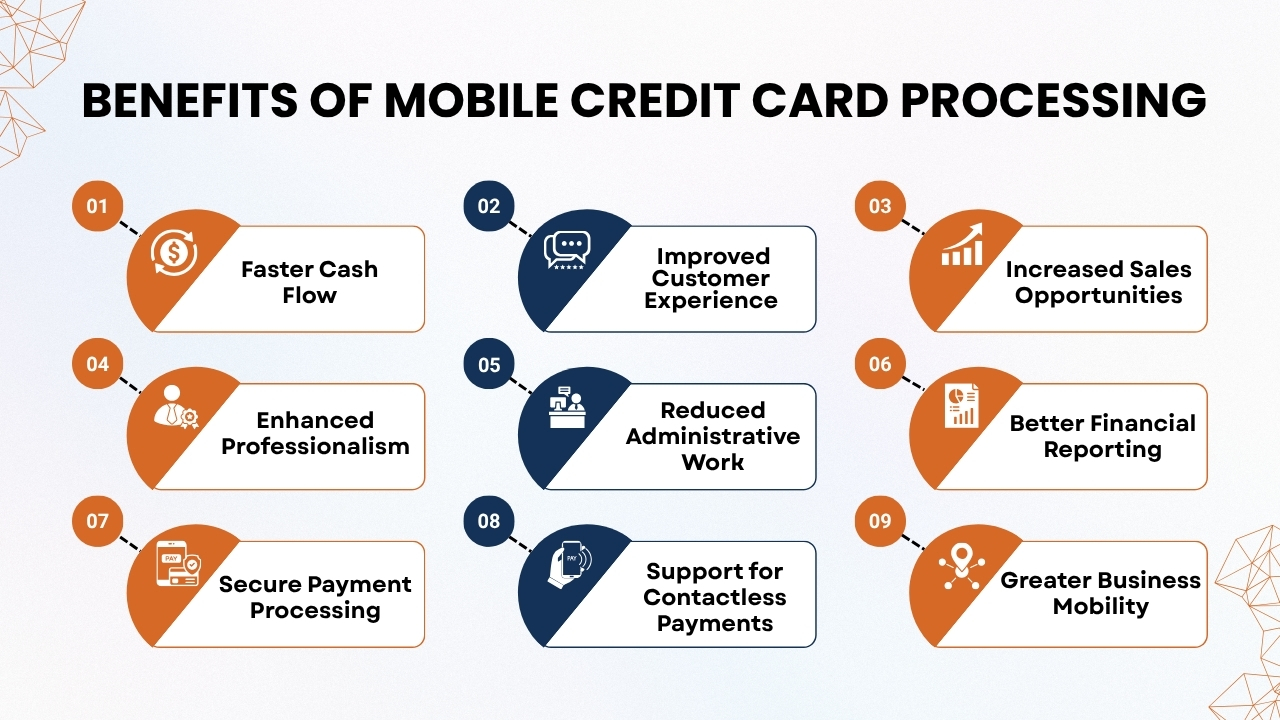
Mobile credit card processing offers more than just the ability to accept payments on the go. This helps field businesses to improve operational efficiency, improve customer relationships, and maintain profitable cash flow.
Below are the key benefits of using a mobile payment solution.
1. Faster Cash Flow
One of the biggest benefits of mobile credit card processing is it gives faster access to revenue. This lets businesses not wait for days or weeks for customers to pay invoices, rather collect payments quickly after completing a service.
Faster payments improve cash flow, which makes it easier to cover payroll, purchase inventory, and manage everyday operating expenses.
2. Improved Customer Experience
Customers today expect their payment options to be convenient and flexible. Mobile payment solutions enable businesses to accept credit cards, debit cards, Tap-to-pay, contactless payments, Apple Pay, Google Pay, and other digital wallets.
Offering multiple payment options increases customer convenience, and gives them a smoother checkout experience, and also increases the number of repeat business.
3. Increased Sales Opportunities
Often customers that spend more while paying with cards rather than cash. By accepting multiple payment methods, businesses can increase average transaction values, encourage upselling, and reduce lost sales due to limited payment options. A smooth payment experience also helps to improve customer retention and long-term loyalty.
4. Enhanced Professionalism
Using a modern mobile payment system builds a professional image for your business. As customers receive instant payment confirmations and digital receipts rather than handwritten invoices or delayed billing. It shows efficiency, builds trust, and improves your company’s reputation.
5. Reduced Administrative Work
Traditional invoicing needs printing, mailing, tracking payments, sending reminders, and manually updating financial records. Mobile payment platforms automate most of these tasks through digital invoicing, electronic receipts, automated payment tracking, and accounting software integration which saves time and reduces admin mistakes.
Also Read: Best Credit Card Processing Solutions for Small Businesses
6. Better Financial Reporting
Most mobile payment solutions include real-time dashboards which provide valuable business insights. Business owners can track daily sales, weekly revenue, monthly transaction summaries, refund history, tax reports, and payment patterns.
Having access to accurate financial data helps businesses to make informed decisions and improve overall financial management.
7. Secure Payment Processing
Security is an important feature of modern mobile payment systems. Implementing advanced technologies like end-to-end encryption, tokenization, EMV chip processing, fraud detection, and PCI DSS compliance that helps to protect sensitive customer payment information. These security measures reduce fraud risks while also increasing trust of customers.
8. Support for Contactless Payments
Contactless payments keep gaining popularity as they are fast, secure, and convenient. While mobile payment systems support contactless cards, Apple Pay, Google Pay, and Tap-to-Pay smartphones, which allows businesses to meet changing customer preferences and offer quicker checkout experiences.
9. Greater Business Mobility
Field businesses operate in different locations which include customer homes, construction sites, outdoor events, and temporary workspaces. Mobile credit card processing allows businesses to accept secure payments virtually anywhere with a Wi-Fi or cellular connection.
This flexibility improves productivity, shortens payment cycles, and enables businesses to deliver exceptional service without being connected to a physical payment terminal.
Key Features to Look for in a Mobile Credit Card Processing Solution
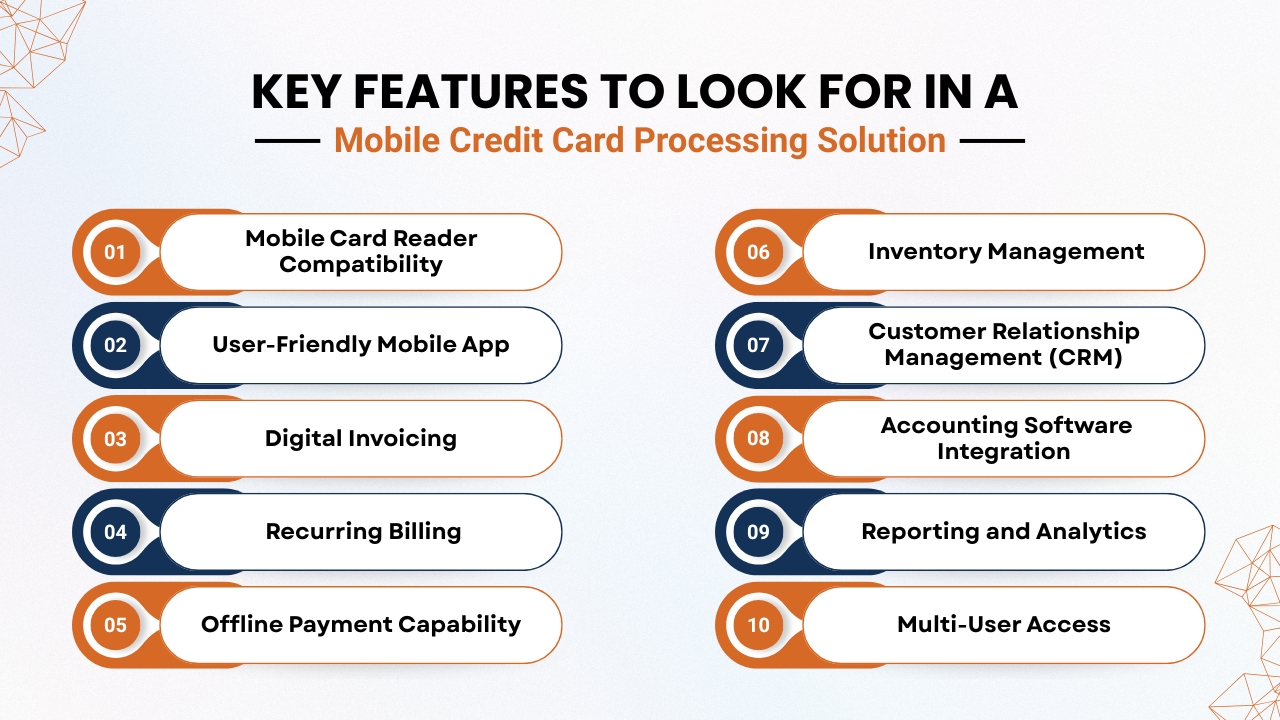
Choosing the right mobile credit card processing solution is essential for improving efficiency, improving customer satisfaction, and supporting business growth.
The best platforms offer more than payment acceptance which include features that smooth operations and simplify business management.
1. Mobile Card Reader Compatibility
Choose a mobile card reader that supports EMV chip cards, magnetic stripe cards, contactless (NFC) payments, Apple Pay, Google Pay, and Samsung Wallet. Because accepting payment options provides more convenience to customers and reduces lost sales.
2. User-Friendly Mobile App
Having a simple and user-friendly mobile app helps employees to process payments, issue refunds, send digital receipts, apply discounts, and monitor daily sales and thereby improving efficiency in the field businesses.
3. Digital Invoicing
They must search for a solution that allows them to create professional invoices, send payment links, automate payment reminders, and track invoice status. While digital invoicing makes payment collection instant and also reduces paperwork.
4. Recurring Billing
Recurring billing is an ideal solution for businesses that offer maintenance contracts or subscription-based services. It automates scheduled payments, improves cash flow, and reduces manual billing tasks.
5. Offline Payment Capability
For businesses that are operating in remote areas or locations with poor internet connectivity, offline payment functionality allows transactions to be securely stored and processed once the connection is restored.
6. Inventory Management
Integrated inventory management instantly updates stock levels after each sale, which makes it easier to track products like plumbing supplies, HVAC parts, electrical components, and cleaning materials.
Also Read: How Long Credit Card Transactions Take to Process: A Complete Guide for Businesses
7. Customer Relationship Management (CRM)
Having built-in CRM features helps businesses to manage customer profiles, purchase history, service records, saved payment methods, and loyalty programs that enables them to offer personalized customer service.
8. Accounting Software Integration
They must smoothly integrate with accounting software such as QuickBooks, Xero, FreshBooks, and Sage, reducing the need for manually entering data and simplified bookkeeping and financial reporting.
9. Reporting and Analytics
Detailed reporting dashboards give insights into daily sales, monthly revenue, average transaction values, employee performance, refund trends, and top-selling services that support better business decisions.
10. Multi-User Access
Businesses with multiple technicians should select a platform that provides role-based access. This lets administrators assign permissions, track transactions, track employee sales, and generate performance reports while maintaining security and accountability.
Types of Mobile Credit Card Readers
Choosing the right mobile credit card reader is essential for offering secure, fast, and convenient payment experiences. Different types of readers are designed to meet the requirements of various field businesses, based on transaction volume, mobility, and payment preferences.
1. Swipe Readers
It is one of the most affordable and portable payment devices. They read the magnetic stripe on payment cards and are easy to set up and use. Although they are cost-effective, they offer lower security than newer technologies and are becoming less common as chip and contactless payments gain popularity.
2. EMV Chip Readers
It processes payments using the embedded microchip found in modern credit and debit cards. It provides more protection against fraud, supports PCI compliance, and increases customer trust by providing a more secure payment method.
3. Contactless (NFC) Readers
These readers allow customers to complete transactions by either tapping a contactless card or mobile phones.It supports Apple Pay, Google Pay, Samsung Wallet, and contactless credit cards, providing quick, secure, and more convenient checkout experience.
4. Bluetooth Mobile Readers
These readers can be connected wirelessly to smartphones or tablets, offering good portability, design, easy setup, and long battery life. It is a good option for technicians and service professionals who navigate between several job sites.
5. Smart Mobile POS Devices
These devices combine payment processing with advanced business features like inventory management, receipt printing, barcode scanning, customer management, and reporting. These are all-in-one handheld terminals which are ideal for businesses who are looking for a complete portable point-of-sale solution.
Understanding Mobile Credit Card Processing Fees
Before selecting a mobile credit card processing provider, it is essential to understand the different fees that may affect your overall expenses. Comparing pricing structures helps businesses to select a solution that fits their budget and payment volume.
1. Transaction Fees
Most payment processors charge a percentage of each transaction along with a fixed fee. Common pricing models are flat-rate, interchange-plus, and tiered pricing.
Businesses have to choose the model that best suits their average transaction size and monthly sales volume.
2. Monthly Fees
Some providers charge monthly subscription fees which include reporting tools, customer support, software updates, and additional business features. They compare these costs with the value of the services included.
3. Hardware Costs
Businesses may need to purchase mobile card readers, portable payment terminals, receipt printers, or accessories. Some providers include hardware with qualifying plans.
4. Chargeback Fees
If a customer disputes a payment, processors may charge a chargeback fee. It is essential to keep detailed transaction records and digital receipts can help to reduce disputes.
5. PCI Compliance Fees
Some providers charge annual or monthly PCI compliance fees to support payment security standards. Hence, it is essential to always verify whether these fees are included in the provider’s pricing plan before signing up.
Also Read: Payment Processing Solutions for High-Risk Businesses
How to Choose the Best Mobile Credit Card Processing Solution
Selecting the right mobile credit card processing solution needs evaluating not just transaction fees. The best provider should support daily operations, improve customer experiences, and expand as your business grows.
1. Understand Your Business Needs
They must begin by assessing business requirements. Consider the number of employees who will process payments, whether they will send invoices after each service, provide recurring services, sell products, or need accounting software integration. It is essential for businesses to understand these needs as it helps to choose a solution which aligns with your operations.
2. Compare Pricing Structures
Review the total cost of each provider instead of focusing only on transaction rates. Compare transaction fees, monthly subscription expenses, hardware expenses, PCI compliance fees, chargeback fees, early termination charges, and software expenses to find the best overall value.
3. Evaluate Customer Support
Check whether they have reliable customer support because it helps to reduce downtime. Businesses must select a provider that offer multiple support channels that includes phone, email, live, chat, knowledge bases, and training resources for quickly resolving payment issues.
4. Review Hardware Options
Select a hardware which is well suitable for your work environment. Small businesses may need a smartphone and Bluetooth card reader, while larger operations may benefit from smart POS terminals, portable receipt printers, barcode scanners, or handheld devices.
5. Check Integration Capabilities
Select a payment solution that integrates with your current business software such as accounting platforms, CRM systems, scheduling tools, inventory management, payroll software, and business analytics. Because smooth integrations with existing systems reduce manual work, improve efficiency, and simplify daily operations.
Best Mobile Credit Card Processing Companies for Field Businesses
Choosing the right mobile payment provider can improve cash flow, simplify payment collection, and improve customer satisfaction.
Below are five leading companies which offer reliable mobile credit card processing solutions for field businesses.
1. AcePay
AcePay offers a secure and flexible mobile payment solution for contractors, home service providers, and other field businesses. It supports credit and debit card payments, contactless payments, digital invoicing, recurring billing, and real-time reporting, which helps businesses to accept payments anytime and anywhere.
2. Square
Square is a popular choice for small businesses because of its easy setup, transparent pricing, and portable card readers. This also includes features like invoicing, inventory management, customer directories, and a user-friendly mobile POS system.
3. Stripe
Stripe provides advanced payment processing while also supporting mobile payments, digital wallets, recurring billing, and customizable payment solutions. It is ideal for businesses that need flexible integrations and scalable payment infrastructure.
4. Clover
Clover combines mobile payment processing with powerful POS features which includes inventory tracking, employee management, reporting, and customer engagement tools. Its portable devices are well suited for businesses operating in the field.
Conclusion
Mobile credit card processing has become an essential tool for field businesses looking to improve efficiency, increase cash flow, and provide a smooth customer experience.
By accepting secure payments on-site, businesses can remove delays associated with invoices and cheques while providing customers with the convenience of paying through credit cards, debit cards, contactless payments, and digital wallets.
Choosing the right solution needs careful evaluation of pricing, security, hardware, software integrations, and customer support. A reliable platform should not just process payments instantly but also simplify invoicing, reporting, and day-to-day business management.
Solutions like AcePay help field service businesses to make payment collection smooth with secure mobile processing, flexible payment options, and valuable business tools which support long-term business growth.
As payment technology keeps evolving with innovations like Tap-to-Pay, AI-driven fraud detection, and cloud-based management platforms, businesses that invest in modern mobile payment solutions will be more equipped to meet customer expectations and stay competitive.
Whether you are an independent contractor or managing a growing field service team, implementing the right mobile credit card processing system can strengthen your operations, enhance customer satisfaction, and support sustainable business success.
If you still have any query about Mobile Credit card process guide for field businesses then you may book a free demo at AcePay and we are more than happy to assist you.