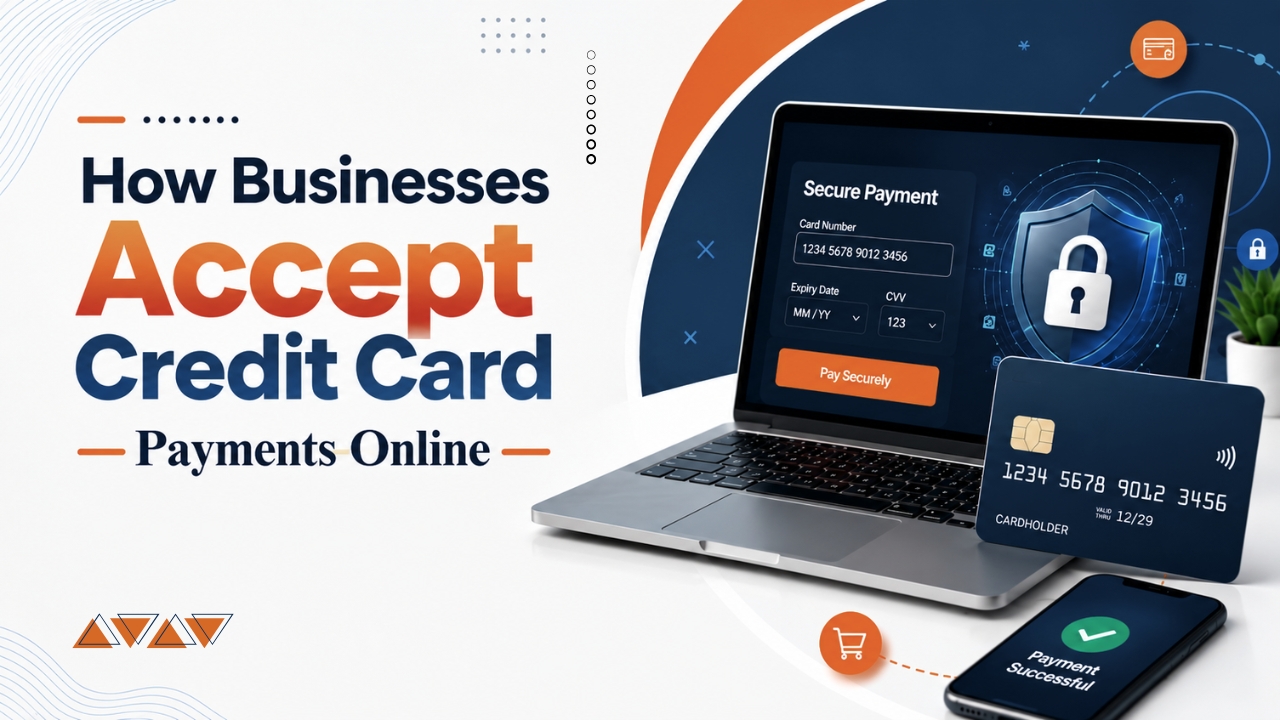
In today’s digital economy, customers expect businesses to provide fast, secure, and convenient online payment solutions.
Whether you are running an eCommerce store, subscription service, SaaS platform, nonprofit organization, or professional service businesses, then it has become essential for businesses to accept credit card payments online for increasing sales and improving customer experience.
Consumers today want to make payments with credit cards, debit cards, digital wallets, and online payment methods because they are quick, secure, and accessible from anywhere.
Modern online payment processing solutions enable businesses to accept payments from customers through websites, mobile apps, payment links, online invoices, and virtual terminals.
These platforms provide advanced security features like fraud protection, recurring billing, payment analytics, and smooth integration with shopping carts, and accounting software.
As the number of online shopping and digital services keep increasing, choosing the right payment gateway and payment processor is essential for achieving success in business.
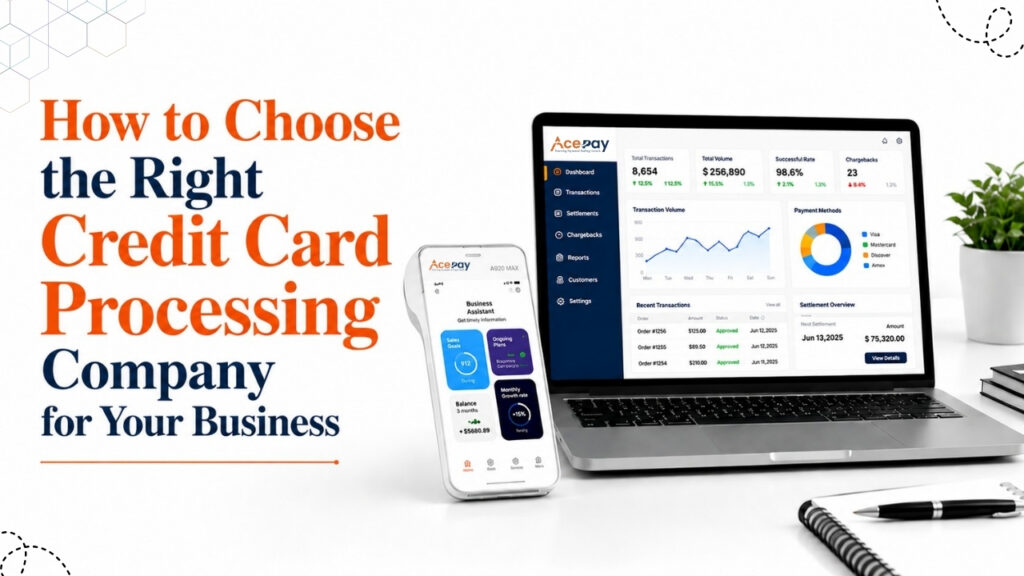
Platforms like AcePay make the payment process simple by offering secure credit card payment processing, several payment options, digital invoicing, recurring billing, and real-time reporting.
As AcePay supports Visa, Mastercard, American Express, Discover, and many digital, it helps businesses to offer a smooth checkout experience while also protecting sensitive customer data through advanced security features.
This blog will walk you through everything you need to know for accepting credit card payments online, that includes the way payment processing works, the technology used, available payment methods, pricing models, security standards, and tips for selecting the best payment solution.
So if you are launching your first online store or expanding your current payment infrastructure, then this blog will help you to make informed decisions which increase customer satisfaction, seamless operations, and drive long-term business growth.
Also Read: Best Credit Card Processing Companies for Small Businesses
What Are Online Credit Card Payments?
These payments allow customers to buy products or avail services online using a debit card, credit card, or digital wallet. Instead of using a physical payment terminal, customers enter payment details through a secure checkout page, mobile app, or payment link.
Then the transaction is processed through a payment gateway and payment processor securely. It ensures fast and secure online payments.
Businesses of different industries use online payment solutions to improve conveniences of customers, seamless transactions, and increase sales.
Online credit card payments are widely used by:
- eCommerce websites
- Subscription-based services
- Online marketplaces
- Educational platforms
- Healthcare providers
- Nonprofit organizations
- Professional service firms
- Travel and hospitality businesses
Modern online payment systems support multiple payment methods like credit cards, debit cards, Apple Pay, Google Pay, PayPal, Buy Now, Pay Later(BNPL) services and bank transfers, which helps businesses to reduce cart abandonment and provide a smooth checkout experience.
How Businesses Accept Credit Card Payments Online
Accepting credit card payments online involves several secure technologies working together to authorize, process, and settle transactions.
Below are the six important steps involved in the online payment process.
1. Customer Places an Order
The process begins with a customer choosing products or services and moves ahead to the secure checkout page. Then the customers make payments using a credit card, debit card, or digital wallets such as Apple Pay or Google Pay.
2. Payment Information Is Encrypted
After the customer enters their payment details, then the payment gateway encrypts the sensitive card details before transmitting it. Such encryption secures payment details from unauthorized access during the transaction.
3. Payment Gateway Processes the Request
The encrypted payment information is securely forwarded to the payment processor, which works as a bridge between the businesses, card networks, and financial institutions to facilitate the transaction.
Also Read: How Credit Card Processing Works Step by Step
4. Authorization by the Issuing Bank
The payment processor then sends the transaction request to the customer’s issuing bank. The bank then verifies the card’s validity, available funds or credit, fraud indicators, and security credentials before approving or declining the transaction.
5. Payment Confirmation
Once approved, the business receives instant confirmation, while the customer receives an order confirmation and a digital receipt. The order management system is automatically updated.
6. Settlement and Fund Transfer
After authorization, the transaction is settled, and the funds are then transferred to the merchant account before being deposited into the business’s bank account as per the payment provider’s settlement schedule.
Why Businesses Should Accept Credit Card Payments Online
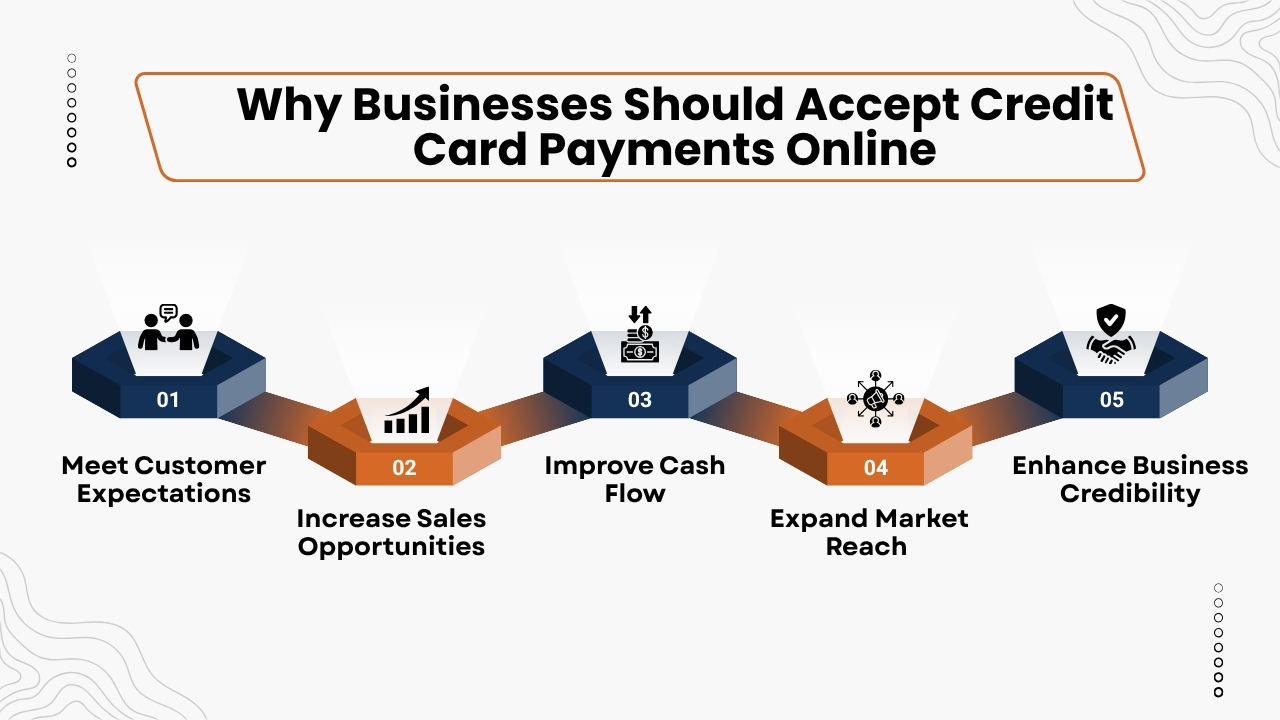
Accepting credit card payments online has become essential for businesses who are willing to grow, improve customer satisfaction, and remain competitive in today’s digital market.
Below are five important reasons to offer online payment options.
1. Meet Customer Expectations
Modern customers want their payment solutions to be secure, convenient, and flexible while they shop online. Businesses accepting multiple payment options like credit cards, debit cards, and digital wallet, improves the customer experience, and encourages customers to complete purchases.
2. Increase Sales Opportunities
Such payments reduce checkout friction and make it easier for customers to complete purchases. Businesses that accept cashless payments often experience more conversion rates, high average order values, and increased customer retention.
3. Improve Cash Flow
These payments can be processed faster than cheques or bank transfers. Many payment providers provide either next-day or same-day funding that helps businesses to receive cash instantly and maintain good cash flow.
Also Read: Credit Card Processing Fees: Complete Breakdown for Businesses
4. Expand Market Reach
Implementing credit card payments online helps businesses to sell products and services to customers across different cities, states, and countries. Such wider reach creates new growth opportunities for businesses and also supports business expansion.
5. Enhance Business Credibility
Implementing a secure online checkout process increases customer trust and improves your brand’s reputation. Businesses use trusted payment solutions and protect sensitive customer details are more likely to earn customer trust and encourage them for repeat purchases.
Benefits of Accepting Credit Card Payments Online
Implementing online credit card payment processing provides many operational and financial benefits to businesses. Whether improving customer satisfaction, increasing revenue, online payment solutions helps businesses to operate effectively and remain competitive.
1. Faster Payments
With online credit card payments enables customers to buy products quickly, and thereby removing delays due to invoices, cheques, or cash transactions.
Faster payments improves cash flow, which helps businesses to manage daily expenses, inventory purchases, and business growth more effectively.
2. Better Customer Experience
When businesses provide multiple payment options like credit cards, debit cards, Apple Pay, Google Pay, and digital wallets, it offers more convenience to customers.
Offering a smooth and secure checkout process increases customer satisfaction, encourages them for repeat purchases, and builds long-term customer loyalty.
3. Increased Revenue
Providing a simplified checkout experience to customers reduces chances of cart abandonment because it lets customers easily complete transactions.
Businesses that accept several online payment methods often achieve higher conversion rates, increased average order values, and more sales.
4. Improved Payment Security
Modern payment processors use advanced security technologies like SSL encryption, tokenization, fraud monitoring, and PCI DSS compliance to protect sensitive payment details. These measures reduce fraud risks and increase trust of customers.
5. Automated Business Operations
Many online payment platforms can be integrated into accounting software, CRM systems, inventory management tools, and eCommerce platforms.
Such integrations automates payment tracking, financial reporting, that reduces manual tasks for staff and also improves overall business efficiency.
Different Ways Businesses Accept Credit Card Payments Online
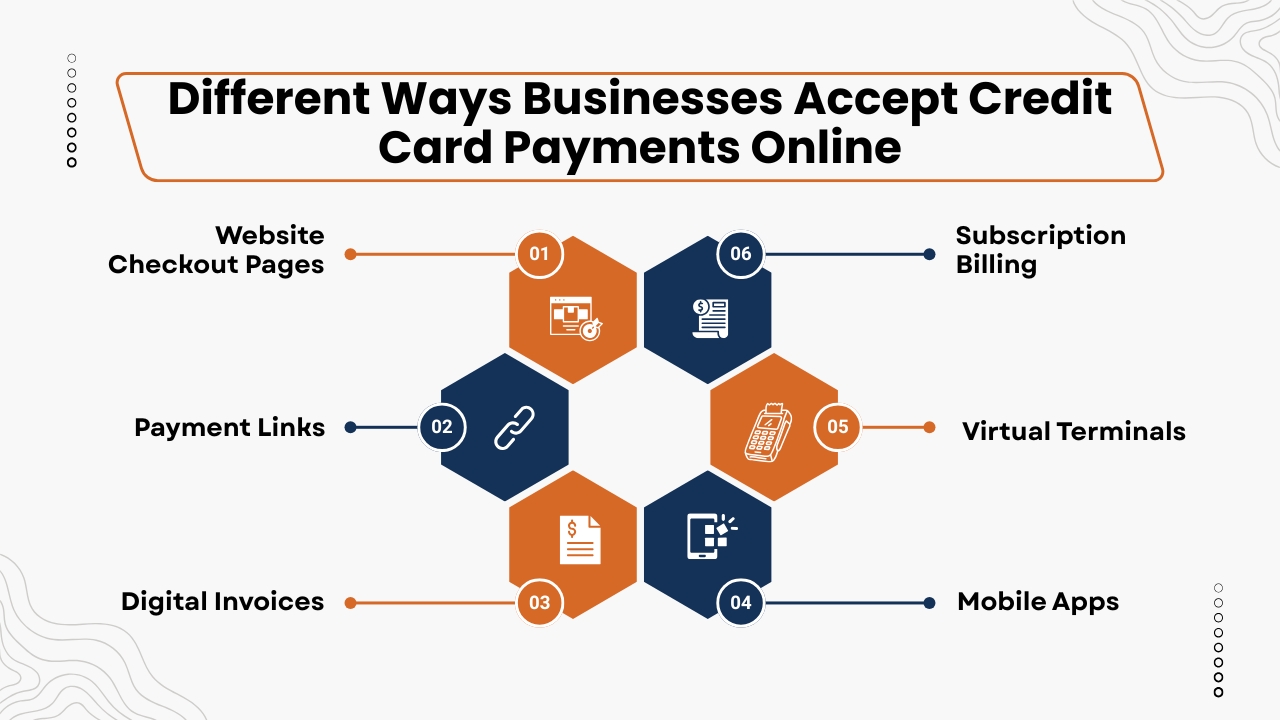
Businesses today have several options for accepting online credit card payment. The right method is based on your business model, customer preferences, and the type of products or services you sell.
Having a flexible payment solution helps businesses to increase customer satisfaction while improving conversation rates.
1. Website Checkout Pages
Website checkout pages are a popular and secular way for businesses to accept credit card payments online. Through these website checkout pages customers can add products or services to their shopping cart, proceed to checkout, and enter their payment details securely.
Then the payment gateways encrypt the details and processes the transactions that ensures a safe, quick, and smooth payment experience.
These pages should be mobile friendly, easy for users to navigate, and optimized to reduce cart abandonment while increasing conversion rates.
Website checkout pages are ideal for:
- eCommerce stores
- Retail businesses
- Wholesale suppliers
- Digital product sellers
- Businesses seeking a secure and user-friendly online checkout experience
Businesses that offer a smooth checkout process can increase customer satisfaction, build their trust, and increase completed purchases.
2. Payment Links
Payment links offer a simple and convenient way for businesses to accept credit card payments online without creating a dedicated eCommerce website.
A payment processor generates a secure payment URL which businesses can share with customers through different digital channels. Customers simply click the link, enter their payment details, and complete the transaction instantly and securely.
This method is a good option for businesses that need a flexible, low-cost payment solution while providing a smooth payment experience to customers.
Payment links can be shared through:
- SMS
- Social media platforms
- QR codes
These links are especially useful for freelancers, consultants, service providers, and businesses that regularly send invoices which enables faster collections, improved cash flow, and more convenience to customers.
3. Digital Invoices
Digital invoices make it easy for businesses to request and receive payments online. Many payment providers enable businesses to create professional invoices with a secure payment button which enables customers to pay instantly using their preferred method.
This approach simplifies the billing process, reduces paperwork, and shortens payment cycles. It also improves the customer experience by providing a fast, secure, and convenient way to complete transactions.
Digital invoicing is especially beneficial for:
- Contractors
- Marketing agencies
- Law firms
- Healthcare providers
- Accounting firms
Automating invoicing and payment collection, helps businesses to reduce need for manual follow-ups, payment delays, improve cash flow, and spend more time to focus on customer service and business growth.
Also Read: Best Credit Card Processing Solutions for Small Businesses
4. Mobile Apps
These apps provide businesses with a convenient way to accept credit card payments online while offering a smooth user experience. By integrating secure online payment processing into a mobile application, customers can safely save their payment information, complete purchases in just a few taps, and manage subscriptions without leaving the app.
This smooth checkout process improves convenience, encourages customers for repeat purchases, and improves customer loyalty.
Mobile payment apps are commonly used by:
- Food delivery services
- Subscription-based businesses
- Fitness platforms
- Online education providers
- Travel companies
Integrating payment processing into a mobile app helps businesses to increase customer engagement, simplify transactions, reduce checkout friction, and offer a fast, secure, and user-friendly payment experience across mobile devices.
5. Virtual Terminals
It enables businesses to accept credit card payments online by manually entering a customer’s payment details through a secure web-based dashboard.
This payment method is a good option for businesses that process phone orders, remote payments, or transactions handled by customer support teams.
Virtual terminals remove the need for costumes to be physically present which make payment collection more flexible while maintaining a high level of security.
Virtual terminals are commonly used by:
- Hotels
- Medical offices
- Professional service firms
- Travel agencies
By using virtual terminals, businesses can securely process remote transactions, improve customer convenience, faster payment collection, and offer a reliable payment solution for customers who prefer to place orders or make payments over the phone.
6. Subscription Billing
It is an automated payment solution which is designed for businesses with recurring revenue models. After customers provide authorization once, the payment platform automatically charges their credit or debit card according to a predefined schedule.
This removes the need for manual invoicing which ensures timely payments and offers customers with a convenient, smooth billing experience. Automated billing also helps businesses to maintain consistent cash flow and reduce admin tasks.
Subscription billing is ideal for:
- SaaS companies
- Membership websites
- Streaming services
- Gym memberships
- Maintenance plan providers
Automating recurring payments enables businesses to improve revenue predictability, reduce missed or late payments, increase customer retention, and streamline billing operations, which allows teams to focus on delivering high-quality products and services.
Understanding Online Credit Card Processing Fees
For selecting a cost-effective payment solution, it is essential to understand online credit card processing fees. Processing expenses may differ based on the provider, pricing model, transaction volume, and additional services offered. Evaluating all fees helps businesses to avoid unexpected expenses and achieve maximum profits.
1. Transaction Fees
Most payment providers charge a percentage of each transaction along with a fixed fee. Common pricing models are flat-rate pricing, interchange-plus pricing, and tiered pricing.
Businesses should compare these models based on monthly transaction volume and average order value to find the most economical option.
2. Monthly Subscription Fees
Some providers charge monthly fees which include access to payment dashboards, customer support, reporting tools, software updates, and fraud monitoring services.
Compare the monthly expenses with the features offered to ensure that you receive the best value for your investment.
3. Payment Gateway Fees
Certain payment processors charge separately for using their payment gateway. These fees include monthly gateway subscriptions, per-transaction gateway charges, or one-time setup fees.
Many modern payment providers combine gateway services into pricing plans, reducing additional expenses.
4. Chargeback Fees
When a customer disputes a transaction, the payment processor may charge a chargeback fee to cover the fees for the investigation process.
Businesses can reduce chargebacks by maintaining accurate transaction records, offering clear refund policies, and sending detailed order confirmations.
5. Hardware Costs
Although most online businesses operate digitally, some businesses also accept in-person payments using mobile card readers or smart POS devices. In such cases, businesses should consider hardware expenses, such as card readers, payment terminals, receipt printers, and accessories, while evaluating the total expenses of a payment processing solution.
Security and PCI DSS Compliance
It is essential for every business to protect their customer payment details if they accept online payments through credit cards. Modern payment providers use several security features to protect transactions, reduce fraud, and build customer trust.
1. PCI DSS Compliance
The Payment Card Industry Data Security Standard(PCI DSS) establishes security needs for businesses that store, process, or transmit cardholder data.
Businesses selecting a PCI-compliant payment provider helps them to secure sensitive payment details, reduces security risks, and ensures compliance with industry regulations.
2. SSL Encryption
SSL encryption protects customer payment details when it is transmitted between the browser and the payment gateway. Websites that offer SSL protection provide a padlock icon in the browser that helps customers to gain trust that their personal and financial details are protected.
Also Read: Payment Processing Solutions for High-Risk Businesses
3. Tokenization
It involves replacing sensitive credit card numbers with unique, randomly generated tokens. So that even if any fraudsters gain access to stored data, then the tokens cannot be used without the actual card details, providing more security.
4. Advanced Fraud Detection
Modern payment platforms use smart fraud prevention tools like Address Verification Service(AVS), CVV verification, device fingerprinting, AI-based fraud detection, and velocity checks to monitor transactions in real and find if there is any suspicious activity before fraud happens.
5. Two-Factor Authentication (2FA)
Many payment providers support two-factor authentication(2FA), which requires users to verify their identity through an additional authentication step.
Such additional security helps businesses to avoid unauthorized account access and protects both businesses and customers from cyber frauds.
Best Online Credit Card Payment Providers
Choosing the right payment provider is crucial for delivering a secure, smooth checkout experience while managing expenses effectively. The best providers provide reliable payment processing, multiple payment options, strong security, and integrations with popular business tools.
1. AcePay
AcePay is a popular choice for businesses who want a secure and scalable online payment solution. It lets businesses accept credit cards, debit cards, digital wallets, and contactless payments through websites, payment links, online invoices, recurring billing, real-time reporting, and business management tools to make payment collection smooth.
Key Features:
- Secure online payment processing
- Payment gateway integration
- Recurring billing
- Digital invoicing
- Payment links
- Real-time analytics
- PCI DSS-compliant security
- Support for Visa, Mastercard, American Express, and Discover
Best For:
- eCommerce businesses
- Subscription services
- Professional service providers
- Nonprofits
- Small and medium-sized businesses
2. Stripe
Stripe is a popular payment which is well known for its strong APIs and flexible integrations. It supports global payments, subscription billing, digital wallets, and advanced developer tools, which makes it ideal for businesses with custom payment requirements.
Best For:
- SaaS companies
- Online marketplaces
- Technology businesses
- International merchants
3. PayPal
PayPal provides a trusted payment experience that supports credit cards, debit cards, PayPal balances, and PayPal Pay Later. It has gained more recognition and increased customer trust during checkout.
Best For:
- Small businesses
- Freelancers
- Online retailers
4. Square
It provides an easy-to-use payment platform with online checkout, payment links, invoicing, and mobile payment capabilities. Square can be integrated with inventory management and customer relationship tools.
Best For:
- Small businesses
- Restaurants
- Retail stores
- Service providers
5. Authorize.net
It is a long-established payment gateway providing fraud detection, recurring billing, virtual terminals, and support for multiple payment methods.
Authorize.net is suitable for businesses requiring reliable and secure online payment processing.
Best For:
- Growing businesses
- Professional services
- eCommerce companies
How to Choose the Right Online Payment Solution
Selecting the right online payment solution goes beyond comparing transaction fees. The ideal online payment platform should align well with your business needs, provide more security, integrate with your current platforms, and offer a smooth payment experience for your customers.
1. Understand Your Business Model
Start by identifying your business requirements. Consider whether you sell physical products, digital products, professional services, subscription plans, or accept donations.
Your payment processing needs will differ based on your business type, sales volume, and preferred payment methods.
2. Compare Total Costs
Evaluate the overall expenses of the payment solution instead of focusing only on transaction rates. Compare transaction fees, monthly subscription charges, payment gateway fees, chargeback fees, currency conversion costs, and any hardware expenses if you also accept in-person payments.
Also Read: How Long Credit Card Transactions Take to Process: A Complete Guide for Businesses
3. Evaluate Security Features
Choose a provider that prioritizes payment security by offering PCI DSS compliance, SSL encryption, tokenization, fraud monitoring, and two-factor authentication(2FA). These security features help protect sensitive customer details, reduce fraud risks, and build customer trust.
4. Consider Integration Capabilities
A modern payment platform should integrate smoothly with existing business tools that includes shopping carts, CRM software, accounting platforms, ERP systems, and marketing automation software.
These integrations reduce manual work, improve efficiency, and simplify financial management.
5. Review Customer Support
Reliable customer support is essential when payment issues impact sales or customer satisfaction. Search for providers that provide 24/7 support, live chat, email assistance, phone support, and detailed documentation to ensure quick issue resolution and detailed documentation to ensure instant issue resolution and uninterrupted business operations.
Conclusion
Accepting credit card payments online has become crucial for running a business successfully in today’s digital economy. Today customers expect fast, secure, and convenient payment options, if they are shopping through an eCommerce website, paying an invoice online, subscribing to a service, or completing a purchase through a mobile app.
Implementing a reliable online payment processing solution, businesses can improve customer satisfaction, increase conversion rates, increase cash flow, and increase their reach to customers around the world.
Choosing the right payment platform needs careful evaluation of factors like pricing, security, payment methods, integrations, scalability, and customer support.
Businesses should also prioritize providers that comply with PCI DSS standards and provide advanced security features such as SSL encryption, tokenization, fraud detection, and two-factor authentication to protect sensitive payment information and reduce fraud risks.
Platforms like AcePay help businesses to simplify online payment acceptance with secure payment processing, support for multiple payment methods, recurring billing, payment links, digital invoicing , smooth integrations, and real-time reporting.
All these capabilities help businesses to smooth operations while delivering a smooth and reliable checkout experience.
As digital payments continue to evolve, investing in a modern online payment solution will help businesses stay competitive, build customer trust, and support long-term growth.
By adopting secure, flexible, and scalable payment technologies, organizations can confidently meet changing customer expectations and drive sustainable business success.
If you still have any query about how businesses accept credit card payments online then you may book a free demo at AcePay and we are more than happy to assist you.