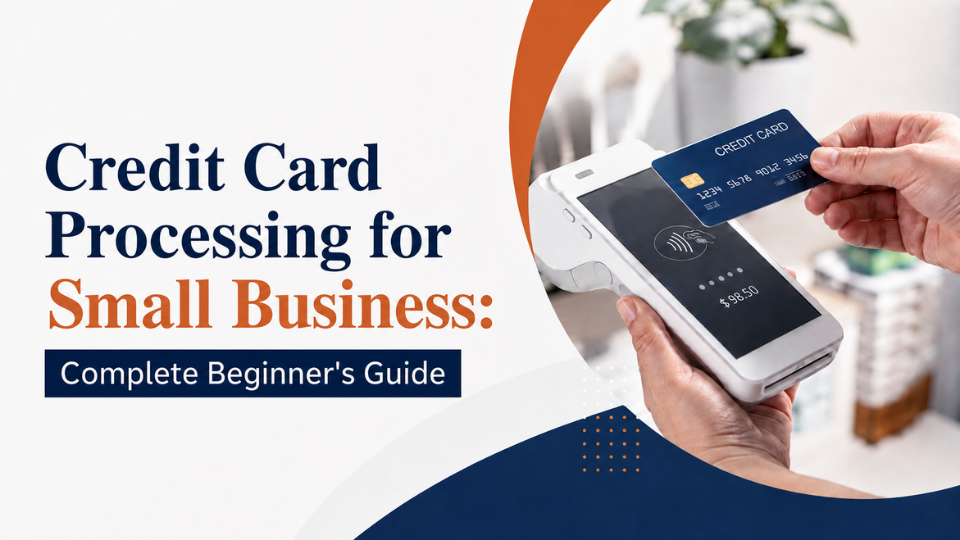
For many small businesses, accepting credit card payments is essential for serving customers and completing sales efficiently. Credit card processing for small businesses involves several technologies and financial institutions working together to authorize, process, and settle transactions.
Understanding the way the system works can help business owners to choose the right payment processor, control expenses, and offer a secure checkout experience.
When a customer makes payment by card, the transaction may pass through a payment gateway, merchant account, card network, issuing bank, and acquiring bank before funds reach the business.
Each participant plays a different role in completing the payment. Businesses also require understanding of credit card processing fees, which includes interchange fees, processor markup, transaction fees, monthly charges, and potential chargeback fees.
Choosing the right credit card processing solution also requires evaluating pricing models like flat-rate pricing, interchange-plus pricing, tiered pricing, and membership pricing. Providers such as AcePay offer payment processing solutions designed to help businesses manage and accept card payments.
Security is another important consideration, making PCI compliance, encryption, tokenization, and fraud prevention essential features of a reliable payment strategy.
This beginner’s blog will walk you through the fundamentals of credit card processing, common fees, payment equipment, security requirements, pricing structures, and selecting providers.
With this knowledge, small business owners can compare cbd payment processors confidently and build a payment system that supports affordability, security, convenience, and long-term business growth.
What Is Credit Card Processing?
Credit card processing is the system that allows a business to accept payments made with credit or debit cards. When a customer makes payments by card, several financial institutions and payment companies work together to authorize the transaction, transfer the funds, and deposit the money into the merchant’s account.
Although the transaction may appear instantaneous to the customer, several steps happen behind the scenes.
For instance, when a customer purchases a $100 product:
- The customer provides a card or enters card details.
- The payment terminal or online checkout collects the transaction information.
- The payment processor sends the transaction through the card network.
- The cardholder’s bank then reviews the transaction.
- The transaction is either approved or declined.
- Approved transactions are either collected and settled.
- Processing fees are deducted.
- The remaining funds are then deposited into the merchant’s bank account.
This process involves multiple components, and each component with a specific role.
Also Read: How to Choose the Right Credit Card Processing Company for Your Business
Why Credit Card Processing Matters for Small Businesses
Customers want convenient payment options. Businesses restricting customers to cash or cheques can create unnecessary friction and may result in lost sales.
Credit card acceptance can help small businesses:
- Provide convenient payment options
- Improve the checkout experience
- Accept online and in-person payments
- Support contactless transactions
- Increase purchasing flexibility
- Enable recurring billing
- Sell through multiple channels
- Reach customers who prefer digital payments
Modern payment systems also support digital wallets and mobile payments. As per the recent industry guidance, businesses increasingly need to support multiple payment methods, which includes contactless payments and digital wallet to meet changing customer expectations.
Meanwhile, the goal for a small business should not simply be to accept credit cards. Their objective should be to create a payment system that is secure, affordable, reliable, and easy to manage.
How Credit Card Processing Works
Understanding the credit card payment process makes it easier to evaluate processors and identify unnecessary fees.
A usual card transaction involves several phases.
1. The Customer Initiates the Payment
The credit card processing journey starts when a customer chooses to make payments for a product or service. At a physical store, customers may make payments by inserting a chip card, tapping a contactless card, or using a digital wallet, or swipe a card where supported.
If customers are purchasing products online, then customers enter their payment details through a secure checkout page. Businesses that accept telephone orders may use a virtual terminal to enter card information.
For online purchases, customers enter their payment details through a secure checkout page. Businesses that accept telephone orders may use a virtual terminal to enter card information. Each payment method may require different security requirements and transaction risks.
2. Payment Information Is Captured
After the customer initiates payment, the POS system, card terminal, mobile application, or payment gateway collects the necessary transaction details.
The data is then securely transmitted through the payment infrastructure. For online transactions, the payment gateway helps to transfer payment information between the customer, merchant, and payment processor while supporting secure communication.
Also Read: How Businesses Accept Credit Card Payments Online
3. The Transaction Is Sent to the Processor
The payment processor receives the transaction information and routes it through the appropriate card network. Major card networks are Visa, Mastercard, American Express, and Discover.
The payment processor connects the merchant with the card network, acquiring bank, and customer’s issuing bank to help authorize and complete the transaction.
4. The Issuing Bank Authorizes the Transaction
The issuing bank evaluates the transaction before authorizing the transaction. The bank may verify whether sufficient credit is available, the card’s status, transaction details, and potential fraud indicators. The bank then sends an approval or decline response through the payment network.
5. The Merchant Receives the Response
The transaction approval or decline is sent back to the payment terminal, POS system, or online checkout platform. If the transaction is approved, then the customer receives confirmation and the purchase can proceed.
But if the payment is declined, the merchant then may ask the customer to use another payment method.
6. The Transaction Is Settled
If a transaction is approved, then it does not mean the payment has been deposited into the merchant’s bank account immediately. Approved transactions are collected and submitted for settlement.
The processor helps transfer the approved funds to the merchant, with applicable processing fees and other charges deducted before the remaining balance reaches the business bank account.
Also Read: How Credit Card Processing Works Step by Step
Key Components in Credit Card Processing
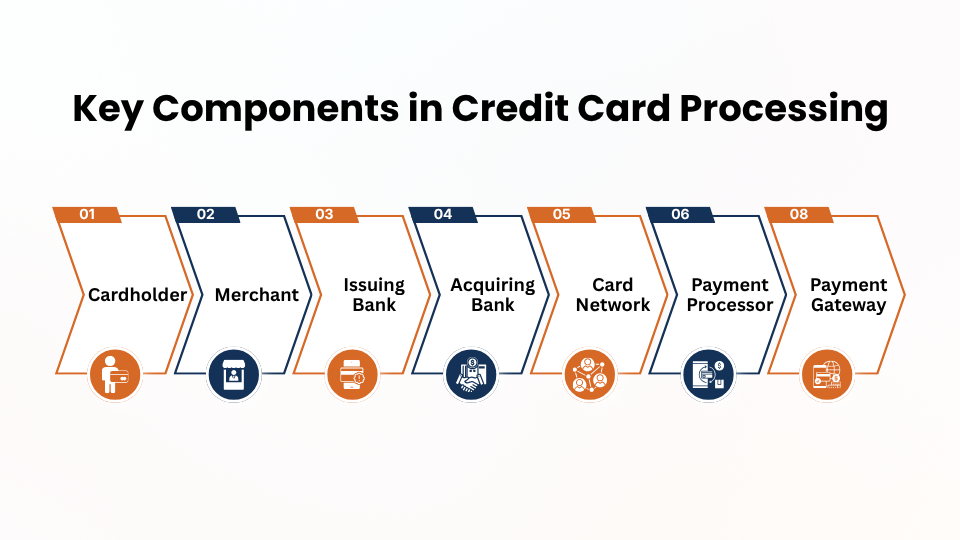
A credit card transaction involves several important participants, and understanding their individual roles helps to clarify the way the payment processing franchise system works.
1. Cardholder
The cardholder is the customer who uses a credit or debit card to purchase products or services. The cardholder’s issuing bank reviews and authorizes the transaction based on available funds, credit, and security checks.
2. Merchant
The merchant is the business accepting the card payment. Restaurants, retail stores, professional service providers, and online businesses can all operate as merchants.
3. Issuing Bank
The issuing bank is the bank that offers the customer’s credit or debit card. It evaluates transactions and determines whether payments should be approved or declined.
4. Acquiring Bank
The Acquiring bank which is also known as the merchant bank, works with the merchant to enable card payment acceptance. This helps to receive and process funds generated through card transactions.
5. Card Network
A card network provides the infrastructure that connects banks and helps route payment transactions. Major networks include Visa, Mastercard, American Express, and Discover.
6. Payment Processor
The payment processor manages the communication and transmission of transaction data between the merchant, acquiring banks, card network, and issuing bank. It helps to handle authorization, transaction processing, and settlement.
7. Payment Gateway
A payment gateway securely transfers payment details between a merchant’s checkout system and the payment processing network. It is particularly essential for online businesses and can connect websites, applications, and e-commerce platforms with payment processors.
Together, these seven components help to ensure that card transactions are securely authorized, processed, and settled from the customer to the merchant.
Also Read: QuickBooks Credit Card Processing: Features and Alternatives
What Does a Small Business Need to Accept Credit Cards?
The exact requirements are based on the way business operates.
A traditional physical business may need:
- Merchant processing services
- A card reader or payment terminal
- POS software
- Internet connectivity
- A business bank account
An online business may need:
- Payment gateway
- E-commerce platform
- Payment processor
- Secure checkout
- Business bank account
A mobile business may need:
- Mobile card reader
- Smartphone or tablet
- Payment application
- Internet connection
Some modern providers combine several of these services into a single platform, reducing the number of separate systems a small business needs to manage.
What Is a Merchant Account?
A merchant account is a specialized account that is used to receive and process card payments. Traditionally, businesses would establish a merchant account separately from other payment services.
Today, many payment providers offer bundled solutions that combine payment processing, gateway services, and merchant account functionality. Before choosing a provider, determine whether you need a dedicated merchant account or whether a bundled payment solution better fits your business.
Also Read: Best Credit Card Processing Solutions for Small Businesses
What Is a Payment Gateway?
A payment gateway is the technology that securely transmits the payment information between a customer, merchant, and payment processing system.
For instance, when a customer enters card information on an online checkout page, the payment gateway helps to securely transmit that information for authorization.
Payment gateways can also provide:
- Payment encryption
- Transaction authentication
- Reporting
- Fraud prevention
- Tokenization
- Integration with e-commerce platforms
A payment gateway is particularly essential for businesses that accept card-not-present transactions.
What Are Credit Card Processing Fees?
Processing fees are among the most important expenses that small businesses need to understand. Rather than looking only at the advertised transaction rate, businesses should evaluate the total cost of payment acceptance.
Depending on the provider, fees may include:
- Interchange fees
- Card network assessment fees
- Processor markup
- Monthly fees
- Payment gateway fees
- PCI compliance fees
- Chargeback fees
- Batch fees
- Statement fees
- Equipment costs
- Early termination fees
- Currency conversion fees
Not every payment processor applies the same fees or charges. Businesses should carefully review each provider’s complete pricing structure, which includes transaction, monthly, gateway, equipment, and chargeback fees, before signing an agreement to prevent unexpected expenses and understand the actual cost of payment processing.
Also Read: Payment Processing Solutions for High-Risk Businesses
Understanding Interchange Fees
Interchange fees are charges associated with card transactions and are generally determined by card networks and issuing banks.
These fees can differ based on factors like:
- Card type
- Transaction type
- Merchant category
- Card-present or card-not-present status
- Risk characteristics
- Other network rules
Interchange fees are different from the processor’s markup. Understanding these differences is essential because a processor may advertise a low processing rate while adding other expenses elsewhere.
What Is Processor Markup?
Processor markup is the amount a payment processor adds additional to underlying transaction expenses. For instance, an interchange-plus pricing model separates interchange expenses from the processor’s markup, offering more transparency.
Higher-volume merchants can use this pricing model to gain more visibility into processing costs and find whether their overall payment costs are competitive.
Common Credit Card Processing Pricing Models
Small businesses can choose from several credit card processing pricing models, each with different fee structures and cost considerations.
1. Flat-Rate Pricing
Flat-rate pricing charges a fixed percentage, a per-transaction fee, or both for each payment. This pricing model is easy to understand, predictable, and convenient for startups and small businesses.
However, costs can become higher as transaction volume increases, which makes this pricing model less attractive for businesses with substantial processing activity.
2. Interchange-Plus Pricing
Interchange-plus pricing separates the underlying interchange expenses from the payment processor’s markup. This pricing model offers more pricing transparency and can be cost-effective for businesses with higher transaction volumes. However, in this pricing model, statements may be more complex, and additional monthly fees can apply.
Also Read: Small Business Credit Card Processing: Everything Business Owners Need to Know
3. Tiered Pricing
Tiered pricing categorizes transactions into groups like qualified, mid-qualified, and non-qualified, with different fees for each category.
Although this approach can appear straightforward, businesses may find expenses difficult to predict because transaction types can receive different pricing.
4. Membership or Subscription Pricing
Membership pricing usually involves a monthly subscription fee combined with lower transaction markups. This approach can be beneficial for businesses processing high payment volumes.
However, merchants should compare the complete annual expenses, which includes membership and transaction fees, before choosing this pricing model.
How Much Does Credit Card Processing Cost?
Credit card processing costs will be different for businesses because providers use different pricing models and fee structures. The total cost depends on transaction volume, average purchase value, payment methods, industry, and additional expenses.
Businesses should compare the overall processing costs instead of depending only on advertised rates.
Important cost factors include:
- Transaction volume: Monthly sales can affect pricing.
- Payment method: Card-present and online transactions may have different costs.
- Processor markup: Additional processor charges affect total expenses.
- Monthly fees: Service, gateway, or account fees may apply.
- Chargebacks: Disputes can create additional costs.
- Equipment: Terminals and payment hardware may increase expenses.
Comparing effective rates helps businesses to choose an appropriate processor.
Also Read: How Long Credit Card Transactions Take to Process: A Complete Guide for Businesses
Card-Present vs. Card-Not-Present Transactions
The way a card is accepted can affect processing expenses and fraud risk.
1. Card-Present Transactions
Card-present transactions happen when customers physically use their cards at a business location. Examples include retail stores, restaurants, salons, and medical offices.
Customers can make payments by inserting a chip card, tapping a contactless card, or swiping where supported. The physical card offers additional verification and can help reduce certain transaction risks.
2. Card-Not-Present Transactions
Card-not-present transactions happen when customers do not physically present their cards, like online purchases, phone orders, recurring payments, or mail orders.
These transactions can involve more fraud risk. Businesses should use secure payment gateways, authentication, fraud monitoring, and tokenization to secure payment information and reduce unauthorized transactions.
Credit Card Processing Equipment
Small businesses can choose from several types of payment equipment.
1. Traditional POS Terminal
It is a countertop device used by businesses with fixed checkout locations. It commonly supports chip and contactless payments, which helps customers complete transactions quickly and securely.
2. Mobile Card Reader
A mobile card reader connects to a smartphone or tablet, which allows businesses to accept payments from different locations. Mobile card readers are useful for contractors, food trucks, market vendors, pop-up shops, and mobile service providers.
3. Smart Payment Terminal
A smart payment terminal combines payment acceptance with business management features. Based on the system, it may support POS functions, inventory tracking, employee management, and sales reporting.
4. Virtual Terminal
A virtual terminal lets employees manually enter card information for remote payments, like telephone orders. As these are generally card-not-present transactions, businesses should use appropriate security and fraud prevention measures.
Also Read: Best Credit Card Processing Companies for Small Businesses
Online Credit Card Processing
E-commerce businesses require a secure and reliable payment system that integrates smoothly with their websites. Online credit card processing lets customers enter payment details, receive authorization, and complete purchases online.
A usual online payment setup includes:
- E-commerce website: It offers an online shopping platform.
- Secure checkout: allows to collect customer payment information securely.
- Payment gateway: Transfers payment data securely.
- Payment processor: It handles transaction authorization and processing.
- Merchant account: It receives processed payments.
- Business bank account: It receives settled funds.
A strong solution should offer mobile-friendly checkout, security, reporting, and smooth integration with existing business technology.
Credit Card Processing Security
Businesses should consider security as a core business requirement instead of an optional feature. A payment system may have highly sensitive customer details, so businesses should take appropriate steps to protect payment data.
1. PCI DSS Compliance
It establishes security requirements for businesses that handle cardholder data. Small businesses should understand their compliance responsibilities and choose payment providers that provide appropriate security support.
Using hosted checkout solutions and tokenization can reduce a business’s direct handling of sensitive customer payment information.
2. Encryption
It protects payment information by converting sensitive customer data into a secure format during transmission. Businesses should use reputable payment processors with appropriate encryption technologies to help protect customer information and reduce unauthorized access.
3. Tokenization
It replaces sensitive card details with a unique token, reducing exposure to the original card number. This feature is especially useful for recurring payments, subscriptions, and cards stored for future transactions.
4. Employee Access Controls
Businesses must restrict access to customer payment information based on employee responsibilities. Strong passwords, unique credentials, appropriate permissions, regular training, and secure procedures can help to avoid unauthorized access and secure customer payment information.
Also Read: Mobile Credit Card Processing Guide for Field Businesses
How to Choose a Credit Card Processor
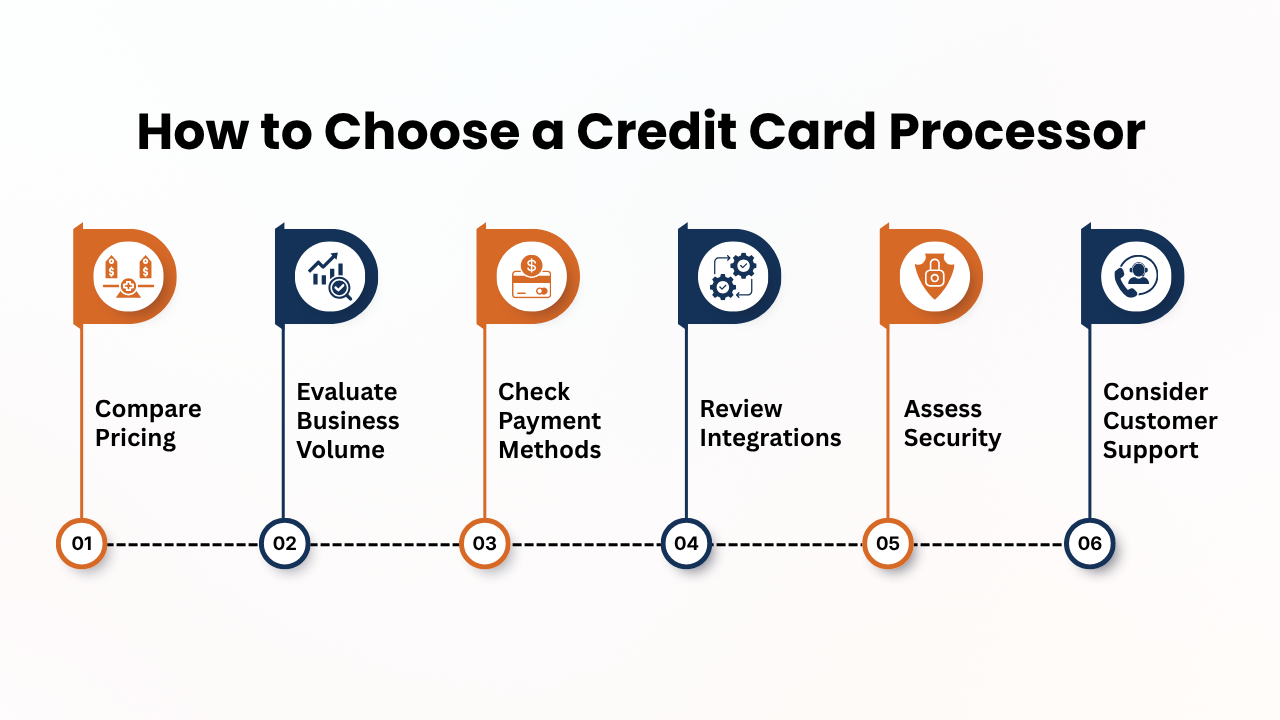
Choosing a processor is a crucial financial decision. Businesses must not choose a provider based only on its advertised transaction rate.
Consider the following factors:
1. Compare Pricing
They must review the processor’s complete pricing structure instead of focusing only on the advertised transaction rate. Check percentage fees, per-transaction charges, monthly fees, payment gateway expenses, PCI fees, chargeback fees, equipment expenses, and contract-related charges.
2. Evaluate Business Volume
Businesses must consider average monthly processing volume and transaction size. A provider suitable for a business processing $5,000 monthly may not provide the best value for a company handling $100,000 or more.
3. Check Payment Methods
They must ensure that the processor supports the payment methods that your customers prefer. It includes credit cards, contactless payments, digital wallets, online transactions, recurring billing, and international cards.
4. Review Integrations
They must select a processor that works with your existing POS, e-commerce, accounting, inventory, customer management, and subscription systems. Good integration can reduce manual work and improve transaction reporting.
5. Assess Security
They must review security features like PCI compliance support, encryption, tokenization, and tracking, and authentication tools. Implementing strong security can help to protect payment information and reduce financial risks.
6. Consider Customer Support
Having reliable customer service is essential when payment problems affect sales. Businesses must check available support channels, response times, operating hours, and whether assistance is available when your business needs it.
How to Reduce Credit Card Processing Costs
Reducing processing costs does not necessarily mean selecting the provider with the lowest advertised rate.
Rather, businesses must focus on your total cost of payment acceptance.
1. Compare Effective Rates
Businesses must not focus only on the advertised processing rate. They must calculate the effective processing rate by dividing total processing fees by total card sales. It provides a clearer overview of your actual payment acceptance costs.
2. Negotiate Processing Fees
Businesses having higher transaction volumes may have opportunities to negotiate processor markups, equipment expenses, monthly charges, or other fees. They must request competitive pricing and compare offers from multiple providers.
3. Review Statements Regularly
Businesses must track payment processing statements to identify new fees, rate increases, unexpected charges, chargeback expenses, and equipment expenses. Regular reviews help businesses to detect unnecessary expenses quickly.
4. Use Efficient Payment Methods
They must encourage secure and efficient payment methods like chip and contactless transactions. These options can provide customers with convenient checkout experiences while supporting smoother payment operations.
5. Avoid Unnecessary Equipment
They must purchase or rent only the equipment that your business actually needs. A small service business may require only a mobile card reader, while a larger retailer may benefit from a complete POS system. They must avoid paying for unused features or hardware.
Also Read: Credit Card Processing Fees: Complete Breakdown for Businesses
Credit Card Processing for Different Types of Small Businesses
Different businesses must have different payment requirements.
1. Retail Businesses
Retailers usually require POS terminals, barcode integration, inventory management, contactless payments, digital wallets, and sales reporting to manage daily transactions efficiently.
2. Restaurants
Restaurants may be beneficial from countertop terminals, tableside payments, QR ordering, online ordering, POS integration, tipping features, and digital wallet support.
3. E-Commerce Businesses
Online retailers usually require secure payment gateways, checkout systems, fraud prevention, digital wallets, recurring billing, and e-commerce integrations.
4. Professional Services
Professional services like consultants, contractors, and service providers can be beneficial from invoicing, payment links, virtual terminals, recurring billing, and mobile payment options.
5. Subscription Businesses
Subscription companies should consider recurring billing, tokenization, card updater services, failed-payment management, and customer payment management tools.
Conclusion
Credit card processing is an important part of running a modern small business, that allows merchants to accept convenient payments while creating a smoother customer experience.
However, choosing the right payment solution needs more than comparing advertised transaction rates. Business owners should check the complete cost structure that includes interchange fees, processor markups, monthly charges, equipment expenses, gateway fees, and chargeback expenses.
Understanding pricing models, payment methods, security requirements, and contract terms helps businesses to avoid unnecessary costs and choose a suitable provider.
Strong security practices like PCI compliance, encryption, tokenization, and fraud prevention, are equally essential for protecting sensitive customer payment information.
Businesses should also consider POS and e-commerce integrations, customer support, funding speed, and scalability. As transaction volumes and customer expectations keep changing, reviewing processing expenses regularly can help to maintain efficiency.
By understanding how credit card processing works and carefully comparing available providers, small businesses can build a secure, cost-effective payment system that supports customer satisfaction, cash flow, and long-term growth.
If you still have any query for credit card processing for small business as beginner’s guide then you may book a free demo at AcePay and we are more than happy to assist you.