Medical payment processing is a crucial part of running a modern healthcare business. Whether medical practices, dental offices, clinics, hospitals, and specialty providers, organizations need reliable systems to gather patient payments while maintaining security, efficiency, and convenience.
Medical payment processing involves handling credit cards, debit cards, ACH payments, online payments, mobile transactions, and other payment methods used to settle healthcare bills.
Unlike traditional retail transactions, healthcare payments can involve insurance claims, copayments, deductibles, recurring billing, patient portals, and complex payment schedules.
Choosing the right healthcare payment processing solution can therefore influence cash flow, admin workload, patient satisfaction, and overall financial efficiency.
Businesses like AcePay can help healthcare organizations to evaluate payment processing solutions designed to support secure and convenient transactions.
While choosing a medical payment processor, healthcare businesses should consider factors like payment processing fees, PCI compliance, data security, integration capabilities, recurring payments, reporting, chargeback management, and customer support.
This complete blog explains how medical payment processing works, the different payment methods available, common healthcare processing fees, security and compliance considerations, and how providers can choose an appropriate payment solution.
Understanding these factors can help healthcare businesses create a smoother patient payment experience while improving payment collection and operational efficiency.
What Is Medical Payment Processing?
Medical payment processing refers to the system healthcare businesses use to securely accept, authorize, settle, and reconcile payments from patients and other responsible parties. It supports organizations like:
- Primary care and specialty practices
- Dental offices and clinics
- Hospitals and urgent care centers
- Physical therapy and wellness practices
- Diagnostic and veterinary facilities
Healthcare providers may accept payments at the front desk, through patient portals, payment links, phone transactions, or mobile devices. Unlike usual retail purchases, medical payments which can include copayments, deductibles, coinsurance, outstanding balances, and post-insurance amounts.
A reliable healthcare payment processing solution should therefore do more than process a card transaction. It should support secure payment collection, accurate reconciliation, convenient payment options, and integration with existing healthcare systems.
The goal is to create a secure, efficient, and patient-friendly payment experience while helping providers manage revenue and reduce admin work.
Also Read: Credit Card Processing for Small Business: Complete Beginner’s Guide
Why Healthcare Payment Processing Is Different
Healthcare payment processing has several characteristics that make it different from conventional retail payments.
1. Multiple Financial Responsibilities
A single healthcare visit can create several financial obligations. Insurance may cover some of the expenses while the patient is responsible for a copayment, deductible, coinsurance, or remaining balance.
Payment technology therefore needs to support different payment amounts and workflows.
2. Sensitive Information
Healthcare businesses handle financial information along with sensitive patient information. Providers are required to consider applicable privacy, security, and payment-card requirements while designing their payment environment.
Stripe notes that healthcare payment systems can involve both financial and medical compliance considerations, including PCI DSS and, in applicable U.S. contexts, HIPAA.
Also Read: QuickBooks Credit Card Processing: Features and Alternatives
3. Complex Billing Workflows
Healthcare organizations may use:
- Electronic health records
- Practice-management software
- Billing platforms
- Accounting systems
- Patient portals
- Insurance systems
- Payment processors
If these systems operate separately, staff may have to manually transfer information between platforms.
4. Patient Experience
Patients may already be dealing with medical problems, unexpected expenses, or complex insurance information. A confusing payment process can add unnecessary frustration.
A better system should clearly communicate:
- What the patient owes
- Why the balance exists
- Available payment methods
- When payment is due
- Whether payment plans are available
- How receipts can be accessed
How Medical Payment Processing Works
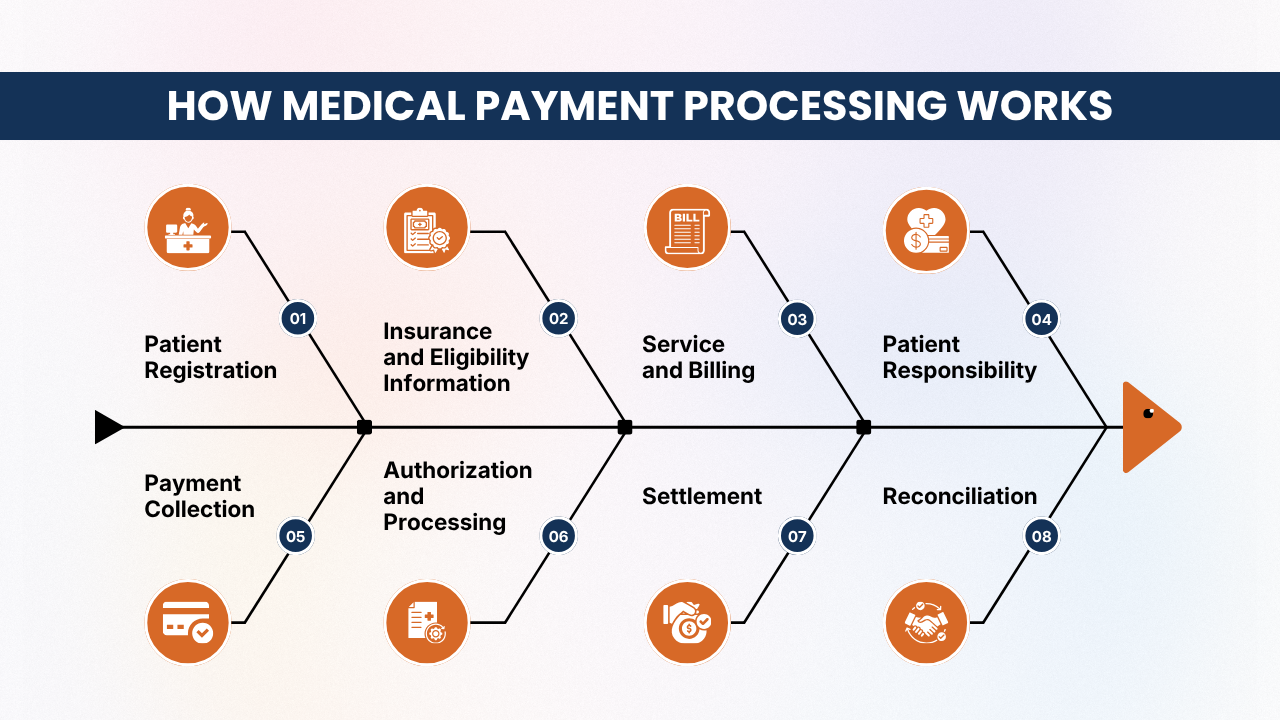
A usual healthcare payment processing workflow can include several connected phases.
1. Patient Registration
The process begins when the patient provides personal, billing, and insurance information. Accurate information helps to establish an accurate patient account.
2. Insurance and Eligibility Information
Where applicable, insurance information is verified and used to determine expected patient responsibility.
3. Service and Billing
Once care is provided, charges are recorded and the appropriate billing process begins.
4. Patient Responsibility
Once applicable insurance processing is completed, the provider determines the amount the patient needs to pay.
Also Read: How Businesses Accept Credit Card Payments Online
5. Payment Collection
Patients may pay through:
- Credit cards
- Debit cards
- ACH
- Bank transfers
- Digital wallets
- Patient portals
- Payment links
- In-person terminals
- Phone payments
- Payment plans
6. Authorization and Processing
The payment processor routes the transaction through the relevant payment networks and receives authorization.
7. Settlement
Approved transactions are settled according to the processor’s funding schedule.
8. Reconciliation
The provider matches payments against billing and accounting records to confirm that transactions have been recorded correctly.
This connected approach can reduce duplicate data entry and help financial teams maintain better visibility into payment activity.
Medical Payment Methods Healthcare Businesses Should Offer
Most patients expect convenient ways to manage bills digitally. Healthcare businesses can provide multiple payment channels instead of requiring every patient to use the same method.
1. Credit and Debit Cards
Cards are a familiar payment option. Providers can accept them through:
- Countertop terminals
- Mobile terminals
- Online checkout
- Patient portals
- Payment links
- Virtual terminals
- Phone-based workflows
Contactless and chip-enabled payments can make in-person transactions more convenient.
2. ACH and Bank Transfers
ACH and bank transfers can be useful for patients managing larger balances or those who prefer paying directly from a bank account. ACH may also support recurring payments when appropriate.
3. Digital Wallets
Digital wallets can provide convenient contactless payment options for eligible transactions. Patients may prefer using an existing mobile wallet instead of manually entering card information.
Also Read: Small Business Credit Card Processing: Everything Business Owners Need to Know
4. Online Payments
Online payment systems allow patients to pay without calling the office or returning to the clinic.
A patient portal can provide access to:
- Current balances
- Statements
- Payment options
- Receipts
- Payment history
5. Payment Links
Secure payment links can provide patients a direct route to a payment page from a phone or computer. AcePay, for instance, describes secure payment links and digital invoices as part of its healthcare payment offering.
6. Payment Plans
Based on the provider’s policies and applicable requirements, payment plans can help eligible patients manage larger balances through scheduled installments.
Collecting Payments at the Right Time
One crucial consideration is when to request payment. Rather than waiting until after an appointment or depending entirely on mailed statements, healthcare providers can address appropriate patient responsibility earlier in the workflow.
Point-of-care collection can involve:
- Explaining expected copayments
- Reviewing outstanding balances
- Explaining payment options
- Collecting applicable amounts
- Discussing eligible payment-plan options
- Obtaining appropriate authorization for card-on-file arrangements
Many healthcare providers find that discussing payment responsibilities during the check-in process, instead of waiting until check-out, can improve transparency, support earlier collections, and create a more consistent patient payment experience when combined with clear policies and proper staff training.
Payment discussions should be clear, respectful, and transparent. Proper staff training helps patients to understand their responsibilities without feeling pressurized.
Integrating payment collection into regular workflows can reduce admin follow-up, improve efficiency, and support more consistent healthcare revenue collection.
Also Read: How to Choose the Right Credit Card Processing Company for Your Business
Making Patient Payments Easier
A convenient patient payment experience should reduce unnecessary steps while providing clear information and flexible payment options. Healthcare businesses can use self-service tools to make billing more accessible and efficient.
1. Patient Portals
Patient portals let individuals to review balances, statements, payment options, receipts, and payment history. As patients may already use portals for appointments and communications, adding payments can create a more convenient experience.
2. Payment Links
Secure payment links offer patients a direct route to a payment page. While patients can complete transactions from their phones without navigating through complicated websites or contacting office staff.
3. Kiosks and Tablets
High-volume practices can use kiosks or tablets to combine check-in and payment activities. These tools can help to reduce waiting times while giving patients more control over routine transactions.
4. Automated Phone Payments
Phone-based payment systems provide another option for patients who prefer telephone interactions. Healthcare businesses should avoid forcing everyone into a single payment channel. Rather than they can provide multiple options while maintaining consistent security, accounting, and reporting processes.
Also Read: How Long Credit Card Transactions Take to Process: A Complete Guide for Businesses
How AcePay Supports Healthcare Payment Processing
AcePay provides healthcare-focused payment tools designed to support medical practices, clinics, urgent care centers, wellness businesses, specialty offices, and medical groups.
AcePay describes capabilities like patient checkout, online billing, virtual invoices, payment links, recurring payments, and practice reporting. These features can help providers to collect copayments, deductibles, outstanding balances, and other eligible patient payments.
Digital invoices and payment links can simplify remote collections, while recurring payment capabilities may support appropriate ongoing payment arrangements. Reporting tools can provide visibility into transactions across locations, departments, providers, and payment channels.
By focusing on healthcare payment workflows, AcePay aims to help organizations to streamline collections and improve administrative efficiency. Healthcare businesses should still evaluate pricing, integrations, security, support, and contract terms before choosing a payment processor.
Understanding Medical Payment Processing Fees
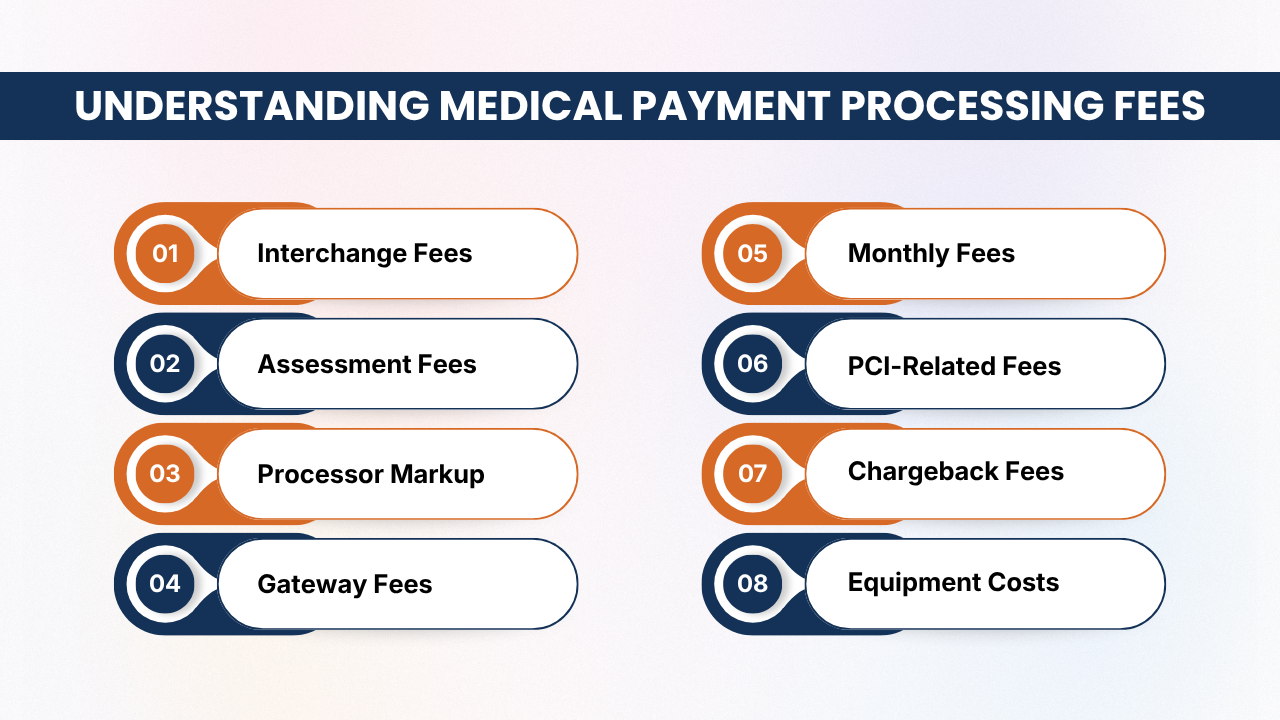
The advertised transaction rate does not always represent the complete expenses of accepting payments. Healthcare businesses should review every component of a processor’s pricing structure before making a decision.
1. Interchange Fees
Interchange fees apply to card transactions and are generally determined by card networks and issuing banks. These costs can differ based on the card type and transaction details.
2. Assessment Fees
Assessment fees are network-related charges that may be applicable additional to interchange expenses. Providers should understand the way these fees appear on their statements.
3. Processor Markup
The processor markup represents the amount added by the payment processor to underlying transaction expenses. Comparing this markup can help businesses to evaluate pricing transparency.
4. Gateway Fees
Online healthcare payments may involve payment gateway fees. These charges can depend on the provider, technology, and account configuration.
Also Read: Mobile Credit Card Processing Guide for Field Businesses
5. Monthly Fees
Some processors charge recurring monthly account or platform fees. Healthcare businesses should determine whether these charges apply irrespective of transaction volume.
6. PCI-Related Fees
PCI-related fees may cover compliance tools, security services, or related support. Businesses should confirm which services are included and whether additional charges are applicable.
7. Chargeback Fees
A chargeback fee may be charged when a transaction is disputed and enters the chargeback process. Reviewing these expenses can help providers understand potential expenses beyond normal transactions.
8. Equipment Costs
Payment terminals can involve purchase, rental, lease, maintenance, and replacement expenses. Healthcare businesses should compare complete fee schedules and estimate total expenses using actual transaction volume, payment methods, and processing needs.
Flat-Rate vs. Interchange-Plus Pricing
Pricing structure is a crucial factor while choosing a medical payment processor. Healthcare businesses should understand how each model works and evaluate which option best matches their transaction volume and payment mix.
1. Flat-Rate Pricing
Flat-rate pricing usually charges a fixed percentage and/or transaction fee for payments. This pricing model has a straightforward approach that can make budgeting and cost estimation easier, particular for smaller practices with relatively consistent transaction activity.
Key benefits include:
- Simple and predictable pricing
- Easier budgeting
- Straightforward cost calculations
However, flat-rate pricing may become more expensive when processing volume increases and generally provides less visibility into the underlying expenses of individual transactions.
2. Interchange-Plus Pricing
Interchange-plus pricing separates card network expenses from the processor’s markup. This structure can provide more pricing transparency and clearer visibility into processing expenses.
Potential advantages include:
- Greater transparency
- Clearer processor markup
- Better visibility into transaction costs
- Potential suitability for higher-volume providers
Healthcare businesses should compare actual statements, transaction types, additional fees, and contract terms before choosing either pricing model.
Also Read: Best Credit Card Processing Companies for Small Businesses
HSA and FSA Payments
Some healthcare providers serve patients who use Health Savings Account(HSA) or Flexible Spending Account(FSA) cards. Supporting these payment methods provide another convenient way for eligible patients to pay healthcare expenses.
However, providers should verify:
- Card eligibility
- Transaction requirements
- Processor capabilities
- Terminal compatibility
- Applicable rules
- Recordkeeping requirements
Businesses should not assume that every processor or payment terminal treats HSA and FSA cards identically.
Security and Compliance Considerations
Security should be a central consideration while selecting a medical payment processing system. Healthcare businesses manage payment information and may also handle sensitive patient-related data, which makes appropriate security controls crucial.
Specific compliance responsibilities can differ based on the organization’s location, systems, services, and data flows.
1. PCI DSS
Healthcare businesses that accept card payments should understand their responsibilities under the Payment Card Industry Data Security Standard(PCI DSS) and maintain appropriate security practices.
2. Encryption
Encryption can help to protect sensitive payment information while it is transmitted between systems and services.
3. Tokenization
Tokenization replaces sensitive card details with tokens, which helps to reduce exposure to raw payment information during storage and processing.
Also Read: Best Credit Card Processing Solutions for Small Businesses
4. Access Controls
Strong access controls can ensure that employees only access payment and financial information required for their specific responsibilities.
5. Audit Trails
Audit trails provide records of payment-related activity, which helps organizations to track transactions and investigate unusual events.
6. Fraud Monitoring
Fraud monitoring can help to identify suspicious transactions and potentially reduce financial risk.
Healthcare organizations should evaluate their complete payment environment and consult qualified security or compliance professionals while determining applicable requirements.
Integrating Payments With Healthcare Systems
Payment processing becomes more effective while it connects with the healthcare systems a business already uses. Integration can reduce repetitive admin tasks and help keep financial information organized across direct workflows.
Important integrations may include:
- Electronic health records (EHRs): involves connecting payment information with patient records whenever appropriate.
- Practice-management systems: it helps to coordinate billing and payment activities.
- Accounting software: it helps to simplify recording and reconciliation.
- Patient portals: it allows patients to view balances and make payments conveniently.
- Scheduling and billing platforms: it helps to connect appointments, charges, and payment information.
- Reporting tools: it provides more visibility into transactions and financial performance.
If several systems are not integrated, then employees may enter information into several systems manually, increasing chances of duplicate data, errors, reconciliation challenges, and processing delays.
An integrated medical payment processing system can help information move efficiently between appropriate platforms, supporting smoother admin workflows and more accurate financial records.
Also Read: Credit Card Processing Fees: Complete Breakdown for Businesses
Medical Payment Processing for Small Practices
Small medical practices usually have different payment processing requirements than hospitals or large healthcare groups. Instead of implementing complex infrastructure, they may benefit from solutions that are easy to implement, affordable, and simple for both staff and patients to use.
The right system should reduce admin work without creating unnecessary complexity.
Small practices may prioritize:
- Simple setup: Easy implementation can help staff begin accepting payments quickly.
- Transparent pricing: must have clear fees that makes it easier for healthcare businesses to manage operating expenses.
- Online payments: Digital payment options allow patients to settle balances remotely.
- Mobile terminals: Portable devices can provide convenient in-person payment acceptance.
- Payment links: Secure links can simplify collection of outstanding balances.
- Basic reporting: Clear transaction reports can support reconciliation and financial tracking.
- Practice-management integration: Connecting payment tools with existing systems can reduce manual data entry.
- Responsive support: Reliable assistance can help resolve payment or technical issues quickly.
Scalability is also essential. A small practice may eventually add providers, locations, recurring payment arrangements, or additional payment channels.
Choosing a flexible medical payment processing solution from the start can help to reduce future migration expenses, operational disruption, and staff training requirements as the practice grows.
Medical Payment Processing for Hospitals and Large Healthcare Groups
Hospitals and multi-location healthcare organizations generally require more advanced medical payment processing infrastructure than smaller practices.
Such systems must manage high transaction volumes, manage multiple departments, locations, payment channels, and complex financial workflows. A scalable solution helps to maintain consistency while supporting organizational growth.
Large healthcare groups can benefit from having payment management on a centralized system across facilities, with detailed reporting that allow finance teams to track transactions and compare payment activities.
Role-based access helps businesses to ensure employees only access information that is relevant to their responsibilities, while advanced reconciliation tools can simplify aligning payments with billing and accounting records.
They can support multiple payment channels, patient portals, and integrations with EHR, billing, accounting, and practice-management systems can further improve efficiency. Reliable infrastructure is also essential when payment systems support high transaction volumes.
As healthcare organizations grow, scalability becomes increasingly essential. A flexible payment system should accommodate additional locations, departments, providers, and payment channels without requiring a complete infrastructure replacement or creating unnecessary operational disruption.
Also Read: How Credit Card Processing Works Step by Step
Choosing a Medical Payment Processor
Choosing a medical payment processor requires healthcare businesses to evaluate more than advertised transaction rates. The right provider should support financial operations, patient convenience, security, and future growth.
1. Healthcare Experience
They must select a processor that understands medical billing workflows, patient payments, healthcare operations, and the specific requirements of healthcare organizations.
2. Payment Methods
Check whether patients can use convenient options like credit cards, debit cards, ACH, digital wallets, online payments, and payment links.
3. Pricing
They must review the complete pricing structure that includes processing fees, monthly charges, gateway fees, equipment expenses, and other potential expenses.
4. Security
They must evaluate security technologies and compliance support that includes encryption, tokenization, fraud monitoring, access controls, and PCI DSS considerations.
5. Integrations
Confirm that the processor can be integrated with EHRs, practice-management platforms, billing software, accounting systems, and patient portals.
6. Patient Experience
They must ensure that the payment process is simple, accessible, mobile-friendly, and easy for patients to understand.
7. Reporting
Look for reporting tools that give visibility into transactions, refunds, settlements, balances, and payment activity.
8. Support
Reliable customer and technical support can help healthcare businesses to resolve payment problems quickly.
9. Scalability
Ensure that the system can accommodate additional providers, departments, locations, payment channels, and transaction volumes.
10. Contract Terms
They must carefully review cancellation provisions, equipment charges, processing minimums, monthly fees, contract length, and other obligations before making a final decision.
Also Read: Payment Processing Solutions for High-Risk Businesses
Embedded and Integrated Healthcare Payments
An increasingly important approach is embedded payments, where payment functionality is built directly into the software used to manage healthcare operations.
Rather than sending patients to a completely separate payment system, the payment experiences can be incorporated into the existing healthcare workflow.
Potential collection points include:
- Appointment booking
- Check-in
- Point of care
- Post-visit billing
- Patient portals
- Recurring-care arrangements
Embedded healthcare payments integrate payment capabilities directly into the software platforms used to schedule, deliver, manage, or document patient care.
The potential benefits include faster payment collection, lower administrative workload, consolidated reporting, and a more consistent patient experience.
However, implementation requires careful planning. Healthcare organizations should understand where payment data flows, how systems communicate, and which compliance responsibilities apply.
How to Improve Healthcare Payment Collection
Healthcare businesses can improve payment collection by creating a process that is clear, convenient, and consistent. The goal should be to make it easier for patients to understand their responsibilities while reducing admin work for staff.
1. Make Bills Clear
Provide statements that clearly explain what the patient owes, why the balance exists, and how it can be paid.
2. Offer Multiple Payment Channels
They must support convenient options like credit cards, ACH, online payments, digital wallets, and secure payment links where appropriate.
3. Collect at Appropriate Points
When patient responsibility is known, discuss applicable payments during check-in or before services instead of depending entirely on later collection efforts.
4. Automate Reminders
Automated reminders can encourage timely payments while reducing repetitive follow-up tasks for admin staff.
5. Use Payment Links
Secure payment links can take patients directly from a reminder or notification to a convenient checkout page.
6. Offer Eligible Payment Plans
Appropriate payment arrangements may help patients to manage larger balances while supporting more predictable collections.
7. Reconcile Regularly
Compare payment activity with billing and accounting records to find discrepancies promptly.
8. Monitor Performance
It involves tracking collection rates, outstanding balances, payment completion, time to payment, failed transactions, refunds, chargebacks, and online payment adoption to analyze performance and identify opportunities for improvement.
Benefits of Modern Medical Payment Processing
A well-designed medical payment processing system can improve financial efficiency while making payment experiences more convenient for patients. Key benefits include:
1. Faster Collections
Collecting appropriate patient payments earlier can reduce delays and help healthcare businesses to manage outstanding balances more effectively.
2. Lower Administrative Work
Automation and system integration can reduce repetitive work, payment tracking, and reconciliation tasks for staff.
3. Better Patient Convenience
Multiple payment options such as online payments, cards, ACH, and secure payment links, allow patients to choose convenient methods.
4. Improved Financial Visibility
Centralized reporting can help administrators to track transactions, refunds, settlements, and outstanding balances more efficiently.
5. Stronger Payment Experience
Clear billing information and simple digital payment processes can reduce confusion and make payments easier for patients.
6. Better Scalability
Flexible payment infrastructure can support additional providers, locations, departments, transaction volumes, and payment channels as healthcare organizations grow.
Conclusion
Medical payment processing has become an essential part of the overall healthcare financial experience. Patients expect convenient payment options, while providers need secure systems that can connect payment collection with billing, reporting, reconciliation, and existing healthcare workflows.
Whether credit and debit cards, ACH, digital wallets, patient portals, payment links, and payment plans, healthcare businesses can offer multiple ways to manage their financial responsibilities. The right technology can also help to reduce manual work and improve payment visibility.
AcePay is one option healthcare organizations can evaluate with its healthcare-focused offering covering payment checkout, online billing, virtual invoices, recurring payments, payment links, and reporting.
Ultimately, the best healthcare payment processing solution depends on the organization’s size, transaction volume, patient needs, existing technology, pricing requirements, and compliance environment.
By evaluating the complete payment journey rather than focusing only on processing rates, healthcare businesses can build a more secure, efficient, and patient-friendly approach to collecting payments.
If you still have any query about medical payment processing for healthcare business then you may book a free demo at AcePay and we are more than happy to assist you.