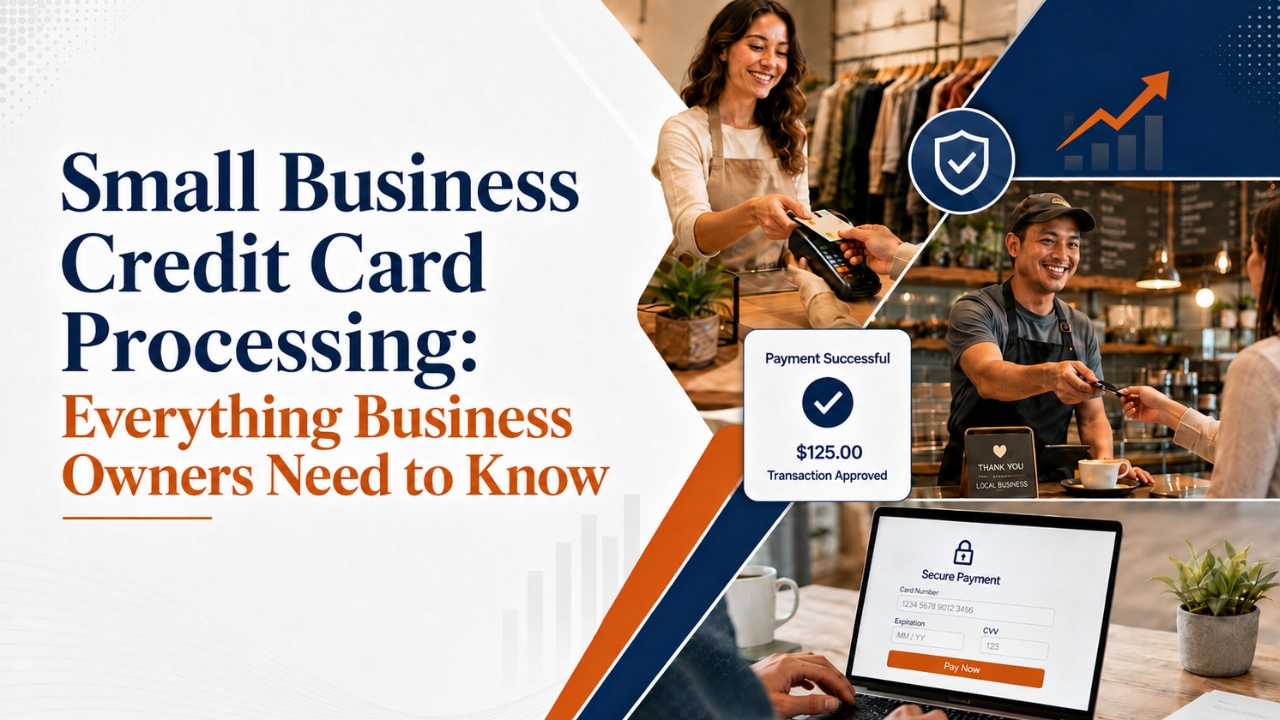
Today, to run a business successfully, you need to provide fast, secure, and convenient payment options to customers. Whether you run a retail store, restaurant, eCommerce website, service-based businesses, mobile businesses, accepting card payments has become important to offer a good experience to customers.
When businesses understand small business credit card processing, it helps businesses to choose the right payment solution, reduce transaction costs, and improve daily operations while also securing customer information.
This detailed blog of Small Business Credit Card Processing: Everything Business Owners Need to Know will walk you through the way payment process works, the role of credit card processing, merchant accounts, payment gateways, and POS systems, as well as the fees and pricing models involved.
This blog will also help you compare credit card processors, manage online and in-store payments, maintain PCI compliance, reduce fraud risks, and choose a payment solution that fits your business needs and future growth.
Whether you are planning to launch a startup or upgrade your payment system, choosing the right small payment processing provider can help businesses improve cash flow, enhance customer satisfaction, and support long-term growth. Acepay provides reliable payment processing solutions designed to help businesses simplify transactions, securely accept payments, and build a smoother payment experience for their customers.
It is essential for small businesses to know about the latest payment solutions, security standards, and industry best practices, as it helps businesses to accept credit card payments confidently, make checkout experiences smooth for customers, and build a reliable payment solution that helps businesses to remain competitive in a highly cashless market.
Also Read: QuickBooks Credit Card Processing: Features and Alternatives
Why Credit Card Processing Is Important for Small Businesses
For businesses accepting credit card payments is no longer a convenience instead it has become essential to run a business successfully.
Modern consumers expect payment options to be fast, secure, and flexible, and businesses that offer multiple payment options have more chances to increase sales, increase customer satisfaction, and support long-term growth.
1. Increase Sales Opportunities
If customers get payment options like credit or debit cards, then they may spend more than while paying with cash. By offering electronic payment options also helps to reduce cart abandonments during purchases and captures more sales.
2. Enhance the Customer Experience
Because credit card processing offers fast, secure, and convenient checkout options that helps businesses to provide a smooth shopping experience for customers which increases customer satisfaction levels, repeat purchases, and long-term customer loyalty.
Also Read: How Businesses Accept Credit Card Payments Online
3. Improve Cash Flow
Most electronic payments are deposited into the business account within one to three business days, offering consistent cash flow and making financial planning easier for businesses.
4. Build Business Credibility
When businesses accept major credit cards and digital wallets allows businesses to improve brand image and ensures customers that their business is reliable and trustworthy.
5. Support Multi-Channel Sales
It helps businesses to accept payments in-store, online through mobile devices, or over the phone, offering a smooth purchasing experience across multiple sales channels.
Also Read: Mobile Credit Card Processing Guide for Field Businesses
How Credit Card Processing Works
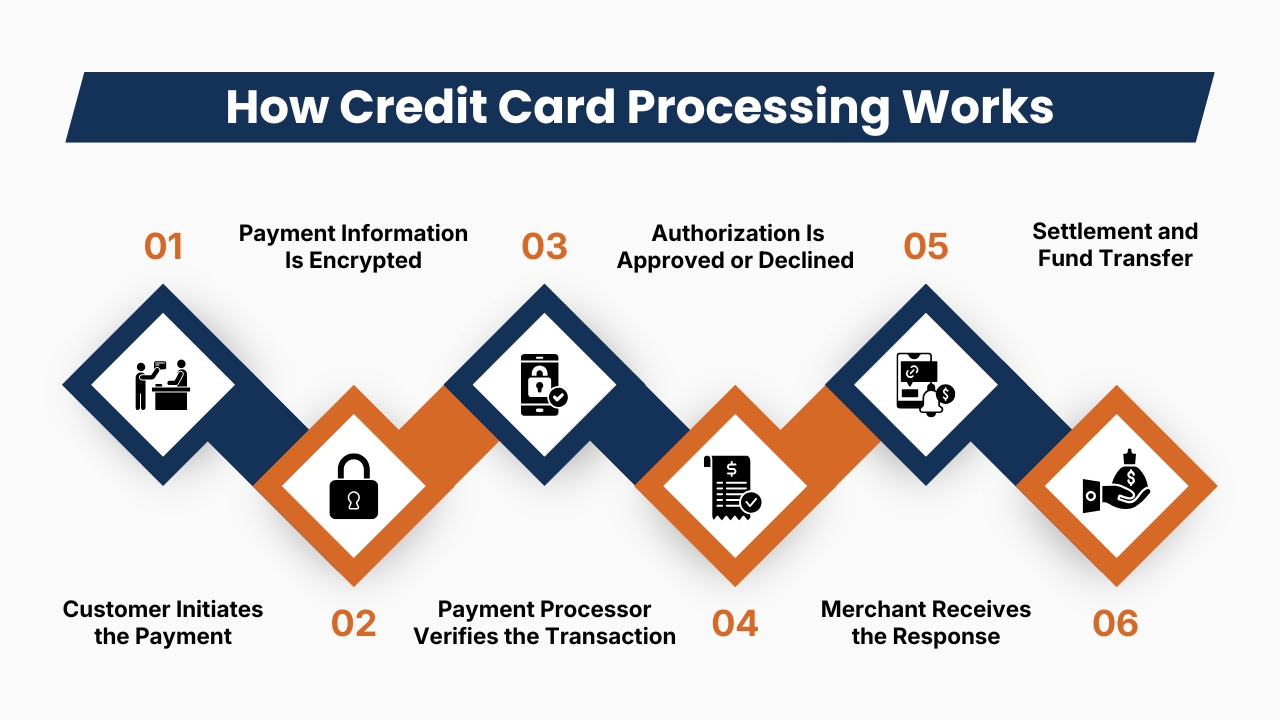
Every credit card transaction is completed within seconds by several financial institutions and technology providers working together behind the scenes to process the payment securely and efficiently.
1. Customer Initiates the Payment
Customers may choose his preferred payment method while making a purchase online. He may use an EMV chip card, swipe a magnetic stripe card, tap a contactless card, use a digital wallet, or enter card details during online checkout. Then the payment terminal or website securely collects the payment details of the customer.
2. Payment Information Is Encrypted
Before the transaction is transmitted, sensitive customer data is encrypted to secure customer data. Encryption secures card numbers, expiry dates, security codes, and other payment details from any unauthorized access.
3. Payment Processor Verifies the Transaction
The payment processor securely sends the transaction through the appropriate card network, like Visa, Mastercard, American Express, or Discover, to the customer’s issuing bank for verification.
Also Read: Best Credit Card Processing Solutions for Small Businesses
4. Authorization Is Approved or Declined
The issuing bank then reviews available funds for credit, validates the card, performs fraud checks, and confirms security requirements. Within seconds, the issuing bank either approves or declines the transaction.
5. Merchant Receives the Response
If the payment is getting approved, then an authorization message is sent back to the merchant’s payment terminal or online checkout that allows the purchase to be completed. And if the payment is declined, then the customer can choose another payment method.
6. Settlement and Fund Transfer
At the end of the business day, approved transactions are submitted for settlement. Then the funds are transferred from the issuing bank through the card network to the acquiring bank, and deposited into the merchant account, and usually transferred to the business bank account within 1 to 3 business days.
Also Read: How Long Credit Card Transactions Take to Process: A Complete Guide for Businesses
Key Components of Credit Card Processing
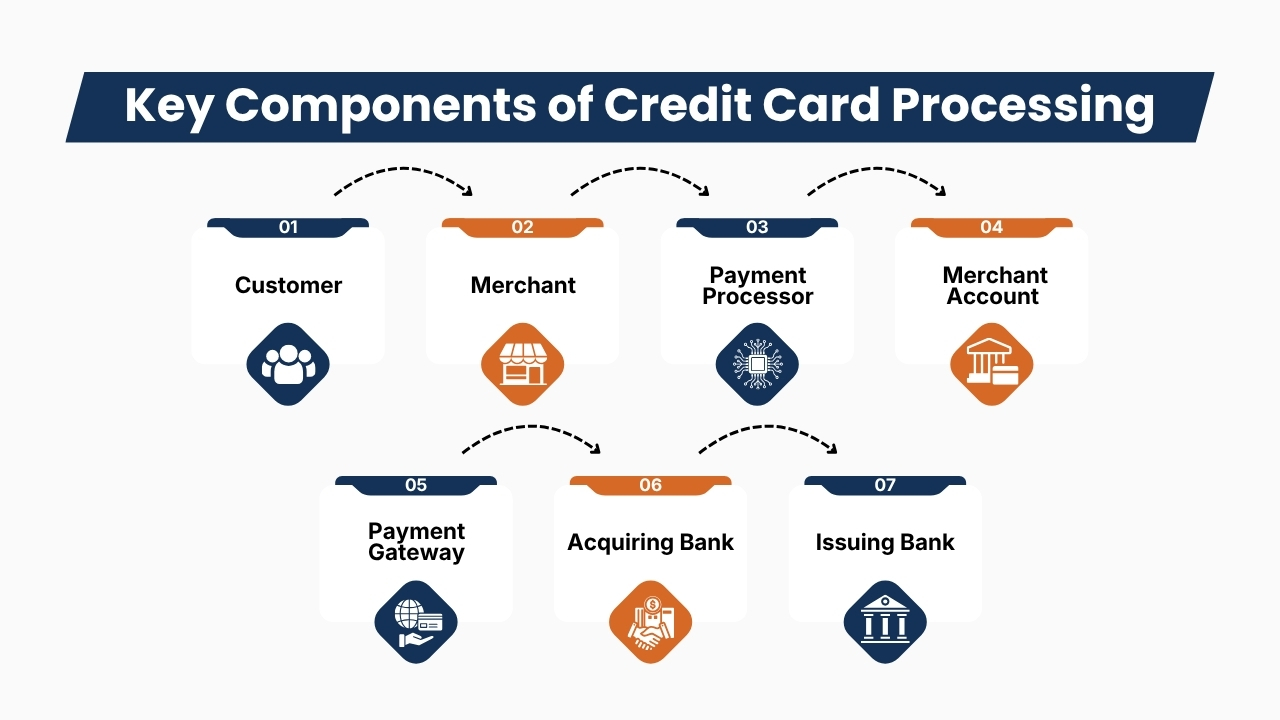
Credit card processing depends on several interconnected components that work together to authorize, process, and settle electronic payments securely.
It is essential to know the role of each component because it helps small business owners to better manage payment operations and choose the right payment processing solution.
1. Customer
The payment process begins with a customer purchasing a product or service using a credit card, contactless card, or digital wallet. The customer’s payment details are securely collected through a payment terminal, mobile device, or online checkout page.
2. Merchant
The merchant is the business accepting electronic payments for its products or services. Using a point-of-sale(POS)system or online payment platform, the merchant submits the transaction for authorization and completes the sale once payment approval is received.
3. Payment Processor
It works as the core communication link between the merchant, card network, acquiring bank, and issuing bank. It securely routes transaction data, performs fraud detection, requests payment authorization, processes settlements, generates detailed transaction reports to ensure accurate and efficient payment processing.
Also Read: Credit Card Processing Fees: Complete Breakdown for Businesses
4. Merchant Account
A merchant account is a specialized account that temporarily holds approved card payments before the funds are transferred to the business’s primary bank account.
Many modern payment providers integrate merchant account services into their platforms, which makes setup and management easier for small businesses.
5. Payment Gateway
A payment gateway encrypts and securely transmits payment details from the customer to the payment processor. It is essential for accepting online, mobile, subscription-based, and remote payments while protecting sensitive financial data during transmission.
6. Acquiring Bank
The acquiring bank partners with the merchant to process approved card transactions. It receives settlement funds from the card network, manages the merchant account, and deposits the funds into the business bank account after settlement.
7. Issuing Bank
The issuing bank offers the customer’s payment card and is responsible for verifying available funds or credit, validating the card, conducting fraud and security checks, and approving or declining the transaction within seconds.
Also Read: Best Credit Card Processing Companies for Small Businesses
Types of Credit Card Processing Solutions
Every small business operates differently, so selecting the right payment processing solution is based on the way businesses sell their products or services.
Modern payment processors provide flexible payment solutions that support physical stores, online businesses, mobile sellers, and subscription-based companies.
1. In-Store Credit Card Processing
It is the most common payment solution for retail stores, restaurants, salons, grocery stores, and physical stores. In-store credit card processing involves customers completing their purchases using a countertop terminal or POS system.
Common payment methods include:
- EMV chip cards
- Magnetic stripe cards
- Contactless tap-to-pay cards
- Apple Pay
- Google Pay
- Samsung Pay
- Debit cards
- Credit cards
Modern POS systems enable businesses to manage inventory, sales reports, employee management, and customer loyalty programs from a single centralized platform.
2. Online Credit Card Processing
For selling products or services online, businesses require a secure payment gateway that lets customers complete their purchases through either a website or eCommerce platform.
Online payment processing typically includes:
- Secure checkout pages
- Shopping cart integration
- Payment encryption
- Fraud prevention tools
- Automatic payment confirmations
- Mobile-friendly checkout
A smooth online checkout experience helps to reduce chances of cart abandonment and increase conversion rates.
3. Mobile Credit Card Processing
This payment solution involves allowing businesses to accept payments from anywhere using smartphones or tablets connected to portable card readers.
This solution is ideal for:
- Food trucks
- Farmers’ markets
- Home service businesses
- Delivery services
- Event vendors
- Independent contractors
This payment solution helps businesses to serve customers without being at a physical location.
Also Read: How Credit Card Processing Works Step by Step
4. Virtual Terminal Processing
A virtual terminal lets businesses manually enter customer payment details through a secure web portal.
This option is commonly used for:
- Phone orders
- Mail orders
- Appointment-based businesses
- Professional services
- Remote billing
Virtual terminals remove the need for physical card readers while maintaining secure payment processing.
5. Recurring Billing and Subscription Payments
Businesses with subscription-based services can automate recurring payments using specialized billing systems.
Recurring billing is commonly used by:
- Membership organizations
- SaaS companies
- Gyms
- Streaming services
- Nonprofits
- Educational platforms
Businesses by automating billing improves convenience for customers and also creates predictable revenue every month.
Merchant Accounts Explained
A merchant account is a specialized business account that temporarily holds funds from approved credit and debit card transactions before transferring those funds to the business’s regular bank account.
Unlike a standard account, merchants accounts are designed specifically for electronic payment processing and settlement. These accounts help businesses to manage card transactions securely while maintaining accurate payment records.
Benefits of a Merchant Account
A merchant account can have several benefits:
- Secure payment acceptance: It allows businesses to process card payments securely.
- Higher transaction capacity: It supports frequent or high-volume transactions.
- Faster funding: It helps to move approved payments efficiently to the business bank account.
- Improved cash flow: It provides predictable electronic deposits for financial planning.
- Refund management: It supports refunds and chargeback handling.
- Accurate records: It maintains transaction information for sales tracking and financial documentation.
Many modern payment providers combine merchant account services with processing platforms, which simplifies setup and payment management for small businesses.
Also Read: Payment Processing Solutions for High-Risk Businesses
Understanding Payment Gateways
It is a technology that securely transfers customer payment details between an online checkout and the payment processor.
It works as a digital link, encrypting sensitive customer information before it is transmitted through payment networks. This helps to protect customer data and supports safe, efficient transaction authorization.
Key Features of Payment Gateways
Payment gateways offer several important capabilities:
- Data encryption: It protects payment details during transmission.
- Tokenization: It replaces card details with secure tokens to reduce exposure.
- Fraud detection: It identifies fraud transactions and potential fraud risks.
- Address verification: It checks billing information to help to prevent fraud.
- Secure authentication: It adds verification steps whenever required.
- Payment authorization: It communicates with processors and issuing banks to approve or decline transactions.
Payment gateways are especially important for eCommerce stores, mobile apps, subscription services, and businesses accepting online payments.
Point-of-Sale (POS) Systems
A Point-of-Sale(POS)system combines payment processing with business management tools, allowing small businesses to handle transactions and daily operations through one centralized platform. Modern POS systems are useful for retail stores, restaurants, salons, and service businesses.
Key POS Features
A modern POS system can help businesses manage:
- Inventory: It tracks stock levels and product availability.
- Sales reports: It monitors revenue, transactions, and performance.
- Employee scheduling: It organizes staff schedules and activities.
- Customer loyalty: It manages rewards and customer information.
- Gift cards: It issues and tracks gift card transactions.
- Promotions: It applies discounts and special offers.
- Product management: These systems update prices and product information.
- Tax calculations: It calculates applicable sales taxes.
Cloud-based POS systems also lets owners access sales data and reports remotely through computers, tablets, or mobile devices.
Understanding Credit Card Processing Fees
Every electronic payment involves several expenses shared among financial institutions, card networks, and payment processors. Understanding these fees helps small businesses to compare providers, estimate expenses, and avoid unexpected charges.
1. Interchange Fees
Interchange fees are paid to the card-issuing bank when customers use credit or debit cards. These fees are generally a significant part of the total processing expenses and can differ based on several factors, including:
- Card type
- Transaction method
- Business industry
- Transaction risk
- Whether the payment is made in person or online
Businesses should understand the way interchange rates may affect their overall processing expenses.
2. Assessment Fees
Assessment fees are charged by major card networks like Visa and Mastercard, for processing transactions through their payment networks.
These fees help to support the infrastructure, security, and operations required to facilitate electronic payments. Assessment fees are generally calculated as a percentage of transaction volume and may differ based on the card network and transaction type.
3. Processor Markup
Payment processors add their own markup to cover services like transaction authorization, payment routing, fraud protection, customer support, reporting, and technology infrastructure.
Markups can be different for different providers. Comparing processor pricing, contract terms, and additional charges can help businesses to identify a cost-effective solution and better manage their payment processing costs.
Common Credit Card Processing Pricing Models
Credit card processors use different pricing models while handling electronic payments. It is essential for business owners to compare costs and select an option that aligns with their transaction volume and needs.
1. Flat-Rate Pricing
This pricing model involves charging a consistent percentage or fee for each transaction irrespective of the card type or transaction category. This pricing is easy for businesses to understand, simplifies budgeting, and offers predictable costs.
This pricing model is suitable for small businesses with relatively low or moderate processing volumes.
2. Interchange-Plus Pricing
This pricing model involves separating the interchange fee of the card network from the processor’s markup. This pricing model offers more transparency and allows businesses to see exactly the amount that they will be paying.
3. Tiered Pricing
This pricing model involves placing transactions into categories such as qualified, mid-qualified, and non-qualified. Though this pricing model appears simple for businesses, rates may be less transparent as businesses may not always know the transaction that qualifies for each tier.
4. Subscription Pricing
Subscription pricing usually combines a monthly membership fee with lower per-transaction processing expenses. This model can benefit businesses with consistent sales and high transaction volumes because predictable monthly pricing may reduce overall processing expenses.
PCI DSS Compliance
PCI DSS(Payment Card Industry Data Security Standard) establishes security requirements that help businesses to protect cardholder data and reduce payment related security risks.
It is essential for businesses to maintain proper security and understand compliance responsibilities while accepting card payments.
Key Requirements
Businesses should:
- Secure payment systems: They must use trusted, properly configured payment terminals and software.
- Encrypt sensitive data: They must protect payment information during transmission and storage.
- Restrict access: They must allow only authorized employees to access sensitive systems.
- Use strong passwords: They must apply passwords and suitable authentication controls.
- Monitor activity: They must review transactions and systems for suspicious behavior.
- Update software: They must install security patches regularly to address vulnerabilities.
- Complete assessments: They must meet applicable PCI DSS validation requirements.
Using a PCI DSS-supporting payment provider can simplify security management and strengthen customer trust.
Payment Security Best Practices
It is essential for every small business that accepts electronic payments to protect customer payment information. Implementing strong security measures helps businesses to reduce fraud , protect sensitive customer data, and build customer trust.
1. Use EMV Chip Technology
EMV chip cards generate unique transaction data for each purpose, which makes it more secure than traditional magnetic stripe cards. Businesses must use EMV-compatible terminals to reduce card-present fraud.
2. Enable Tokenization
Tokenization replaces sensitive card information with randomly generated tokens. If payment data is exposed, these tokens are generally less useful to attackers helping to reduce the risk of sensitive information being compromised.
3. Encrypt Payment Data
Encryption involves converting sensitive payment details into protected data while the details are transmitted between systems. Businesses must use secure payment technologies to prevent unauthorized access during transactions.
4. Activate Fraud Detection Tools
Modern payment processors often offer fraud monitoring tools that identify unusual transaction patterns and suspicious activity. Businesses should enable appropriate fraud filters and review potentially risky transactions.
5. Update Payment Software
Businesses must regularly update POS systems, payment terminals, applications, and security software. Because software updates can address vulnerabilities and improve protection against cybersecurity threats.
6. Train Employees
It is essential for businesses to train employees as they should understand secure payment procedures and know the way to recognize suspicious transactions, phishing attempts, and other fraud risks. Providing regular security training to staff helps businesses to create a stronger defense against payment-based threats.
How to Choose the Right Credit Card Processor
Choosing the right credit card processor can highly affect their business’s expenses, security, customer experience, and ability to expand. Rather than focusing only on transaction rates, they must check the provider’s features, payment options, integration capabilities, and support services.
1. Compare Processing Fees
They must review the complete processing fees before choosing a provider.
Businesses must compare transaction fees, monthly fees, payment gateways fees, chargeback expenses, PCI compliance fees, equipment expenses, and early termination fees.
Because transparent prices make it easier for businesses to calculate your actual processing expenses and avoid unexpected fees.
2. Evaluate Accepted Payment Methods
Select a processor that supports the payment methods that their customers prefer. It may include credit cards, debit cards, EMV cards, contactless payments, Apple Pay, Google Pay, digital wallets, online payments, and QR code transactions. Providing flexible payment options can increase convenience for customers and reduce chances of cart abandonment.
3. Prioritize Security
Payment security should be an important consideration while comparing providers. They must seek security features like PCI DSS compliance, encryption, tokenization, fraud detection, Address verification service(AVS), and multi-factor authentication.
Implementing strong security measures help businesses to protect sensitive customer information and reduce fraud transactions.
4. Check Integration Options
Businesses must ensure that payment processors should work smoothly with existing systems. So they must check whether payment processors smoothly integrate with POS systems, accounting software, eCommerce platforms, inventory management tools, and customer relationship management systems. Smooth integration reduces the need for manual data entry and improves operational efficiency.
5. Assess Customer Support
It is essential for businesses to evaluate whether payment options are providing good customer support when payment problems occur. Ensure that the payment providers provide phone support, live chat, email assistance, technical documentation, or dedicated account managers.
Offering responsive customer support can reduce downtime for businesses, resolve transaction problems instantly, and help businesses to maintain payment operations without any interruptions.
Having reliable customer support is essential when payment problems happen. They must look for providers offering phone support, live chat, email assistance, technical documentation, or dedicated account managers.
Conclusion
Choosing the right small business credit card processing solution is a crucial decision that can influence your expenses, customer experience, security, and long-term growth.
A reliable payment processing system allows businesses to accept credit cards, debit cards, contactless payments, and digital wallets while providing customers with a fast and convenient checkout experience.
Before choosing a provider, business owners should carefully compare processing fees, pricing models, payment methods, security features, POS integrations, payment gateways, funding times, and customer support.
Understanding interchange fees, processor markups, merchant accounts, and other expenses can also help businesses to avoid unexpected expenses and choose a solution that fits their budget.
As payment technology keeps evolving, modern processing systems offer valuable tools for improving sales reporting, managing transactions, protecting customer information, and supporting multiple sales channels.
Investing in secure, flexible, and scalable credit card processing, small businesses can make operations smooth, build customer trust, improve cash flow, and build a stronger foundation for sustainable growth.
If you still have any query about small business credit card processing then you may book a free demo at AcePay and we are more than happy to assist you.